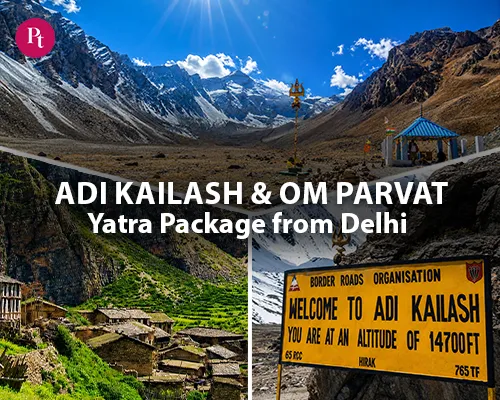
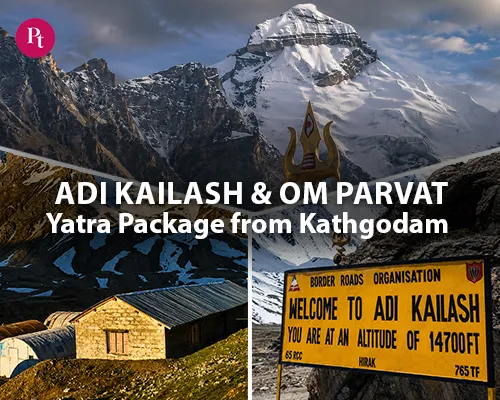
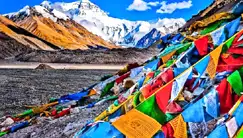
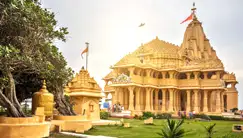
This 10-day tour covers a direct Mumbai–Delhi flight, a Delhi–Kathgodam rail transfer, private vehicle travel through the Kumaon Himalaya, Inner Line Permit assistance at Dharchula, and hotel or homestay stays — built to give pilgrims of all ages a smooth, well-paced journey.
Whether travelling with family, senior citizens, or a small group of devotees, our Adi Kailash tour package from Mumbai offers the right mix of devotion, comfort, and route planning across nearly 3,600 km of combined air, rail, and road travel. Every permit and transport arrangement stays in expert hands — while leaving every decision on dates and pace with you.
Key Takeaways
- Duration: 10 days / 9 nights (Mumbai to Mumbai)
- Starting price: ₹57,900 per person (Standard, twin-sharing)
- Mumbai–Delhi: Daily nonstop flights (~2 hours)
- Highest point: Jolingkong (approx. 4,400–4,700 m)
- Om Parvat viewpoint: Nabhidhang (approx. 4,260–4,300 m)
- Walking: Approx. 2–6 km; no multi-day trekking
- Best season: June & September–October
- Route closed: November–April (snowfall)
- Permit: Inner Line Permit (ILP) mandatory from SDM Dharchula
What Is Adi Kailash Yatra?
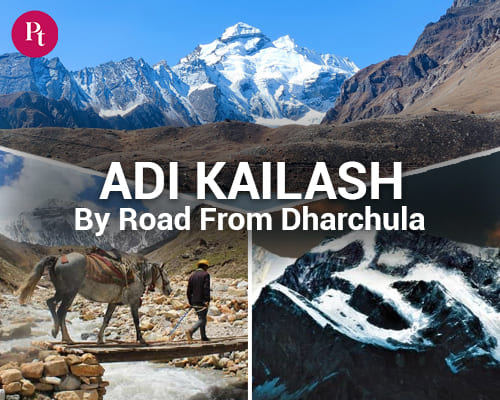
Adi Kailash — also called Chhota Kailash or Baba Kailash — is a sacred Himalayan peak in the Pithoragarh district of Uttarakhand. According to Hindu tradition, it is regarded as an earthly abode of Lord Shiva and is counted among the Panch Kailash, the five sacred Kailash peaks.
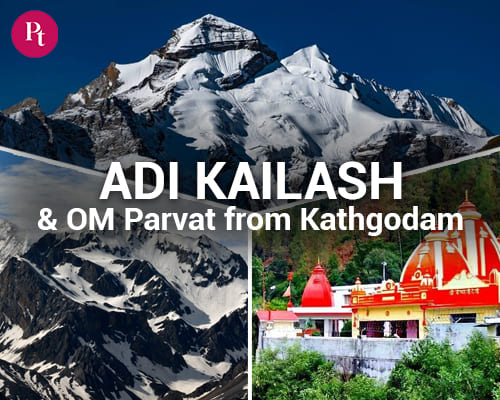
It sits close to Om Parvat, where seasonal snow is believed to form a natural "ॐ" symbol on the rock face. The yatra covers 10 days from Mumbai and includes darshan at Jolingkong's Parvati Sarovar, plus a separate day at the Nabhidhang viewpoint for Om Parvat.
Unlike the Tibet-based Kailash Mansarovar Yatra, this pilgrimage requires no Chinese visa and no lottery system, and Indian citizens do not need a passport to travel.
Tour Highlights
- Adi Kailash: Jolingkong (~4,570–4,700 m), no climbing required
- Om Parvat: Nabhidhang, natural "ॐ" snow formation
- Parvati Sarovar: Sacred glacial lake near Adi Kailash
- Gauri Kund: Holy lake beyond Parvati Sarovar
- Kuti Village: Last inhabited border village before Jolingkong
- Kalapani: Historic area near the Lipulekh route
- Jageshwar Dham: Ancient Shiva temple complex
- Patal Bhuvaneshwar: Sacred limestone cave temple
- Kali River Valley: Scenic drive via Jauljibi
- Optional stops:Kainchi Dham & Chitai Golu Devta Temple
Short Itinerary
The full day-by-day breakdown is shared at booking. Here is the route at a glance:
| Day | Route | Distance | Overnight | Altitude |
|---|
| 1 | Mumbai → Delhi (direct flight) → board train to Kathgodam | Flight + rail | Overnight train | — |
| 2 | Arrive Kathgodam → drive via Almora to Pithoragarh | ~220 km | Pithoragarh | 1,814 m |
| 3 | Pithoragarh → Jauljibi → Dharchula (ILP formalities) | ~90 km | Dharchula | ~915 m |
| 4 | Dharchula → Gunji (ITBP checkposts, acclimatization) | ~120–170 km (varies by route) | Gunji | ~3,200 m |
| 5 | Gunji → Jolingkong (Adi Kailash darshan) → back to Gunji | ~50–90 km round trip (varies by operator) | Gunji | ~4,400–4,600 m (day visit) |
| 6 | Gunji → Nabhidhang (Om Parvat darshan) → back to Gunji | ~45–55 km round trip (varies by operator) | Gunji | ~4,260–4,300 m (day visit) |
| 7 | Gunji → Dharchula → Pithoragarh | ~210 km | Pithoragarh | 1,814 m |
| 8 | Pithoragarh → Kathgodam (via Patal Bhuvaneshwar) | ~220 km | Kathgodam | 300 m |
| 9 | Kathgodam → Delhi (train) → board flight | Rail + flight | Overnight travel | — |
| 10 | Arrive Mumbai | Flight | — | — |
Distances beyond Dharchula vary meaningfully between operators, since the exact overnight stops, route, and vehicle path differ — treat the figures above as a planning guide rather than a fixed measurement.
Most pilgrims prefer keeping Day 5 and Day 6 as separate outings from the same Gunji base rather than combining both in one long day — the road to Jolingkong and the road to Nabhidhang branch off in different directions from Gunji, and doing both together leaves no buffer if weather closes in.
What's Included and What's Not
Included
- Mumbai–Delhi return flights (subject to availability)
- Delhi–Kathgodam–Delhi train tickets (AC 2-tier/equivalent)
- Private vehicle (Innova/Bolero/4×4 in restricted sectors)
- Twin-sharing hotels, KMVN stays & homestays
- Daily breakfast & dinner
- ILP documentation assistance at Dharchula
- Local driver & route coordinator
- Basic first aid & oxygen support kit
- Toll, parking & driver charges
Not Included
- 5% GST
- Lunch & refreshments
- Monument/cave/viewpoint entry fees
- Personal expenses (tips, laundry, phone/data)
- Travel insurance
- Medical fitness certificate fee
- Extra stay costs due to weather or road delays
Adi Kailash Yatra Package from Mumbai — Pricing 2026
| Category | Price / Person | Accommodation | Meals | Best For |
|---|
| Standard | ₹57,900 | KMVN/guesthouse, twin-sharing | Breakfast + Dinner | Budget pilgrims, groups |
| Deluxe | ₹65,900 | Better hotels at Pithoragarh/Dharchula | Breakfast + Dinner | Families, first-timers |
| Premium | ₹73,900 | Best available + private vehicle upgrade | Breakfast + Dinner | Senior citizens, small private groups |
Per Person Cost by Group Size
| Vehicle | Group Size | Per Person Cost |
|---|
| Sedan/Innova | 2 travelers | ₹73,900 |
| Innova/Tempo Traveller | 4–6 travelers | ₹65,900 |
| Tempo Traveller | 8–10 travelers | ₹57,900 |
During peak season — June and the last two weeks of September — flight and train fares from Mumbai rise sharply, so booking your Adi Kailash Yatra package from Mumbai at least 6–8 weeks in advance keeps both airfare and ILP slot availability manageable.
Best Time to Visit Adi Kailash
| Month | Weather | Road/Access | Crowd | Worth Going? |
|---|
| May | Cold, some residual snow | Usually opens during May once BRO clears snow — exact date varies by year | Low | Yes, for early clear views |
| June | Sunny days, cold nights | Fully open, best road condition | Moderate | Yes — peak recommendation |
| July | Humid, monsoon rain | Landslide risk on Dharchula–Gunji stretch | Low | Not recommended |
| August | Wet, misty at altitude | High landslide risk, frequent delays | Low | Not recommended |
| September | Clear, crisp air | Roads dry out post-monsoon | Moderate-High | Yes — excellent visibility |
| October | Cold, frosty nights | Usually operational until weather permits | Moderate | Yes, until closure |
| November–April | Heavy snow | Route closed beyond Dharchula | — | No |
Most pilgrims prefer June for warmer daytime temperatures. September–October usually gives the clearest mountain visibility once the monsoon clouds clear.
One thing most guides miss: the second half of June can bring early pre-monsoon showers in the Kumaon foothills. Building one buffer day into the Kathgodam–Pithoragarh stretch protects the rest of the schedule.
Who Is This Tour For?
Senior Citizens (60+)
The physical strain is concentrated at Jolingkong and Nabhidhang, both above 4,000 m, where even short walks feel harder than at sea level. The Deluxe or Premium package with an extra acclimatization day at Gunji suits senior travelers best. Pony support may be available for the short stretch at Jolingkong depending on the season — confirm at the time of booking if this matters to you. Most Mumbai travelers in this age group tell us the extra Gunji night made the biggest difference to how they felt at altitude.
Families with Children
The Dharchula–Gunji road is narrow and winds through ITBP checkposts, which can feel long for younger children. Kids generally enjoy Kuti Village and the Parvati Sarovar walk the most, since neither requires technical trekking.
NRI and International Travelers
Indian passport holders travelling as NRIs need only their passport or Aadhaar as ID proof for the ILP — no separate visa is required for Adi Kailash. Foreign passport holders need a Protected Area Permit, and both the process and eligibility for foreign travelers on this route change from season to season — confirm current rules with an MEA-authorized operator before making any bookings.
Solo Travelers
Solo travelers are usually merged into a shared group vehicle from Pithoragarh onward, which also reduces per-person cost. Mobile network becomes very limited and unreliable between Gunji and Jolingkong — occasional BSNL signal has been reported at Gunji itself, but don't count on it beyond that point, so informing family of the return schedule before departure is worth doing.
Inner Line Permit (ILP) — How It Works
The Inner Line Permit is mandatory for every Indian traveler heading beyond Dharchula into the restricted border zone toward Gunji.
- In most recent seasons, online pre-registration has been available through the Pithoragarh district portal before arrival — confirm the current process before your trip, since the portal and steps have changed between seasons
- Carry a valid ID proof — Aadhaar, passport, voter ID, or driving license — plus two passport-size photographs
- Obtain a medical fitness certificate from any MBBS doctor, dated close to the travel date
- Report to the SDM office in Dharchula in person for physical verification and permit collection
- Foreign nationals need a separate Protected Area Permit (PAP), typically arranged through an MEA-authorized operator well in advance — eligibility and processing time for foreign travelers change from season to season, so this needs direct confirmation before booking flights
| Document | Status | Notes |
|---|
| ID proof (Aadhaar/Passport) | Mandatory | Original + 2 photocopies |
| Passport-size photographs | Mandatory | 2–3 copies |
| Medical fitness certificate | Mandatory | From any registered MBBS doctor |
| Foreign nationals — PAP | Mandatory for non-Indians | Process and eligibility vary by season — confirm current rules with the district administration |
Pilgrimage Tour handles the SDM office coordination at Dharchula and current portal formalities — you provide the ID copies, photographs, and medical certificate.
A note on permit rules: Inner Line Permit and Protected Area Permit procedures for this border zone are set by the district administration and Ministry of External Affairs, and they do change between seasons — especially for foreign nationals. Treat the steps above as a general guide, and reconfirm the exact process with the SDM office, Dharchula, or your operator close to your travel date.
What to Pack for Adi Kailash Yatra from Mumbai
Mumbai's warm, humid climate makes it easy to underpack for a route that drops well below freezing at night above Gunji.
- Thermal inners, fleece layer & windproof jacket
- Woollen socks, gloves, warm cap & trekking shoes
- Sunglasses, sunscreen & lip balm
- Prescribed altitude medicine (if advised) & basic first-aid kit
- ID copies, ILP documents & medical fitness certificate
- Power bank (limited charging beyond Gunji)
- Refillable water bottle & energy snacks
Most pilgrims from Mumbai underestimate the cold gap between the coastal climate they're used to and Gunji nights, so packing warm layers matters more than packing light on this route.
Altitude, Network & On-Ground Facilities
Published altitude figures for this route vary because government surveys, GPS handhelds, and individual operators don't always measure from the same reference point. Here's a transparent comparison instead of a single "universal" number:
| Location | Commonly Reported Altitude | Note |
|---|
| Dharchula | ~915 m | Consistent across most sources |
| Gunji | ~3,200 m | Consistent across most sources |
| Kalapani | ~3,600 m | Varies slightly by source |
| Nabhidhang (Om Parvat viewpoint) | ~4,260–4,300 m | Range depending on survey/operator |
| Jolingkong (Adi Kailash base) | ~4,400–4,600 m | Widest variation — treat as approximate |
Network, cash, and facilities on the ground:
| Stretch | Mobile Network | ATM | Food/Fuel |
|---|
| Kathgodam to Pithoragarh | Reliable | Available | Widely available |
| Pithoragarh to Dharchula | Mostly reliable | Available at Pithoragarh | Available |
| Dharchula to Gunji | Patchy | None | Limited, at homestays |
| Gunji to Jolingkong/Nabhidhang | Very limited to unavailable (occasional BSNL signal reported at Gunji) | None | None — carry your own snacks and water |
The nearest hospital with reasonable facilities is at Pithoragarh; Dharchula and Gunji have basic ITBP or primary health center support only. For anything beyond minor first aid, plan on evacuating to Pithoragarh. Save the local ITBP checkpost and district administration helpline numbers from PilgrimageTour before you leave network range.
How to Reach — Mumbai to Adi Kailash
| Leg | Train | Flight | Best Option |
|---|
| Mumbai → Delhi | Overnight/day trains available (~16–22 hrs) | Direct, ~2 hrs | Flight |
| Delhi → Kathgodam | Ranikhet Express (overnight, ~7 hrs) | No direct flight | Overnight train |
| Kathgodam → Pithoragarh | No rail | No airport nearby | Private vehicle, ~220 km |
Chhatrapati Shivaji Maharaj International Airport (BOM) connects directly to Delhi's Indira Gandhi International Airport in roughly 2 hours, with multiple nonstop departures throughout the day across IndiGo, Air India, Air India Express, Akasa Air, and SpiceJet. This makes Mumbai one of the best-connected departure cities in the country for this yatra.
From Delhi, the overnight Ranikhet Express to Kathgodam is the most comfortable rail option, arriving in time for an early-morning start toward Almora and Pithoragarh. Travelers who prefer flying closer to the mountains can connect via Pantnagar Airport instead. Seat availability and flight frequency from Delhi are limited and change with the season, so confirm current schedules before relying on this option.
Adi Kailash vs Kailash Mansarovar — Which Is Right for You?
| Factor | Adi Kailash (India) | Kailash Mansarovar (Tibet) |
|---|
| Location | Pithoragarh district, Uttarakhand | Tibet Autonomous Region, China |
| Documents | Inner Line Permit only | Chinese visa + lottery/quota system |
| Duration from Mumbai | 10 days | 15–20 days typically |
| Highest point reached | Approx. 4,400–4,600 m (Jolingkong) | Over 5,600 m at Dolma La pass |
| Trekking required | Roughly 2–6 km of short walks | Multi-day parikrama trek |
| Approx. cost | ₹57,900–₹73,900 | ₹2,09,000+ per person |
| Best for | First-timers, seniors, families | Experienced high-altitude trekkers |
For most Mumbai-based pilgrims booking their first Himalayan yatra, Adi Kailash is the more practical choice — it delivers a comparable spiritual experience without a Chinese visa, a lottery wait, or a multi-day trek.
Common Mistakes to Avoid
- Skipping the acclimatization day at Gunji. Jumping straight from Dharchula to Jolingkong in one day raises AMS risk sharply — build in the extra night at Gunji.
- Booking flights before confirming the ILP window. Permit slots at Dharchula can fill up during the June and September rush — confirm permit availability before locking Mumbai–Delhi flight dates.
- Not carrying a medical fitness certificate. Without it, the SDM office in Dharchula will not process the Inner Line Permit — carry two copies, not just one.
- Assuming a direct flight exists close to Pithoragarh. The nearest usable airport is Pantnagar, still 220 km away from Pithoragarh by road.
- Underestimating cold at Jolingkong and Nabhidhang. Daytime sun can feel deceptively warm, but wind chill above 4,000 m drops fast — pack proper thermals regardless of the month, especially coming from Mumbai's coastal climate.
- Traveling during July–August to save money. Monsoon-season fares are lower, but landslide-related delays on the Dharchula–Gunji stretch are far more common in these two months.
Insider Tips
- Start early: Gunji–Jolingkong drive around 6:30 AM for clearer Adi Kailash views
- Best darshan: Morning hours offer better visibility before clouds form
- No network: Download offline maps before Gunji–Jolingkong sector
- Keep buffer day: Kalapani roads may change due to BRO work
- Carry cash: ATMs are not available beyond Pithoragarh
- Power backup: Carry a power bank as charging is limited beyond Gunji
Why Choose Pilgrimage Tour?
- Experience: Kumaon Himalaya pilgrimages with Dharchula–Gunji–Jolingkong route expertise
- Government Registered: ILP coordination support with Dharchula SDM office
- Transparent Pricing: Toll, parking & driver charges included upfront
- Local Expertise: Familiar with ITBP checks and seasonal road conditions
- Mumbai Planning: Flight + train connections coordinated smoothly
Booking early is recommended during the June and September rush, when both airfare from Mumbai and ILP appointment slots at Dharchula tighten.
Group Departures for Mumbai & Maharashtra Travelers
Maharashtra has no direct rail or road route to Kumaon, so most Mumbai pilgrims prefer joining a fixed group departure rather than planning transfers on their own.
- Mumbai departures: Scheduled group departures in June & September–October
- Maharashtra travelers: Pune, Nashik, Thane & Nagpur travelers can join Mumbai groups
- Group benefit: Lower vehicle cost from Pithoragarh onward
- Solo travelers: Added to fixed departures instead of private vehicles
- Booking tip: Confirm departure dates before booking flights (peak slots fill fast)