
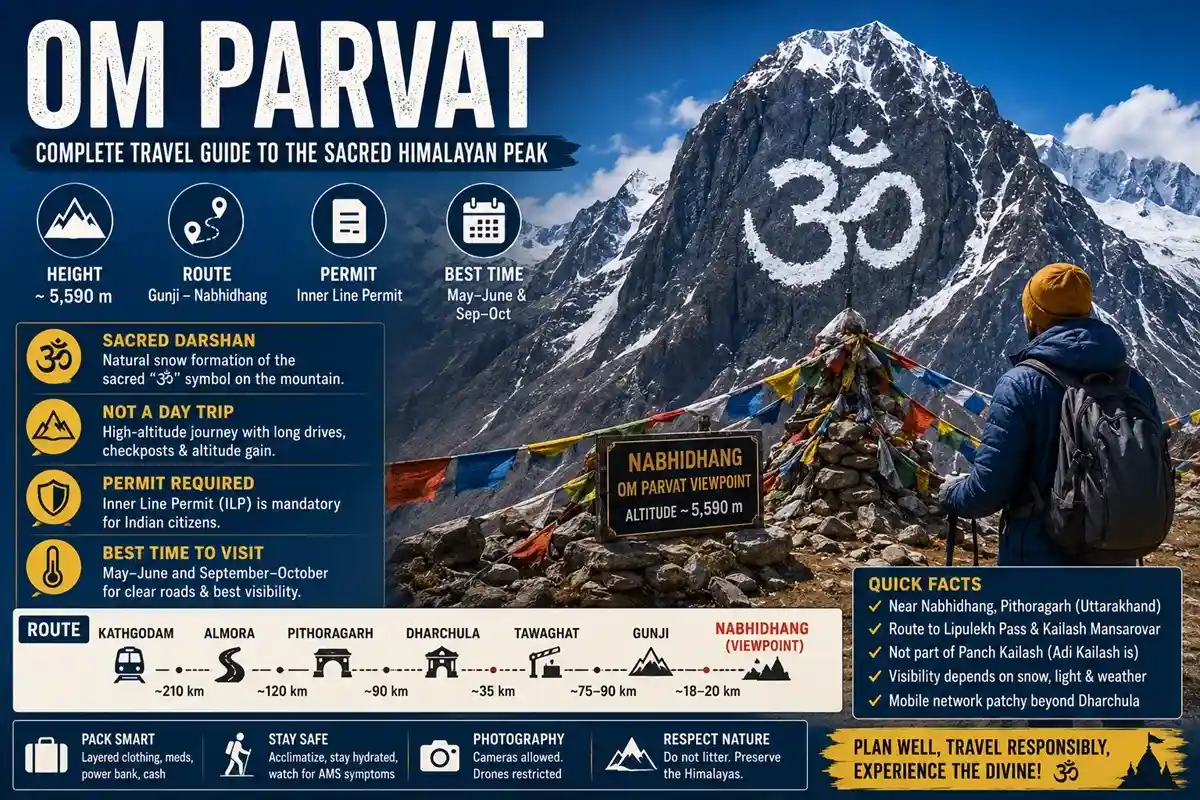
Om Parvat is the Himalayan mountain in Pithoragarh, Uttarakhand, where snow naturally settles into the shape of the sacred “ॐ” symbol on its dark rock face. Most pilgrims see it as a short detour from Gunji on the way to Adi Kailash. For many, that first glimpse from Nabhidhang is the emotional high point of the whole trip. This guide covers the verified facts, route, permits, budget, and honest ground realities before you plan your Om Parvat Yatra.
Key Takeaways
- Om Parvat is a separate peak from Adi Kailash — the two sit in different directions from Gunji but are usually visited together.
- Published elevations vary by source (5,570 m to 6,191 m); this guide follows the figure most pilgrim-focused references use.
- The Om symbol forms naturally from snow deposition on the rock face and is visible only under the right light and season.
- Only Indian citizens with a valid Inner Line Permit can currently visit; foreign-national access is restricted and rules can change.
- Even though the final walk from Nabhidhang is short, the overall journey is still a high-altitude expedition with long mountain drives and checkposts.
What Is Om Parvat?
Om Parvat is a sacred peak in the Kumaon Himalayas near Nabhidhang village, on the traditional route to the Lipulekh Pass and the Kailash Mansarovar Yatra. Its fame comes from a snow-deposition pattern that resembles the Sanskrit “ॐ” — a symbol representing the primal sound of creation in Hindu tradition.
Despite the name similarity, Om Parvat is not one of the five Panch Kailash peaks. That ranking belongs to nearby Adi Kailash. In Hindu belief, the mountain is associated with Shiva’s presence, and local legend says the sage Ashtavakra’s devotion is why the Om symbol appears here — a devotional story, not a documented historical claim.
Why Does the Om Symbol Actually Form?
The pattern isn’t painted or carved. It comes from how snow settles unevenly across the mountain’s dark, ridged rock face. Wind direction, the angle of the slope, and seasonal snowfall levels all combine to create the crescent-and-line shape. Because this depends on live weather, the symbol can look sharp on one visit and faint on another, even a week apart.
Why Sources Disagree on Om Parvat’s Height
You’ll find different numbers online — some say 5,570 m, others 5,590 m, and several tourism sites quote 6,191 m. Part of this comes from mapping and survey differences; part comes from a genuine mix-up with a separate, taller peak near Dharchula that locals sometimes call Jonglingkong or Chhota Kailash. Since that peak and the Om Parvat viewpoint at Nabhidhang get referenced under overlapping names, always check which mountain a source actually means before quoting its height.
This Isn’t a Light Day Trip
It’s easy to assume this yatra is easy because the final stretch from Nabhidhang is just a short walk. In reality, reaching that point involves several days of mountain driving, permit checkposts, and altitude gain from near sea level to over 4,000 m. Treat it as a genuine high-altitude expedition, not a casual sightseeing stop.
Best Time to Visit Om Parvat
Most pilgrims prefer May–June and September–October, when weather is stable, roads are open, and the Om formation is clearest.
| Month | Visibility | Road Condition | Crowd |
|---|---|---|---|
| May–June | Good | Recently reopened, generally stable | Moderate to high |
| July–August | Poor | Landslide-prone, frequent delays | Low |
| September–October | Best | Clear post-monsoon, stable | High |
| November–April | Not accessible | Closed under snow | None |
The Om pattern depends on live snowfall and wind, so it can shift within the same week. Local drivers usually recommend reaching the viewpoint early morning, before cloud cover builds over the ridgeline by late morning.
Route, Checkposts, and Distance Chart
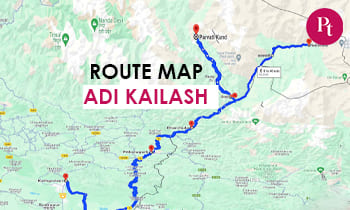
The standard route runs: Kathgodam or Delhi → Almora → Pithoragarh → Dharchula → Tawaghat → Gunji → Nabhidhang. Expect roughly 6–8 travel days round trip, including acclimatization halts, since altitude gain across the route is significant.
Along the way, expect ID and permit verification at Tawaghat and again at Gunji, where ITBP personnel check documents before allowing further movement toward the border zone. Carry your Inner Line Permit and a photo ID at every checkpost.
| From | To | Approx. Distance |
|---|---|---|
| Delhi | Kathgodam | ~280 km |
| Kathgodam | Pithoragarh | ~210 km |
| Pithoragarh | Dharchula | ~90 km |
| Dharchula | Gunji | ~75–90 km |
| Gunji | Nabhidhang (viewpoint) | ~18–20 km |
These figures are approximate and vary slightly by route and season.
Road Conditions
The Kathgodam-to-Dharchula stretch is generally well-paved. Beyond Dharchula, roads are BRO-maintained but narrower, with rough or landslide-prone patches near Gunji and Nabhidhang after rain. Sturdy SUVs like Boleros handle this stretch better than sedans; self-drive is possible but only recommended for experienced mountain drivers.
Weather at Om Parvat
Expect a subarctic climate at this altitude, even in summer. Daytime temperatures in May–June and September–October generally range from 10°C to 18°C, dropping sharply after sunset, sometimes near freezing. Wind picks up noticeably by afternoon, and visibility can change within hours, so always carry rain and wind protection regardless of the forecast.
Connectivity, ATMs, and Basic Facilities
- Mobile network: BSNL and Jio have patchy coverage till Dharchula; beyond that, network is unreliable or absent. Download offline maps in advance.
- ATM: The last reliable ATM is in Dharchula; carry sufficient cash for the rest of the trip.
- Electricity: Limited past Dharchula; carry a power bank for charging.
- Fuel: Dharchula has the last petrol pump before the interior route; top up fully here.
- Water and toilets: Basic dry-pit toilets and boiled drinking water are available at KMVN stops and homestays; carry a personal bottle and purification tablets as backup.
Permit and Registration Process
Om Parvat lies inside a restricted border zone, so an Inner Line Permit (ILP) is mandatory for every Indian traveler. Foreign-national access is restricted in this corridor, and since border-area rules can change, it’s best to confirm current status with district authorities before planning.
- Apply for the ILP through the Pithoragarh or Dharchula SDM office, directly or through your tour operator.
- Carry a valid photo ID, passport-size photographs, and a medical fitness certificate from a government hospital for organized yatras.
- Processing usually takes a day or two at Dharchula, though peak-season delays are common.
- Registration for the combined Adi Kailash–Om Parvat Yatra generally opens before the travel season begins, subject to district administration announcements — booking early is recommended once it does.
Permit charges are revised periodically by the administration, so confirm the current fee locally rather than relying on a fixed figure online.
How to Reach and Transport Options
The nearest airport with limited scheduled flights is Pantnagar, though most travelers fly into Delhi and continue overland. The nearest major railhead is Kathgodam, connected to Delhi by overnight train and Volvo buses.
Beyond Dharchula, public transport thins out. Most pilgrims use a hired SUV, join an organized batch — whether through KMVN or a private trekking operator — or occasionally attempt the drive independently if experienced with mountain roads. Motorcycles are used by some seasoned riders, but this stretch isn’t beginner-friendly given the terrain and altitude.
Where to Stay
- Dharchula: Basic hotels and guesthouses with reliable electricity and the last dependable ATM.
- Gunji and Nabi: KMVN rest houses and local homestays, often shared-room basis with basic hot water access.
- Nabhidhang and Napalchu: Campsites with dry-pit toilets and minimal facilities — pack accordingly.
Booking is usually done directly through KMVN or via private operators who bundle stays into their yatra packages; independent booking gets harder the further you go from Dharchula.
Budget Breakdown (Approximate, per person)
| Trip Type | Estimated Cost (INR) |
|---|---|
| Budget/self-arranged (shared transport, homestays) | 12,000–18,000 |
| Standard KMVN package | 18,000–25,000 |
| Private/deluxe operator package | 25,000–35,000 |
| Self-drive (fuel, permits, stays only) | 15,000–22,000 |
Costs vary by season, group size, and package inclusions; treat these as rough planning figures, not fixed quotes.
Packing List
- Layered woollens, thermal wear, and a windproof jacket
- Sturdy trekking shoes with good grip
- Power bank and offline maps
- Personal medication, ORS, and a basic first-aid kit
- Sunglasses and sunscreen for high-altitude glare
- Cash in small denominations, since the last ATM is in Dharchula
Photography and Drone Rules
Since this is a sensitive border zone, drone photography is generally restricted or requires prior clearance — check current rules with your operator before carrying one. Regular cameras are usually fine for the landscape and darshan point, but avoid photographing ITBP posts, checkposts, or personnel.
Do’s and Don’ts
- Do carry your ILP and photo ID at every checkpost.
- Do keep a buffer day in your itinerary for weather delays.
- Don’t litter at campsites or near the lakes.
- Don’t attempt to cross into restricted military or border areas.
- Don’t trek alone beyond Nabhidhang without a local guide.
Travel Tips and Local Insights
Most pilgrims combine Om Parvat with the Adi Kailash Yatra in one circuit, since both viewpoints branch off from the same Gunji-based route. Morning darshan is better because cloud cover tends to roll in by late morning, obscuring the Om formation. Road conditions near Gunji and Nabhidhang fluctuate with rainfall, so always build in a buffer day rather than a tightly packed schedule.
Health Tips for Seniors, Children, and Anyone with Medical Conditions
Senior citizens should prefer organized batches with built-in acclimatization halts and basic medical checks; a doctor’s clearance is worth getting before the trip, especially past age 60. Since the final approach from Nabhidhang is a short walk rather than a long trek, it’s realistically manageable for reasonably fit older travelers.
Children, diabetics, and anyone with heart or blood pressure conditions should consult a doctor beforehand, since oxygen levels drop noticeably above 4,000 m and altitude sickness (AMS) is common even in otherwise healthy travelers. Age eligibility varies by operator, so confirm limits when booking rather than assuming a fixed cutoff.
Safety and Local Warnings
- Altitude sickness (headache, nausea, breathlessness) is common above 4,000 m; acclimatize properly and avoid rushing the ascent.
- Sudden weather shifts can bring snow or rain even in the “safe” season, so pack accordingly.
- Medical facilities are limited beyond Dharchula; carry essential medicines and know that emergency evacuation from remote stretches can take time.
- Avoid travel during active monsoon warnings, since landslide risk on hill roads is real, not just a formality mentioned in brochures.
Latest Updates (2026)
Road conditions between Gunji and Nabhidhang continue to see periodic BRO upgrades, though monsoon damage still causes temporary closures in most years. Registration for the 2026 season is processed through KMVN and authorized operators; confirm exact opening dates directly with the district administration, since these are announced closer to the season rather than fixed year to year.
Om Parvat vs Adi Kailash vs Mount Kailash
| Feature | Om Parvat | Adi Kailash | Mount Kailash |
|---|---|---|---|
| Location | Pithoragarh, India | Pithoragarh, India | Tibet |
| Visit type | Darshan from viewpoint | Darshan near base | Parikrama (circumambulation) |
| Permit | Inner Line Permit | Inner Line Permit | Chinese visa and permits |
| Panch Kailash status | Not included | Widely regarded as second peak | Primary, most revered peak |
| Highlight | Natural “ॐ” snow formation | Pyramid-shaped sacred peak | Traditional 52 km parikrama |
Frequently Asked Questions
Q-1: What is the height of Om Parvat?
Most pilgrim-focused sources cite about 5,590 m; other figures online often refer to a different nearby peak.
Q-2: Is Om Parvat the same as Adi Kailash?
No, they’re separate peaks visited together on the same broader pilgrimage circuit.
Q-3: What is the best time to visit Om Parvat?
May–June and September–October offer stable weather and the clearest Om formation.
Q-4: Do I need a permit to visit Om Parvat?
Yes, an Inner Line Permit is mandatory, arranged through the Pithoragarh or Dharchula SDM office.
Q-5: Is Om Parvat worth visiting without Adi Kailash?
Yes, some travelers do it as a shorter standalone trip, though most combine both for one permit and journey.
Q-6: Can I travel by self-drive or bike?
Yes, but only experienced mountain drivers should attempt it; roads past Dharchula are narrow and weather-dependent.
Q-7: Is photography allowed at Om Parvat?
Regular cameras are fine at the viewpoint; drones are generally restricted in this border zone.
Q-8: Is mobile network available near Om Parvat?
Coverage is patchy till Dharchula and largely unavailable beyond it, so download offline maps beforehand.
Q-9: How many days does the Om Parvat Yatra take?
Roughly 6–8 days round trip from Delhi or Kathgodam, including acclimatization halts.
Q-10: Can senior citizens or children visit Om Parvat?
Yes, with medical clearance; the final walk is short, but altitude and long drives still demand basic fitness.
Q-11: Is altitude sickness common on this route?
Yes, AMS symptoms are common above 4,000 m, so acclimatization and a gradual ascent matter.
Q-12: Is Om Parvat part of the Panch Kailash?
No, that ranking belongs to the nearby Adi Kailash, not Om Parvat.
Q-13: What is the nearest airport to Om Parvat?
Pantnagar has limited flights; most travelers fly into Delhi and continue by road or rail via Kathgodam.
Q-14: How much does the Om Parvat Yatra cost?
Roughly ₹12,000–₹35,000 per person depending on whether you choose budget, standard, or deluxe packages.
Q-15: Is Om Parvat visible throughout the year?
No, it’s best seen from May to October and is often hidden during heavy snowfall or monsoon cloud cover.
Conclusion
Om Parvat rewards travelers who plan around its conditions rather than against them — the right season, a realistic budget, and a buffer for weather delays make all the difference. Families and first-time pilgrims should stick to an organized circuit combined with Adi Kailash, while senior citizens and those with health conditions should prioritize batches with acclimatization stops. Whichever way you plan it, visiting between May–June or September–October, permit in hand, is what turns this remote Himalayan darshan into a genuinely smooth and memorable journey.
Must Reads on:


 Call
Call WhatsApp
 Enquiry