
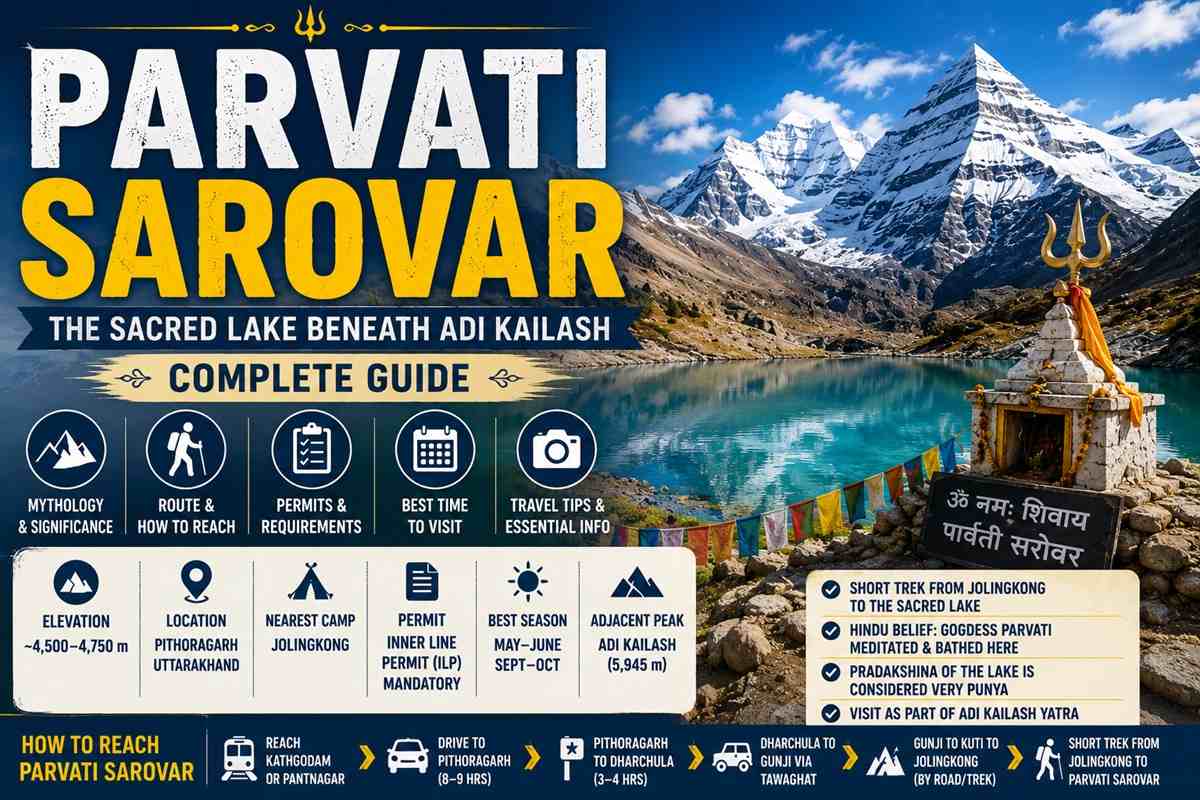
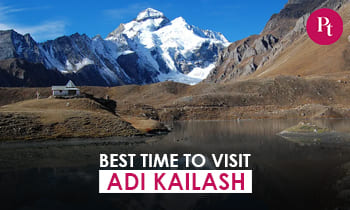
At the foot of Adi Kailash, in a valley so remote it stayed largely off-limits for decades after the 1962 Indo-China war, sits a lake that pilgrims call the Mansarovar of India. Parvati Sarovar isn’t large, and it isn’t easy to reach — but for anyone who’s stood at its edge with Adi Kailash’s pyramid-shaped peak mirrored in still water, that’s precisely the point.
If you’re planning a trip here, here’s the essential picture: Parvati Sarovar, one of Uttarakhand’s most sacred high-altitude lakes, sits near Jolingkong, the final base camp on the Adi Kailash Yatra route in Pithoragarh district. It’s reached by a mix of road travel and a short trek, and it’s usually visited as part of a broader 6–8 day yatra rather than as a standalone trip.
Quick Facts: Elevation ~4,500–4,750 m | State: Uttarakhand | District: Pithoragarh | Nearest camp: Jolingkong | Nearest village: Kuti | Permit: Inner Line Permit mandatory | Best season: May–June, Sept–Oct | Adjacent peak: Adi Kailash (5,945 m)
The Mythology Behind Parvati Sarovar
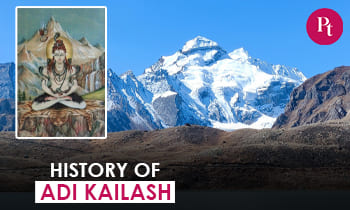
According to Puranic tradition, Goddess Parvati performed penance here to win Lord Shiva as her consort, and the lake is believed to be where she bathed and meditated during that period. Since Adi Kailash is regarded as Shiva’s secondary Himalayan abode — a stand-in for the original Mount Kailash across the Tibet border — the lake at its base naturally inherited comparable reverence.
What most pilgrims don’t realize before arriving is that there are actually two sacred water bodies here, not one. Parvati Sarovar is the larger lake near the Jolingkong campsite, while Gauri Kund — a smaller, higher pool about 1–1.5 km away at roughly 5,600 metres — is a separate site tied to a different legend: Parvati immersing herself here to restore her strength after defeating the demon Jalandhar. Local usage sometimes blurs the two names together, so don’t be surprised if guides and older write-ups use them interchangeably.
A small shrine dedicated to Shiva and Parvati stands on the Sarovar’s shore, and many pilgrims perform a short pradakshina (clockwise circumambulation) of the lake — a 30–45 minute walk at this altitude — as a complete act of worship in itself.
Best Time to Visit Parvati Sarovar
| Season | Conditions |
|---|---|
| May–June | Snow retreating, lake filling with meltwater, stable roads |
| July–August (Monsoon) | Landslide risk on approach roads; visibility can drop suddenly |
| September–October | Cold, clear, and considered ideal for photography and darshan |
| November–April | Route closed; the lake freezes over completely |
The lake itself is seasonal in character — it swells with snowmelt through summer and visibly recedes by late September, so an early-autumn visit still catches it, just with less water than a June trip would.
How to Reach Parvati Sarovar
The journey mirrors the standard Adi Kailash Yatra route, since the lake sits right at the pilgrimage’s final camp:
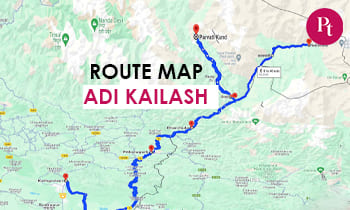
- Reach Kathgodam or Pantnagar. Kathgodam is the nearest railhead; Pantnagar has the nearest airport with limited flights.
- Drive to Pithoragarh. Roughly 8–9 hours through the Kumaon hills from Kathgodam.
- Continue to Dharchula. About 90 km and 3–4 hours, where your Inner Line Permit gets processed.
- Drive to Gunji via Tawaghat. A rugged 4×4 stretch, with permit checks at Tawaghat and Kalapani along the way.
- Gunji to Kuti to Jolingkong. This final leg has traditionally required trekking, though improved BRO road connectivity now lets 4×4 vehicles cover much of the distance in most seasons — check current conditions with your operator, since this stretch is the most weather-dependent part of the route.
- Jolingkong to Parvati Sarovar. A short walk from camp brings you to the lakeshore.
Most yatra packages run 6–8 days round trip from Delhi or Kathgodam, building in acclimatization stops at Pithoragarh, Dharchula, and Gunji.
Permits: What You’ll Need
Because this route runs through a restricted border zone, an Inner Line Permit (ILP) is mandatory for all Indian travellers heading beyond Dharchula.
- Where to apply: The SDM office in Dharchula, the official Pithoragarh district portal, or through an authorised yatra operator
- Documents needed: Valid photo ID, passport-size photographs, a medical fitness certificate, and address proof
- Checkpoints: Permits get verified at multiple posts, including Tawaghat and Kalapani — carry physical copies as backup
- Foreign nationals: This route is currently restricted mostly to Indian citizens; check current government guidelines before planning if you hold a foreign passport
What Else to See Nearby
Since Jolingkong is the endpoint of a long journey, most pilgrims combine Parvati Sarovar with these nearby sites:
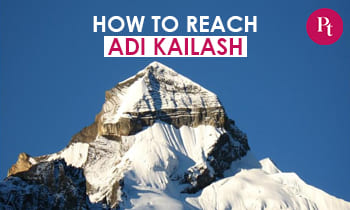
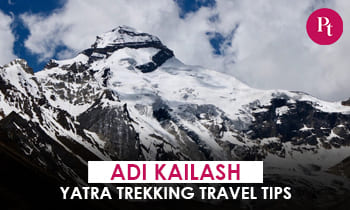
- Adi Kailash (Chhota Kailash): The 5,945-metre pyramid-shaped peak that towers directly above the lake, best viewed at sunrise from the shore
- Gauri Kund: The smaller, higher sacred pool near Jolingkong, visited on the same morning excursion
- Om Parvat: Viewed separately from Nabhidhang, on a diversion off the main Gunji route
- Kuti Village: The last inhabited settlement before Jolingkong, linked in local legend to the Pandavas
Temples & Sacred Sites Along the Route
Since the journey to Parvati Sarovar runs through Kumaon’s spiritual heartland, it’s worth planning stops at these sites on the way:
- Shiv-Parvati Temple, Jolingkong: The small shrine right at the lakeshore, maintained seasonally by yatra operators and sometimes a resident pujari, where pilgrims perform abhishek with water from the Sarovar.
- Patal Bhuvaneshwar Cave Temple: A limestone cave shrine near Gangolihat, believed to be discovered by Adi Shankaracharya, often visited on the way to or from Pithoragarh.
- Kali Mandir, Kalapani: An ancient shrine believed to mark the origin of the Kali river, and a mandatory permit-check halt en route to Gunji.
- Haat Kalika Temple, Gangolihat: One of Kumaon’s revered Shaktipeeth temples, dedicated to Goddess Kali.
- Narayan Ashram: A meditation retreat near Pithoragarh, a good stop for quiet reflection before the high-altitude leg begins.
Practical Tips for Visiting
- Don’t force a full dip. The water is glacial and genuinely cold — partial immersion or simply touching the water is considered spiritually complete; don’t risk cold shock at this altitude.
- Acclimatize in stages. Rest properly at Pithoragarh, Dharchula, and Gunji before pushing on to Jolingkong.
- Pack for sub-zero mornings. Even in June, dawn temperatures at Jolingkong can drop well below freezing.
- Time your visit for early morning. Weather at this altitude turns fast — clear skies at 7 AM can give way to cloud cover by early afternoon.
- Travel with a registered operator. Tent camps at Jolingkong are set up seasonally by yatra operators; there’s no permanent accommodation here.
Parvati Sarovar Trip Budget
| Style | Approx. Cost (per person) | Includes |
|---|---|---|
| Budget (self-organized) | ₹15,000–20,000 | Shared transport, KMVN guesthouses, basic meals |
| Mid-range (group package) | ₹25,000–35,000 | Private 4×4, tent camps, permit assistance |
| Premium | ₹45,000–70,000 | Dedicated vehicle, upgraded camps, guided support, better logistics |
Costs vary by operator, season, and group size — confirm exactly what’s included (permits, meals, camping gear) before booking.
What to Pack
- Layered thermal wear, windproof jacket, gloves, and a warm cap — Jolingkong nights drop well below freezing even in summer
- Sturdy trekking shoes and trekking poles for the final stretch to camp
- A sleeping bag rated for sub-zero temperatures if your operator doesn’t provide one
- Sunglasses and high-SPF sunscreen for intense high-altitude UV exposure
- Basic first-aid kit with AMS medication, after consulting your doctor
Health & Safety at High Altitude
Altitude Mountain Sickness (AMS) is a real risk above 3,500 metres, and Jolingkong sits close to 4,700 m. Watch for headaches, nausea, or breathlessness, and descend if symptoms worsen rather than pushing through. Basic medical aid is available at Dharchula and Gunji; serious cases require evacuation to Pithoragarh, so travellers with existing heart or lung conditions should get medical clearance before attempting this yatra.
Mobile network is unreliable beyond Dharchula and largely absent near Gunji and Jolingkong — let family know your rough schedule in advance. For emergencies, dial 108 for ambulance service or 112 for police anywhere in Uttarakhand; Uttarakhand Tourism’s helpline (1364) can help with general yatra queries.
Distance & Route Chart
| Leg | Distance | Approx. Time |
|---|---|---|
| Delhi to Kathgodam | ~285 km | 6–7 hrs |
| Kathgodam to Pithoragarh | ~210 km | 8–9 hrs |
| Pithoragarh to Dharchula | ~90 km | 3–4 hrs |
| Dharchula to Gunji | ~60–70 km | 6–8 hrs |
| Gunji to Kuti to Jolingkong | ~30–35 km | Half to full day, road/trek mix |
Sample Day-Wise Itinerary
- Day 1: Delhi to Kathgodam
- Day 2: Kathgodam to Pithoragarh, acclimatize
- Day 3: Pithoragarh to Dharchula, collect Inner Line Permit
- Day 4: Dharchula to Gunji via Tawaghat and Kalapani
- Day 5: Gunji to Kuti to Jolingkong, evening rituals at the lakeshore
- Day 6: Sunrise darshan at Parvati Sarovar and Adi Kailash, pradakshina, return to Gunji
- Day 7–8: Return journey to Dharchula, Pithoragarh, and back toward Kathgodam/Delhi
Most operators build in a spare day for weather or road delays, which is worth keeping rather than cutting.
Weather By Month
| Month | Conditions at Jolingkong |
|---|---|
| May–June | Cold mornings, milder afternoons, lake filling with snowmelt |
| July–August | Monsoon rain, higher landslide risk on approach roads |
| September–October | Clear, crisp, best visibility for photography and darshan |
| November onward | Snowfall begins, route and camp close for the season |
Photography & Etiquette
Personal photography is allowed at Parvati Sarovar and Jolingkong, but this is both a sensitive border zone and an active pilgrimage site. Avoid photographing ITBP checkpoints, and be respectful during others’ rituals at the shrine — ask before photographing anyone mid-prayer. Drones are effectively off-limits in this border corridor and can create serious permit complications if carried.
Common Mistakes to Avoid
- Confusing Parvati Sarovar with Gauri Kund and being surprised to learn there are two separate sacred sites at Jolingkong.
- Underestimating the final stretch from Gunji to Jolingkong — even with better roads, this is the most physically demanding and weather-sensitive leg of the trip.
- Skipping acclimatization days to save time — altitude sickness risk is real above 4,000 metres, and rushing rarely ends well.
- Assuming the lake looks the same year-round — a June visit and a late-September visit can look like two completely different places depending on snowmelt.
FAQs About Parvati Sarovar
Q-1: What is the altitude of Parvati Sarovar?
Sources place it between approximately 4,497 and 4,750 metres, near the Jolingkong campsite at the base of Adi Kailash.
Q-2: Is Parvati Sarovar the same as Gauri Kund?
No, though the names are often used interchangeably. Parvati Sarovar is the larger lake near Jolingkong; Gauri Kund is a separate, smaller, higher pool about 1–1.5 km away.
Q-3: What is the significance of Parvati Sarovar in Hindu mythology?
It’s believed to be where Goddess Parvati meditated and bathed while performing penance to win Lord Shiva, making it spiritually comparable to the original Mansarovar Lake in Tibet.
Q-4: How do I reach Parvati Sarovar?
Via Kathgodam, Pithoragarh, Dharchula, Gunji, and Kuti, ending with a drive or short trek to Jolingkong, where the lake sits at the base of Adi Kailash.
Q-5: Is a permit required to visit Parvati Sarovar?
Yes, an Inner Line Permit from the Dharchula SDM office is mandatory for all Indian travellers on this route.
Q-6: What is the best time to visit Parvati Sarovar?
May–June and September–October, when snow has retreated enough to reveal the lake and roads remain passable.
Q-7: Can Parvati Sarovar be visited without doing the full Adi Kailash Yatra?
Not practically — the lake sits at the yatra’s final campsite, so reaching it means completing essentially the entire route.
Q-8: Is bathing in Parvati Sarovar mandatory for pilgrims?
No. A partial dip, or simply touching the water, is considered spiritually sufficient; full immersion in the glacial water isn’t required and carries real cold-shock risk.
Q-9: What is the difference between Parvati Sarovar and Mansarovar Lake?
Mansarovar is the larger, more famous lake near Mount Kailash in Tibet; Parvati Sarovar is a smaller Himalayan lake in India considered its spiritual miniature.
Q-10: Are there temples near Parvati Sarovar?
Yes — a small Shiva-Parvati shrine sits right at the lakeshore, and Patal Bhuvaneshwar, Haat Kalika, and Kali Mandir at Kalapani are all on the wider route.
Q-11: What is a realistic budget for a Parvati Sarovar trip?
Budget trips run ₹15,000–20,000 per person, mid-range group packages cost ₹25,000–35,000, and premium options start around ₹45,000, depending on inclusions.
Q-12: Is the trek to Parvati Sarovar difficult?
It’s moderately to highly demanding due to altitude rather than technical climbing — the Gunji to Jolingkong stretch is the toughest part of the route.
Q-13: Can senior citizens visit Parvati Sarovar?
Yes, with proper medical clearance and gradual acclimatization; many operators recommend the May–June window for milder weather.
Q-14: What is the ideal duration for the Parvati Sarovar yatra?
Most itineraries, combined with Adi Kailash darshan, run 7–8 days round trip from Delhi or Kathgodam.
Q-15: Is mobile network available near Parvati Sarovar?
No, network coverage is largely unavailable beyond Dharchula and completely absent at Jolingkong.
Q-16: What altitude sickness precautions should I take?
Acclimatize gradually at Pithoragarh, Dharchula, and Gunji, stay hydrated, avoid alcohol, and carry AMS medication after consulting a doctor.
Q-17: Can I visit Parvati Sarovar without a registered tour operator?
Technically yes with a valid Inner Line Permit, but most travellers use an operator given the remote camping logistics at Jolingkong.
Q-18: What is the water like at Parvati Sarovar?
It’s glacial meltwater — extremely cold and clear, described by many pilgrims as remarkably pure, though not something to fully immerse in casually.
Q-19: Which is better for visiting Parvati Sarovar — May–June or September–October?
Both work; May–June offers a fuller lake from fresh snowmelt, while September–October gives clearer skies with a somewhat reduced water level.
Q-20: What should I pack for the Parvati Sarovar trek?
Layered thermal wear, a sub-zero-rated sleeping bag, sturdy trekking shoes, sunglasses, high-SPF sunscreen, and basic altitude sickness medication.
Conclusion
Parvati Sarovar rewards exactly the kind of traveller willing to spend a week getting there — permits, acclimatization stops, and all. What waits at the end isn’t a large or dramatic lake by any conventional measure; it’s a quiet, glacial sacred lake that happens to sit beneath one of the Himalayas’ most revered peaks. If you’re planning an Adi Kailash Yatra, build in enough time at Jolingkong to actually sit by the water rather than rushing through for a photo — that stillness is, by most accounts, the whole point of coming this far.


 Call
Call WhatsApp
 Enquiry