
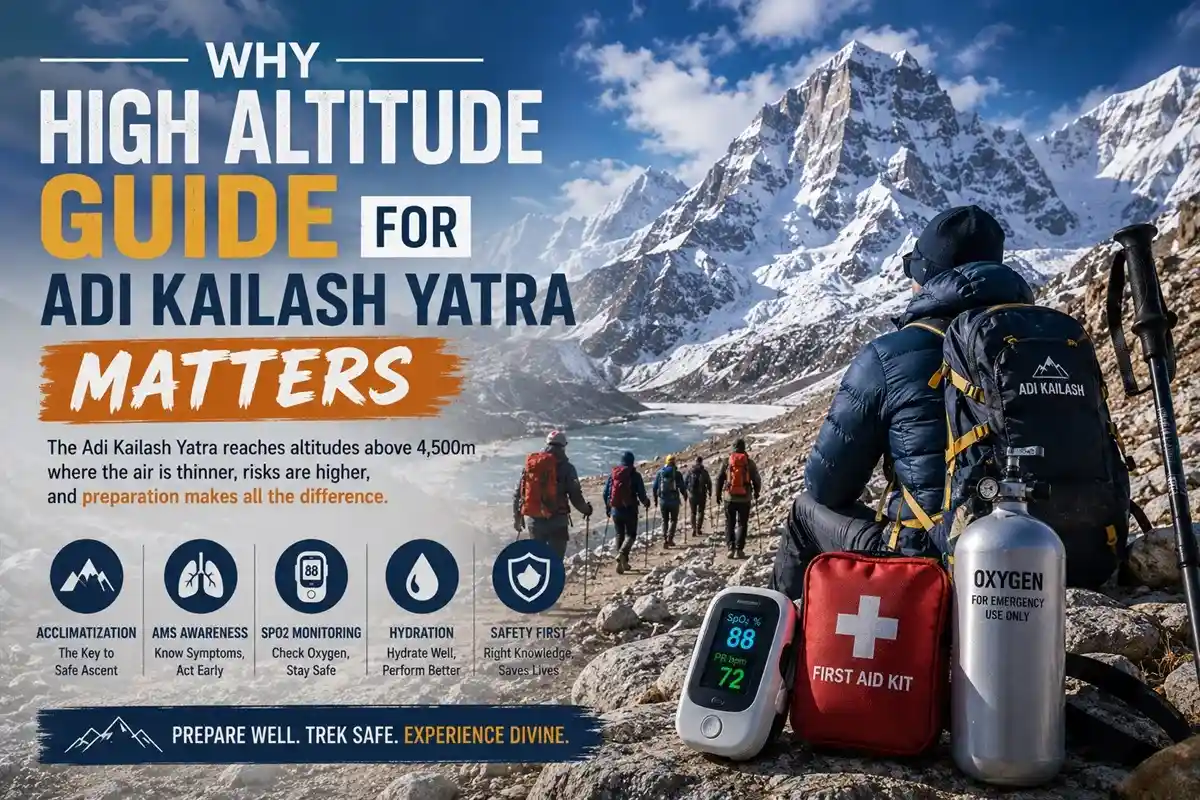
This high altitude guide for Adi Kailash Yatra is not cautionary boilerplate. It is practical safety information for a route that climbs from Dharchula at ~945 m to Jolingkong at ~4,572 m — through a restricted border zone with extremely limited medical infrastructure.
AMS (Acute Mountain Sickness) does not select for the unfit. Experienced trekkers, marathon runners, and healthy pilgrims have all been turned back by altitude illness on Himalayan routes at similar elevations. What protects you is knowledge, correct acclimatization, and the discipline to act on symptoms early.
This guide covers the physiology of altitude, a day-by-day acclimatization schedule, SpO2 monitoring, Diamox, oxygen availability, emergency protocols, high-altitude nutrition, and a myth-vs-fact section that addresses the most common dangerous misconceptions about Adi Kailash altitude safety.
Key Takeaways — Before You Leave for Adi Kailash
- AMS begins above 2,500 m. The route spends most of its high section between 3,200 m and 4,600 m.
- Fitness helps with endurance — it does NOT prevent altitude sickness. Even elite athletes get AMS.
- The Gunji rest day is your single most important acclimatization tool. Do not skip it.
- Carry a pulse oximeter. Check SpO2 every morning and evening above 3,000 m alongside symptoms.
- Hydration: 3–4 litres daily above 3,000 m — adjust based on weather, exertion, and how you feel.
- Diamox: only if prescribed by your doctor. Never self-medicate at altitude.
- HACE and HAPE are life-threatening. Seek emergency medical care immediately and descend.
- Save emergency contacts offline before entering the restricted zone — no network beyond Gunji.
Myth vs Fact — Common Dangerous Misconceptions About Altitude
❌ MYTH: Fit people don’t get altitude sickness.
✅ FACT: Fitness has no direct correlation with AMS susceptibility. Physical conditioning improves endurance but does not affect how your body acclimatizes to reduced atmospheric pressure. Marathon runners and mountaineers are affected just as frequently as first-time trekkers.
❌ MYTH: If I felt fine at 3,000 m before, I’ll be fine at Jolingkong.
✅ FACT: Previous altitude tolerance is not a reliable predictor for future trips. Acclimatization responses vary between seasons, health status, hydration levels, ascent rate, and even stress. Each high-altitude trip should be approached fresh.
❌ MYTH: Drinking alcohol at altitude is fine in moderation.
✅ FACT: No safe level of alcohol consumption exists above 3,000 m during active acclimatization. Alcohol suppresses the hypoxic ventilatory response (your body’s instinct to breathe faster at altitude), worsens dehydration, and directly increases AMS risk. Zero alcohol is the correct recommendation.
❌ MYTH: If I take Diamox, I don’t need to worry about acclimatization.
✅ FACT: Diamox reduces AMS risk by stimulating faster breathing — it does not replace acclimatization, does not prevent HACE or HAPE, and does not make descent unnecessary in severe cases. Pilgrims who rely on Diamox and skip the Gunji rest day remain at risk.
❌ MYTH: SpO2 below 80% means I must descend immediately.
✅ FACT: SpO2 readings must always be interpreted alongside symptoms, not in isolation. SpO2 can read low due to cold fingers, poor device contact, or movement. A reading below 80% at rest is concerning, but the clinical decision must consider your overall symptom picture. Inform your guide and assess together.
What High Altitude Does to Your Body — Plain Language Science
Why Altitude Reduces Available Oxygen
The proportion of oxygen in air remains approximately 21% at all altitudes — this does not change. What changes is atmospheric pressure. As altitude increases, barometric pressure drops, which means each breath you take draws in fewer air molecules overall — and therefore fewer oxygen molecules — than the same breath at sea level.
At 3,200 m (Gunji), barometric pressure is roughly 70% of sea level — your lungs receive significantly less oxygen per breath than at Delhi, even though the oxygen concentration in the air is identical. At 4,572 m (Jolingkong), barometric pressure drops further to approximately 57% of sea level pressure.
Your body responds by increasing breathing rate and heart rate. Over 2–3 days, it begins producing additional red blood cells to carry the available oxygen more efficiently. This adjustment process is acclimatization — and it cannot be rushed or pharmacologically replaced.
The Three Altitude Conditions
| Condition | Full Name | When It Develops | Key Symptoms | Action |
| AMS | Acute Mountain Sickness | Within 6–24 hrs above 2,500 m | Headache, nausea, dizziness, fatigue, poor sleep | Rest. Do not ascend. Descend if no improvement in 24 hrs. |
| HACE | High Altitude Cerebral Edema | AMS that progresses — often overnight | Confusion, loss of balance, severe headache, drowsiness | Seek emergency medical care immediately. Begin descent. |
| HAPE | High Altitude Pulmonary Edema | Can develop rapidly, often at night | Breathlessness at rest, persistent cough, pink/frothy sputum, blue lips | Seek emergency medical care immediately. Begin descent. |
⚠️ HAPE is the leading cause of death from altitude illness. Both HACE and HAPE can develop within hours. Descent — even 300–500 m — typically produces rapid improvement. Do not wait for daylight or better weather.
Altitude Profile — What Your Body Faces Stage by Stage
| Location | Altitude | Barometric Pressure vs Sea Level | AMS Risk | Key Note |
| Delhi / Kathgodam | ~250–300 m | ~97% | None | Departure. Hydrate well. |
| Pithoragarh | ~1,800 m | ~80% | Very low | Optional overnight — useful first altitude step. |
| Dharchula | ~945 m | ~90% | None | River valley. Rest here. Reliable ATM availability limited beyond this point. |
| Gunji Village | ~3,200 m | ~69% | Moderate | CRITICAL stop. 1–2 nights minimum. AMS possible. |
| Kuti Village | ~3,600 m | ~63% | Moderate–High | Last village. Lunch stop recommended. |
| Jolingkong | ~4,572 m | ~57% | High | Highest sleeping point. Rest on arrival. |
| Gauri Kund | ~4,730 m | ~55% | High | Move very slowly. Stop if breathless. |
| Nabhidhang | ~4,600 m | ~56% | High | Day excursion only if fully symptom-free. |
Note: Column heading changed to ‘Barometric Pressure vs Sea Level’ to reflect the scientifically accurate mechanism. Oxygen concentration in air remains ~21% at all altitudes — what reduces is the air pressure available to push oxygen into the lungs.
AMS Symptoms — Recognise Them Early, Act Correctly
Mild AMS — First 12–24 Hours
Mild AMS is extremely common on first arrival at altitude. These are manageable signs:
- Persistent headache — the most reliable early indicator, within 6–12 hours of arrival.
- Loss of appetite — even the smell of food is unappealing. Eat small amounts anyway.
- Mild nausea — usually without vomiting at this stage.
- Fatigue disproportionate to exertion.
- Disrupted sleep — waking frequently, periodic breathing.
- Slight dizziness on standing — passes within seconds.
Mild AMS resolves with rest, hydration, and time at the same altitude. Do not ascend while any symptom is present.
Moderate AMS — Warning Stage
⚠️ Headache that does not improve after 4–6 hours of rest, fluids, and paracetamol.
⚠️ Persistent vomiting — unable to keep water down.
⚠️ Severe weakness — unable to walk at normal pace on flat ground.
⚠️ Marked breathlessness at rest — not during exertion, but sitting still.
Stay at current altitude. Inform your guide immediately. Consider Diamox if prescribed. Monitor every 2 hours. If no improvement in 12 hours, begin descent.
Severe AMS / HACE — Medical Emergency
⚠️ Confusion or disorientation — cannot name the day or their location.
⚠️ Loss of balance — inability to walk heel-to-toe in a straight line (ataxia).
⚠️ Extreme drowsiness — difficult to keep awake.
⚠️ Severe headache unresponsive to any medication.
HACE: seek emergency medical care immediately. Begin descent — minimum 500–1,000 m. Give supplemental oxygen if available. Do not leave the person alone.
HAPE — Most Dangerous
⚠️ Breathlessness at rest, progressively worsening.
⚠️ Persistent cough producing pink, frothy, or blood-tinged sputum.
⚠️ Cyanosis — blue or grey tinge to lips and fingertips.
⚠️ Crackling sound when breathing (pulmonary rales).
HAPE: seek emergency medical care immediately. Begin descent without delay. Administer supplemental oxygen at 4–6 L/min if available. HAPE is the leading cause of altitude death on Himalayan routes.
Source: Wilderness Medical Society altitude illness guidelines | WHO | CDC Travel Health
Suggested Tour: Adi Kailash Yatra Packages
SpO2 Monitoring — How to Use a Pulse Oximeter
A pulse oximeter measures blood oxygen saturation (SpO2). Check SpO2 every morning immediately after waking and every evening before sleep, at all altitudes above 3,000 m. Sit still for 5 minutes before measuring — readings taken immediately after exertion will be temporarily lower.
Important: SpO2 readings must always be interpreted alongside your symptoms — never in isolation. Cold fingers, poor device contact, nail polish, movement, and even certain skin tones can affect reading accuracy. A single low SpO2 reading without symptoms requires re-testing and clinical assessment by your guide. Always consider SpO2 and how you feel together.
SpO2 Reference Guide at Altitude (Symptom Context Required)
- 95–100% Normal at any altitude — continue monitoring
- 90–94% Expected at 3,200–4,500 m — monitor closely with symptoms
- 85–89% Significant reduction — rest, hydrate, do not ascend. Inform guide.
- Below 80% at rest + symptoms Serious concern — assess with guide, consider descent
- Below 70% at rest with symptoms Seek emergency medical care immediately. Begin descent.
Note: These SpO2 thresholds are approximate references, not absolute clinical triggers. What matters is the combination of SpO2 reading + symptoms. A 78% reading in someone who feels completely well at altitude requires reassessment; a 83% reading in someone with confusion or breathlessness at rest is a medical emergency.
Adi Kailash Acclimatization Schedule — Day by Day
This is the recommended Adi Kailash acclimatization schedule aligned with the 300–500 m maximum sleeping altitude gain per day rule above 3,000 m:
Day 1 — Kathgodam / Pithoragarh | ~300 m / ~1,800 m (h3)
Arrive and rest. Begin hydrating — 3 litres minimum. Light dinner. Avoid alcohol for the entire yatra. Pithoragarh (~1,800 m) provides a useful first altitude step if your itinerary allows.
Day 2 — Dharchula | ~945 m (river valley) (h3)
Collect ILP. Buy final supplies — reliable ATM availability is limited beyond this point. Reliable pharmacy access ends here too. Sleep early — tomorrow’s drive takes you to 3,200 m in approximately 5–6 hours.
Day 3 — Dharchula → Gunji | ~945 m → ~3,200 m (h3)
The most medically significant transition. You gain ~2,255 m by vehicle. Arrive by early afternoon. Short 20-minute gentle walk on arrival — do not rest supine for hours. Drink 3–4 litres. Warm meal (carbohydrates). No alcohol, no sedatives.
Day 4 — Gunji — Rest Day | ~3,200 m (do not ascend) (h3)
Non-negotiable acclimatization day. Morning: 1–2 km gentle walk toward Kuti road, gaining ~100–200 m, then return to sleep at Gunji (‘climb high, sleep low’). Afternoon: rest, check SpO2, eat well. Before Day 5: headache resolved? Appetite returning? Balance test passed? If not — one more night at Gunji.
Day 5 — Gunji → Kuti → Jolingkong | ~3,200 m → ~3,600 m → ~4,572 m (h3)
Travel by vehicle. On arrival at Jolingkong: walk to accommodation only. Rest 1–2 hours before any sightseeing. No visiting Parvati Sarovar on arrival day. Check SpO2 morning and evening. Walk to sarovar next morning at a very gentle pace — stop every 15–20 minutes.
Day 6 — Jolingkong — Exploration | ~4,572 m (h3)
Parvati Sarovar and Gauri Kund at a gentle pace. Stop if breathless at rest. Do not attempt any ascent above the basin without a guide. Afternoon rest. Check SpO2.
Day 7 — Nabhidhang — Om Parvat | ~4,600 m (h3)
Day excursion from Gunji or overnight. ~4,600 m — slightly above Jolingkong. Do not attempt if any AMS symptoms remain from the Jolingkong section. Move slowly. Check SpO2 on arrival.
Note: Some operators compress this schedule. A compressed itinerary significantly increases AMS risk. One extra day at Gunji costs very little; a forced descent from Jolingkong costs the entire yatra.
Diamox (Acetazolamide) — What It Does and Does Not Do
Diamox is the most widely used pharmacological aid for AMS prevention. It works by stimulating faster breathing, which compensates for the reduced oxygen availability at altitude due to lower barometric pressure.
What Diamox Does
- Reduces AMS risk when taken prophylactically (before reaching altitude).
- Reduces severity and duration of existing mild AMS symptoms.
- Improves sleep quality at altitude by reducing Cheyne-Stokes periodic breathing.
What Diamox Does Not Do
- Does not prevent HACE or HAPE.
- Does not make descent unnecessary in severe cases.
- Does not replace proper acclimatization — never skip the Gunji rest day because you are on Diamox.
Dosage
Dosage is determined by your doctor based on your individual medical history. A general clinical reference (not a prescription): 125–250 mg twice daily, typically starting 24–48 hours before reaching altitude above 2,500 m. Always follow your physician’s instructions.
Contraindications and Side Effects
- Contraindicated: sulfa drug allergy, kidney disease, certain liver conditions. Inform your doctor fully.
- Common effects: increased urination (drink more water), tingling in fingers and toes, altered taste of carbonated drinks — all expected and normal.
- Rare but serious: Stevens-Johnson syndrome (severe allergic skin reaction). Seek medical care immediately if rash or skin blistering develops.
⚠️ Do not take Diamox without an in-person prescription from your doctor. Do not self-prescribe based on online research or peer recommendation. At altitude, an allergic reaction to Diamox is a compounding emergency.
Oxygen Availability on the Adi Kailash Route
Supplemental oxygen is the fastest non-pharmacological treatment for altitude illness. However, its availability on this route is limited and cannot be assumed.
KMVN Emergency Oxygen
KMVN camps at Gunji and Nabhidhang typically maintain emergency oxygen cylinders for critical cases. These are not available for routine or recreational use — they are reserved for medical emergencies. Availability is not guaranteed at every camp and varies by season.
Private Operator Oxygen
Reputable registered operators typically carry portable oxygen cylinders — usually at least one per group. Before booking, confirm with your operator explicitly:
- How many cylinders do you carry per group?
- What capacity are the cylinders (litres)?
- Which team member is trained to administer supplemental oxygen?
- At what SpO2 and symptom combination do you initiate oxygen?
Personal Oxygen Canisters
Small personal canisters (approximately 15–20 breaths) are useful for mild breathlessness during exertion. They are not a treatment for AMS, HACE, or HAPE — and do not remove the need for descent in a medical emergency. Buy before entering the restricted zone, as availability in Dharchula and beyond is limited.
Note: Ask your operator specifically about oxygen carrying policy before booking — not after. This is a legitimate safety question that responsible operators will answer clearly.
Hydration at Altitude — Rules That Directly Affect Safety
Dehydration at altitude worsens AMS symptoms and reduces acclimatization efficiency. At high altitude, you lose water faster: breathing rate increases, cold dry air carries moisture away with each exhale, and acclimatization-related hormonal changes increase urination.
- Target: 3–4 litres daily above 3,000 m — adjust based on temperature, activity level, and how you feel.
- Urine colour is your practical guide: pale yellow or clear = adequate. Dark yellow = dehydrated. Amber = seriously dehydrated.
- Drink before you feel thirsty — thirst perception is unreliable at altitude.
- ORS sachets on trekking days: plain water alone can flush electrolytes. ORS replaces sodium, potassium, and glucose.
- Hot liquids count: herbal tea, warm lemon water, clear dal broth — all contribute to hydration.
- Zero alcohol above 3,000 m. Not moderation — zero. Alcohol suppresses the breathing reflex during sleep and worsens AMS risk.
- Carry a 1-litre bottle at all times. Refill at guesthouses.
Nutrition at Altitude — What to Eat and What to Avoid
Digestion slows above 3,500 m as the body prioritises oxygen delivery over digestive processes. Eating correctly has a measurable impact on energy and recovery.
What to Eat
- Carbohydrate-rich foods: rice, roti, oats, boiled potatoes — processed with lower oxygen demand than protein or fat.
- Simple vegetarian meals (default on this route: dal, rice, roti, sabzi) — altitude-optimised by default.
- Small, frequent warm meals rather than large ones — easier on the slow digestive system at altitude.
What to Carry Beyond Guesthouses
- Energy bars, chikki, jaggery-peanut bars — lightweight, calorie-dense.
- Dry fruits and nuts: almonds, walnuts, raisins.
- ORS sachets — carry 20+ per person minimum.
- Glucose biscuits or glucose powder — fast energy for sudden fatigue on ascent.
- Ginger candy or ginger tea bags — effective for altitude-related nausea.
What to Avoid
- Heavy, oily food — difficult to digest; triggers nausea at altitude.
- Alcohol — zero. Not moderation.
- Caffeinated drinks in excess — mild diuretics; fine in small amounts, not as water substitutes.
The Ataxia Test — 30 Seconds That Can Save a Life
The ataxia test identifies early HACE before confusion becomes obvious. Every group member should perform it each morning above 3,200 m.
How to Perform
- Stand near a wall on flat ground.
- Walk heel-to-toe in a straight line for 5 metres — like walking a tightrope.
- A person without HACE should complete this without losing balance.
- Stumbling, widening stance, or inability to complete the line = positive test. Treat as a HACE warning. Do not ascend. Inform guide immediately.
Note: Do this test every morning above 3,200 m. It takes 30 seconds. It is far easier to identify balance issues in others than in yourself — make it a group habit, not a personal assessment.
High Altitude Sleep — Why It Feels Different
Sleep disruption at altitude is almost universal and does not indicate illness on its own.
Why Sleep Is Difficult
Periodic breathing (Cheyne-Stokes respiration) is common above 3,000 m: breathing slows significantly during sleep, carbon dioxide builds up, which triggers a sudden deep breath. This cycle repeats every 15–30 seconds and frequently wakes sleepers. This is a normal physiological response, not illness.
Practical Sleep Tips
- Sleep with head slightly elevated — reduces breathlessness during Cheyne-Stokes cycles.
- Keep sleeping bag slightly open at the chest — prevents constricted feeling that worsens sleep anxiety.
- Do not take sleeping pills or sedatives — they suppress the breathing reflex and worsen hypoxia risk during sleep.
- Diamox (if prescribed) significantly reduces Cheyne-Stokes and improves sleep quality at altitude.
- Accept 1–2 nights of poor sleep as normal at Gunji — typically improves by Night 2–3.
- Check SpO2 before sleep and immediately on waking. Consider SpO2 alongside any symptoms.
Golden Rules — High Altitude Safety at Adi Kailash
| Rule | Why It Matters | Action |
| Never ascend with symptoms | AMS at current altitude means body has not adapted | Rest until fully symptom-free before ascending |
| Climb high, sleep low | Sleeping lower accelerates acclimatization | Day hike above camp; return lower to sleep |
| 3–4 litres water daily | Dehydration worsens AMS — adjust for weather and activity | Drink before thirst; monitor urine colour |
| Zero alcohol above 3,000 m | Suppresses breathing reflex during sleep | Not moderation — zero |
| Slow pace always | Exertion at altitude consumes far more O₂ than at sea level | If you can’t speak full sentences, slow down |
| Check SpO2 + symptoms | Objective data + clinical picture together | Morning and evening above 3,200 m |
| Daily ataxia test | First sign of HACE may be balance loss | 30-second heel-to-toe walk every morning |
| Seek care at first severe sign | HACE and HAPE are time-critical | Immediate descent + emergency contact — no delay |
| Tell your guide immediately | Guides can act; symptoms cannot self-resolve at altitude | Report any unusual symptom at once |
Who Should Not Attempt Adi Kailash Yatra — Medical Contraindications
This is the section most high-altitude guides omit and most pilgrims skip. For a route reaching 4,572 m in a restricted border zone with no hospital, this information is non-optional.
⚠️ If you have any of the following conditions, consult a specialist doctor before registering for this yatra — not your general physician, but the relevant specialist. Condition management at sea level does not automatically qualify you for 4,572 m.
Cardiovascular Conditions
- Uncontrolled heart disease or congestive heart failure — significant decompensation risk at altitude.
- History of heart attack, cardiac surgery, or stroke within the past 12 months — discuss explicitly with your cardiologist.
- Severe uncontrolled hypertension — altitude raises blood pressure further; uncontrolled baseline values are high risk.
- Severe pulmonary hypertension — altitude increases pulmonary artery pressure; this is a contraindication for high altitude.
Respiratory Conditions
- Severe COPD (Chronic Obstructive Pulmonary Disease) — significantly reduced baseline oxygen exchange is compounded by altitude.
- Severe or uncontrolled asthma — cold dry mountain air is a potent bronchospasm trigger.
- Recent acute respiratory infection — seek medical clearance before travel if recovered within 4 weeks of departure.
Neurological and Other Conditions
- Recent stroke — within 12 months. The hypoxic environment at altitude can affect cerebral perfusion.
- Severe anaemia (haemoglobin below 10 g/dL) — reduced oxygen-carrying capacity further compromised by altitude.
- Uncontrolled diabetes with poor blood sugar management — altitude affects glucose metabolism unpredictably.
Pregnancy
- Pregnancy is generally considered a contraindication for travel above 3,500 m, due to the risk of reduced fetal oxygen supply and altitude-related physiological changes. Consult your obstetrician specifically about travel above 3,000 m before planning.
Age-Related Note
- Minimum age: 18 years for independent registration. KMVN practical maximum: 70 years.
- Pilgrims aged 60–70 require additional medical documentation. Two nights at Gunji is strongly recommended over one for this age group.
Note: This list covers common high-risk conditions but is not exhaustive. If you are on regular medication for any chronic condition, discuss this yatra specifically — at this altitude range — with your treating specialist before registering.
Emergency Response — What Actually Exists on the Route
Understanding what medical support realistically exists on the Adi Kailash route — not what you hope exists — is part of responsible preparation.
ITBP Support
ITBP personnel at checkpoints including Gunji provide basic first aid and can assist emergency coordination. They are not a medical facility and cannot manage HACE or HAPE beyond basic oxygen and evacuation initiation.
KMVN
KMVN guesthouses at Gunji typically have emergency oxygen cylinders and basic first aid. There is no hospital at Gunji. For major medical events, evacuation is the only option.
Nearest Hospital
District Hospital Dharchula — approximately 100 km from Gunji. Evacuation time varies significantly depending on road condition, weather, and time of day — plan for several hours minimum, longer in adverse conditions.
Helicopter
Commercial helicopter services are not routinely operated on this restricted border route due to airspace restrictions near the India-China boundary. Government agencies may coordinate air support in declared emergencies, but this cannot be assumed as a reliable evacuation option. Plan your safety around ground evacuation as the primary route.
⚠️ The combination of remote location, restricted airspace, and limited road accessibility makes early symptom recognition and conservative acclimatization the most important safety tools on this route — far more than any emergency equipment.
Emergency Contacts — Save Before Entering the Restricted Zone
- Your registered operator’s local emergency number — obtain and save before leaving Delhi.
- ITBP Gunji Post — confirm current contact number with your operator before entering the zone.
- Dharchula SDM Office emergency coordination — verify current number with operator.
- District Hospital Dharchula, Pithoragarh district.
- National Emergency: 112
Note: Save all emergency contacts in offline mode (screenshots, written notes) — mobile network does not function beyond Gunji. Your operator should provide a laminated emergency card — ask for one before departure.
High Altitude Safety Kit — What to Pack
| Item | Purpose | Notes |
| Pulse oximeter | SpO2 monitoring — twice daily above 3,200 m | Carry batteries; cold affects battery life |
| ORS sachets (20+/person) | Electrolyte replacement — daily above 3,000 m | Buy in Delhi — last reliable purchase point |
| Diamox (if prescribed) | AMS risk reduction — doctor prescription only | Bring the prescription document |
| Paracetamol 500 mg | Mild AMS headache | Standard; available in India |
| Ibuprofen | Headache; do not use if dehydrated or kidney concerns | Avoid if on Diamox without doctor advice |
| Anti-nausea tablets (prescribed) | Altitude nausea | Ask doctor — Ondansetron commonly used |
| Personal O₂ canisters (2–3) | Short-term breathlessness relief during exertion | Not a treatment for HACE/HAPE — supplement only |
| Ginger candy / tea | Altitude nausea — effective and safe | Widely available |
| Glucose powder / biscuits | Fast energy for sudden altitude fatigue | Carry 3–4 packets minimum |
| Hand warmers | Cold triggers vasoconstriction; affects SpO2 readings | Delhi outdoor stores |
| Thermometer | Fever at altitude worsens AMS | Digital — compact |
| Blister plasters | Blisters at altitude heal slowly | Carry 6–8 minimum |
Note: Buy altitude-specific medical items in Delhi or Kathgodam. Once you enter the restricted zone past Dharchula, there are no pharmacies. What you pack before Dharchula is all you have.
High Altitude Considerations for Special Groups
Senior Citizens (60–70 years)
Older bodies acclimatize more slowly. Two nights at Gunji is the recommended minimum. Perform the ataxia test daily — balance deterioration can mimic normal ageing without the test baseline. Build buffer days into the itinerary explicitly.
Pilgrims with Controlled Hypertension
Blood pressure rises at altitude. Carry medication consistently — never skip doses. Monitor BP with a portable cuff if possible. Discuss this altitude range with your cardiologist specifically — some antihypertensives interact with Diamox.
Pilgrims with Controlled Asthma
Cold dry mountain air triggers bronchospasm. Carry your reliever inhaler in an outer accessible pocket at all times — not buried in your bag. Consult a pulmonologist before registering. Controlled mild asthma is manageable on this route for many pilgrims.
First-Time High-Altitude Travellers
Build 1–2 extra buffer days at Gunji into your itinerary. You have no personal altitude reference. Follow every acclimatization rule without exception and without comparing yourself to experienced group members.
Connectivity, Power, and Offline Preparation
Digital connectivity ends at Gunji — plan accordingly before you enter the restricted zone.
Mobile Network
- Jio has the strongest coverage from Delhi through Kathgodam, Pithoragarh, and Dharchula.
- Network drops significantly from Gunji onward. Do not rely on connectivity for safety information beyond this point.
- Download offline maps (Maps.me or Google Maps offline areas) for the Pithoragarh and Dharchula regions before departure.
Power Bank
- Carry a minimum 20,000 mAh power bank — cold temperatures drain batteries significantly faster at altitude.
- Charging facilities are available in Dharchula and Gunji guesthouses but can be intermittent.
- Prioritise keeping your pulse oximeter and emergency contact device charged above entertainment devices.
Offline Emergency Contacts
- Screenshot or write down all emergency contacts before leaving Dharchula — phone screenshots are unreliable if the battery dies.
- Ask your operator for a physical laminated emergency card — name, blood type, conditions, emergency contacts, operator number, nearest hospital.
Frequently Asked Questions
Q1. How to avoid altitude sickness on Adi Kailash Yatra?
Spend 1–2 nights at Gunji (~3,200 m) before proceeding to Jolingkong (~4,572 m). Drink 3–4 litres water daily (adjust for weather and activity). Walk slowly. Monitor SpO2 with symptoms twice daily. Do not ascend with any AMS symptom present.
Q2. What are AMS symptoms to watch for at Adi Kailash?
Persistent headache (within 6–24 hrs of arrival), loss of appetite, mild nausea, unusual fatigue, disrupted sleep, slight dizziness. These are manageable mild AMS — rest and do not ascend. Confusion, balance loss, breathlessness at rest, or frothy cough = seek emergency medical care immediately and descend.
Q3. What is the Adi Kailash acclimatization schedule?
Day 1–2: Dharchula. Day 3: Drive to Gunji — gentle walk on arrival. Day 4: Full rest day at Gunji — ‘climb high, sleep low’ gentle walk. Day 5: Jolingkong by vehicle — rest 1–2 hours on arrival. Day 6: Gentle exploration of Jolingkong basin.
Q4. What SpO2 reading should concern me at Adi Kailash Yatra?
SpO2 must always be read alongside symptoms — never in isolation. Below 90% warrants close monitoring. Below 80% at rest with symptoms = significant concern; discuss with guide. Below 70% at rest with symptoms = seek emergency medical care immediately. Check SpO2 morning and evening above 3,200 m.
Q5. Should I use a pulse oximeter on Adi Kailash Yatra?
Yes — carry one per group minimum, ideally one per person. Sit still for 5 minutes before measuring. Combine the reading with how you feel — a low SpO2 reading in an asymptomatic person requires reassessment, not panic. Cold fingers affect accuracy.
Q6. Can diabetics do Adi Kailash Yatra?
Controlled diabetes on stable medication is not automatically disqualifying. Altitude affects glucose metabolism and insulin absorption. Consult your endocrinologist specifically about trekking to 4,572 m. Carry extra glucose snacks, your glucometer, and a detailed medication log.
Q7. Can children or teenagers do the Adi Kailash Yatra?
Minimum registration age is 18 years. Children under 18 are not eligible for independent registration. Children are not categorically more vulnerable to AMS, but they may struggle to describe early symptoms accurately — watch for unusual fatigue or refusal to eat as early indicators.
Q8. Is the yatra safe during pregnancy?
Travel above 3,500 m is generally considered a contraindication during pregnancy due to reduced fetal oxygen supply. Consult your obstetrician specifically before planning any pilgrimage above 3,000 m. Seek explicit medical clearance — not general advice.
Q9. What travel insurance do I need for Adi Kailash Yatra?
Get specialist adventure travel insurance explicitly covering: trekking above 4,000 m, emergency medical evacuation, and restricted-zone travel in India. Read exclusions carefully — standard travel policies often exclude high-altitude trekking. Medical evacuation from Jolingkong can be a very costly event without coverage.
Q10. Does oxygen at altitude drop to 57%?
No — oxygen concentration in air remains approximately 21% at all altitudes. What drops is atmospheric pressure. At Jolingkong (~4,572 m), barometric pressure is approximately 57% of sea level — this means your lungs draw in fewer air molecules overall with each breath, reducing effective oxygen intake.
Q11. Is there mobile network at Gunji and Jolingkong?
Mobile network is limited and unreliable from Gunji onward. Jio has partial coverage at Gunji but drops significantly beyond. Do not rely on connectivity past Gunji. Download offline maps, save all emergency contacts offline, and carry a written emergency contact list before leaving Dharchula.
Q12. What power bank should I carry for Adi Kailash?
Minimum 20,000 mAh. Cold temperatures at altitude drain batteries significantly faster than normal. Charging is available at Gunji guesthouses but can be intermittent. Prioritise keeping your pulse oximeter and emergency phone charged above other devices.
Q13. Can I use personal oxygen canisters instead of descending for AMS?
No. Personal canisters provide 15–20 breaths of temporary relief — useful for mild exertion breathlessness, not for treating AMS, HACE, or HAPE. In a medical emergency, oxygen buys time during descent, not instead of it. Descent is always the primary treatment.
Q14. What is the Adi Kailash high altitude preparation tip most pilgrims overlook?
Performing the ataxia test every morning above 3,200 m. Walk heel-to-toe for 5 metres in a straight line. Inability to do so without losing balance is the earliest clinical sign of HACE — it appears before confusion becomes obvious. It takes 30 seconds and should be a group daily habit.
Q15. Is fitness enough preparation for Adi Kailash high altitude?
No — fitness improves endurance but has no direct effect on AMS susceptibility. Physically fit pilgrims, including athletes, develop altitude sickness at the same rate as less fit individuals. The correct preparation is cardiovascular training plus acclimatization planning plus medical readiness plus the knowledge in this guide.


 Call
Call WhatsApp
 Enquiry