
Most people book the Adi Kailash Yatra for two darshans — the sacred peak and Om Parvat. Then the road itself starts revealing places they never planned for, and the trip becomes something bigger.
This route through Kumaon and the Byans Valley of Pithoragarh, Uttarakhand, strings together ancient cave temples, Mahabharata-linked villages, glacial lakes and border-road drama. Here are the 15 places worth your time, arranged exactly in route order from Kathgodam — so this list doubles as your itinerary.

Route Overview: How the 15 Places Connect
Kathgodam → Kainchi Dham → Jageshwar/Almora → Chaukori → Patal Bhuvaneshwar → Pithoragarh → Dharchula → Chialekh → Garbyang → Gunji → Kuti → Jolingkong (Adi Kailash) → Parvati Sarovar → Gauri Kund → Kalapani → Nabhidhang (Om Parvat)
| Zone | Places | Permit |
| Kumaon hills (Day 1–2) | 1–5 | Not needed |
| Border gateway (Day 2–3) | 6–8 | ILP from Dharchula onward |
| Vyas Valley core (Day 4–6) | 9–15 | ILP + ITBP checks |
The Kumaon Stretch (No Permit Needed)
1. Kainchi Dham
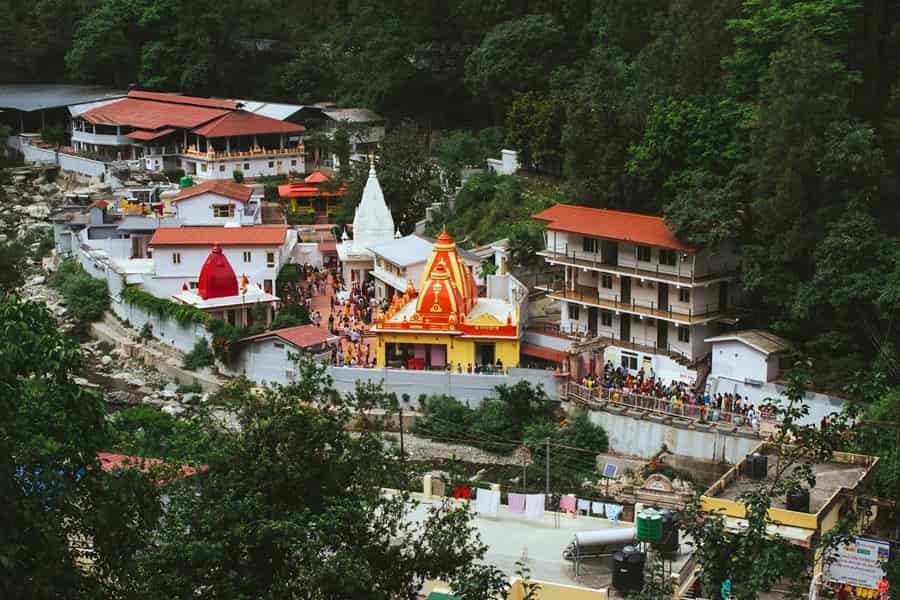
The ashram of Neem Karoli Baba on the Bhowali–Almora road is where most yatra vehicles make their first halt. Devotees worldwide — famously including tech pilgrims from Silicon Valley — come for the Hanuman temple and the ashram’s stillness beside the Kosi stream.
Plan it right: Reach before 9 AM; weekend and June 15 (foundation day mela) queues stretch for hours. Photography inside is restricted, prasad is simple, and 45 minutes is enough. Parking on the highway fills fast.
2. Jageshwar Dham
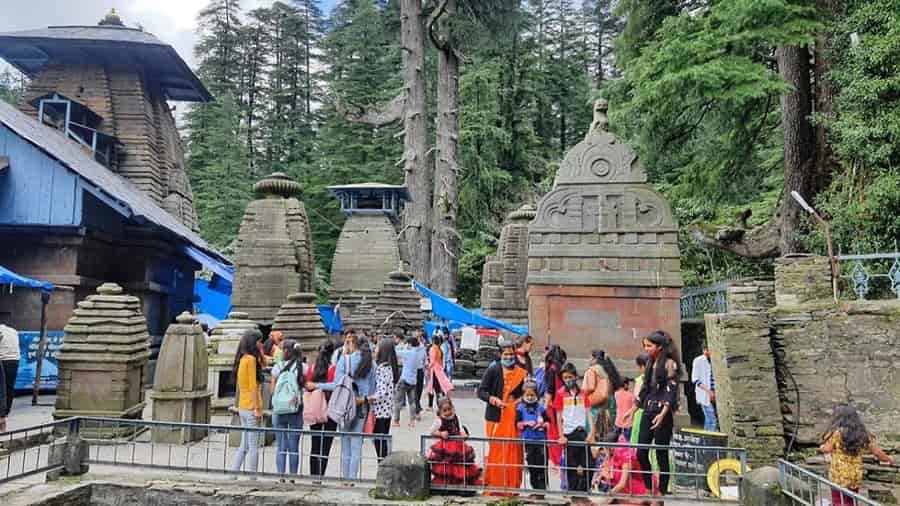
Hidden in a deodar grove near Almora stands one of India’s densest ancient temple clusters — over 100 stone shrines (commonly cited around 124), built roughly between the 7th and 14th centuries and protected by the ASI. Tradition counts the main Mahamrityunjaya shrine among the Jyotirlinga claims.
Plan it right: The morning light through the deodars justifies the detour alone. Give it an hour, see the small ASI museum, and don’t miss the Dandeshwar group 500 m up the road that most tourists skip.
3. Chaukori
A ridge of tea gardens facing the Panchachuli massif head-on. Most groups overnight here on Day 1 or 2 — sunrise over the five peaks is the trip’s first real Himalayan moment, and it’s the best-resort belt of the entire route.
Plan it right: Families usually choose Chaukori as their comfort stop; book view-facing rooms weeks ahead in season. Sunrise point is a five-minute walk from most stays — carry a jacket even in June.
4. Patal Bhuvaneshwar
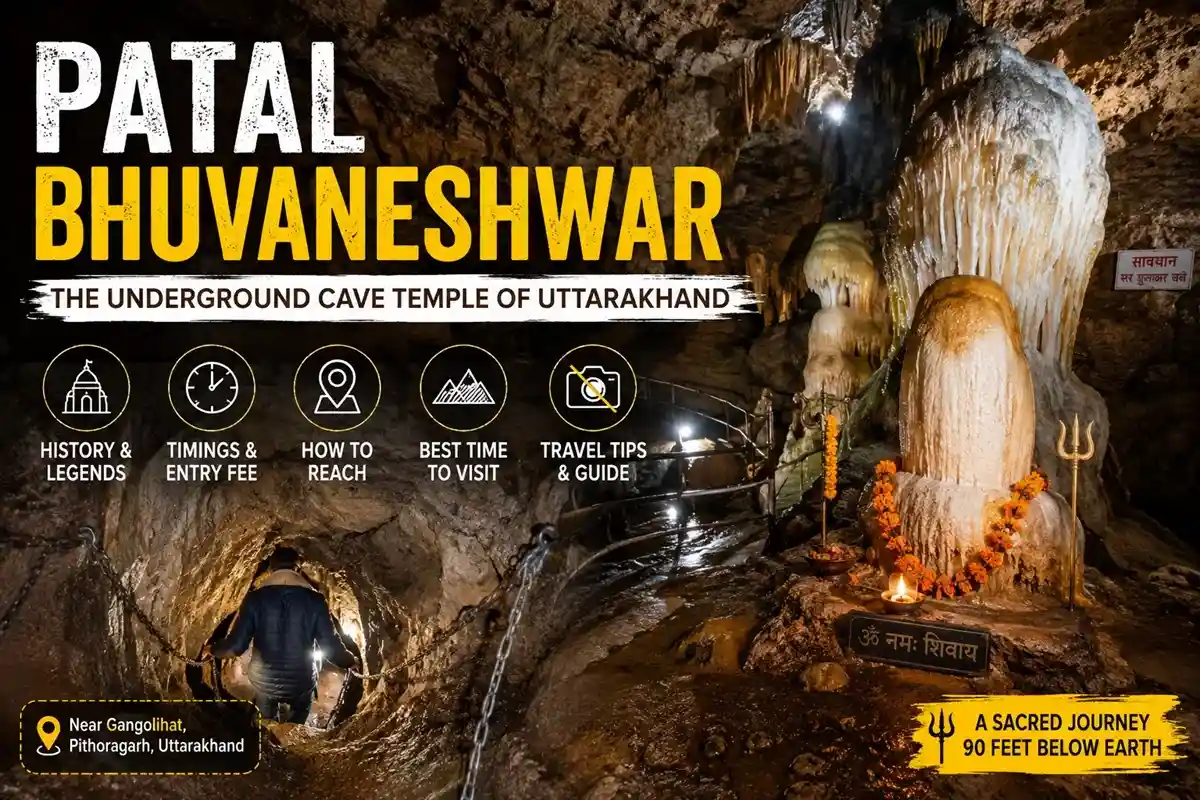
The underground limestone cave temple near Gangolihat — about 160 m long and roughly 90 ft deep per temple references — is the most memorable hour of the Kumaon stretch. You descend holding iron chains into chambers that temple tradition reads as the abode of 33 koti deities, guided in small batches.
Plan it right: Go with the first morning batch; a guide is mandatory, no permit is needed, and photography inside is restricted. Anyone with serious claustrophobia can take darshan at the surface temple instead. (Full details in our dedicated Patal Bhuvaneshwar guide.)
5. Pithoragarh
The district headquarters spreads across the Soar Valley — locals call it “Little Kashmir.” Visit the hilltop fort (built in the Gorkha era), stock up at the last big market of the route, and note Naini Saini airstrip nearby.
Plan it right: This is where helicopter-assisted yatra packages begin, so heli travellers join the route here. Road travellers should fuel up, withdraw cash and buy any missing gear — options shrink sharply after this.
The Border Gateway
6. Dharchula
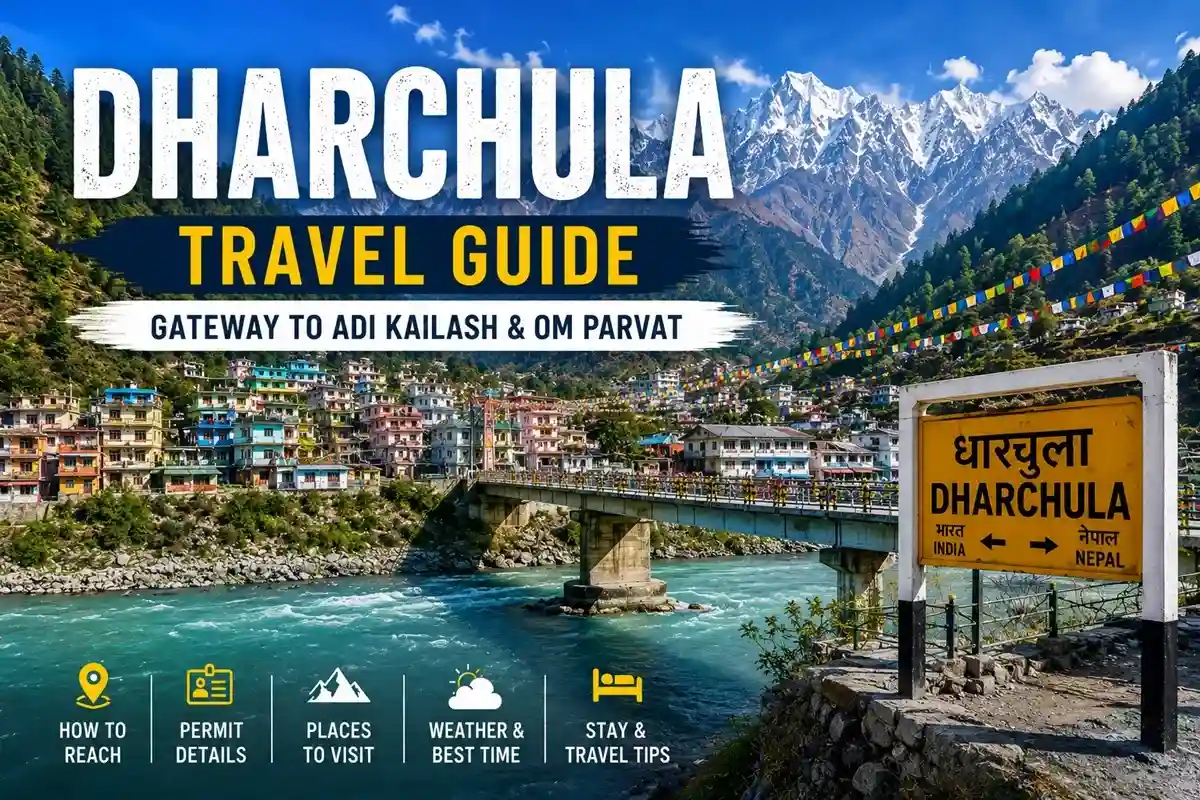
A river town split by the Kali — Nepal sits across a footbridge you can walk in minutes. For the Adi Kailash Yatra, Dharchula is command central: the SDM office issues the Inner Line Permit here, medical checks happen here, and it has the route’s last reliable ATMs, fuel and mobile network.
Plan it right: Permit processing takes time, so use it — walk the two-nation bazaar, watch the Kali from the bridge, and download offline maps before you lose signal for days.
7. Chialekh Viewpoint
After the steep climb from the Kali gorge, the road suddenly levels onto a flower-filled meadow — Chialekh, the gateway of the Vyas Valley and the first major ITBP check. According to local tradition, this meadow is where sage Vyas’s country truly begins.
Plan it right: The valley reveal here is the moment most yatris start filming. Keep permits handy for the check, expect 15–20 minutes, and don’t photograph the post itself.
8. Garbyang
A 19th-century village of grand wooden houses from the old Indo-Tibet trade days — now famous as the “sinking village,” its buildings tilting as the slope slowly subsides. Carved doorways, empty courtyards, and a reminder of how rich this trade route once was.
Plan it right: A haunting 20-minute stop — enough for the old lanes and a few frames. Tread respectfully; a handful of families still live among the leaning houses.
The Vyas Valley Core (ILP Zone)
9. Gunji
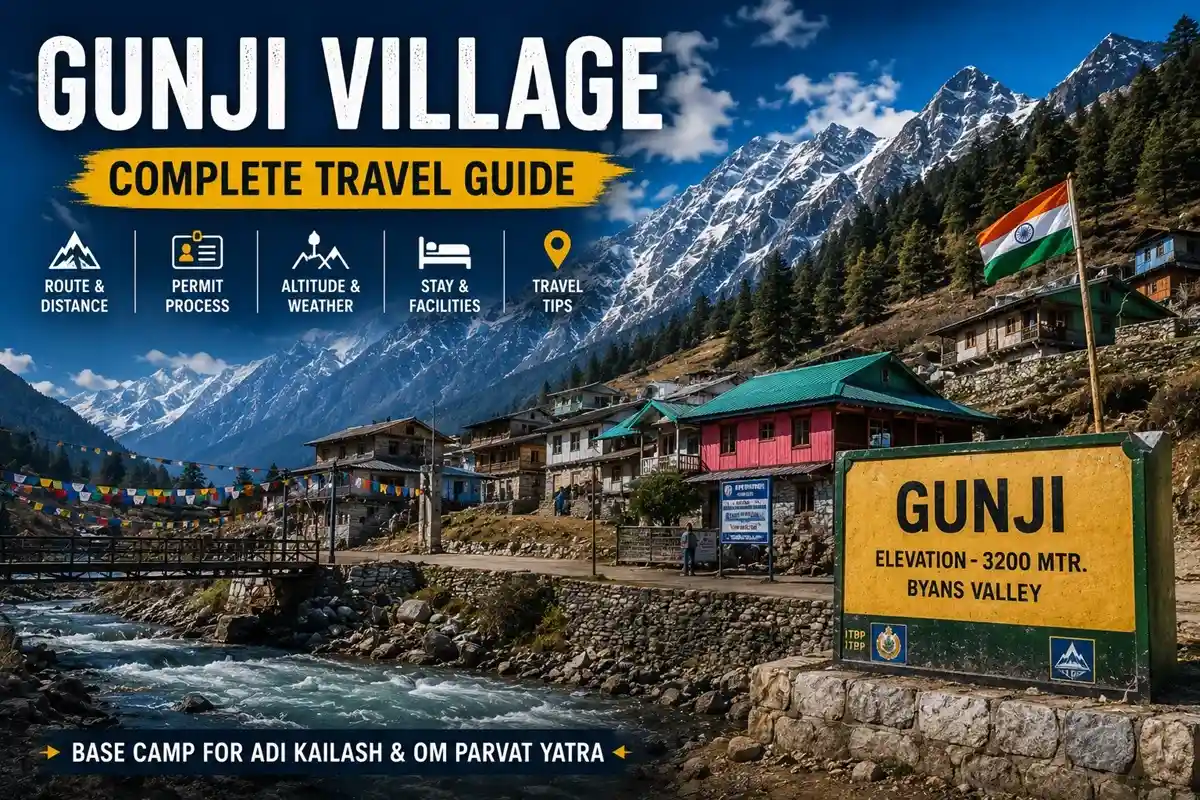
The operational heart of the Adi Kailash Yatra. Sitting near the confluence of the Kuthi Yankti and Kali rivers at about 3,200 m, Gunji is where every itinerary parks itself for two nights of acclimatisation — homestays, a KMVN guesthouse, an ITBP presence, and morning views that make the wait easy.
Plan it right: Use the rest day for a gentle walk to Nabi village (quieter homestays, Vyas Gufa connection) rather than lying flat — light movement acclimatises better than bed rest.
10. Kuti Village
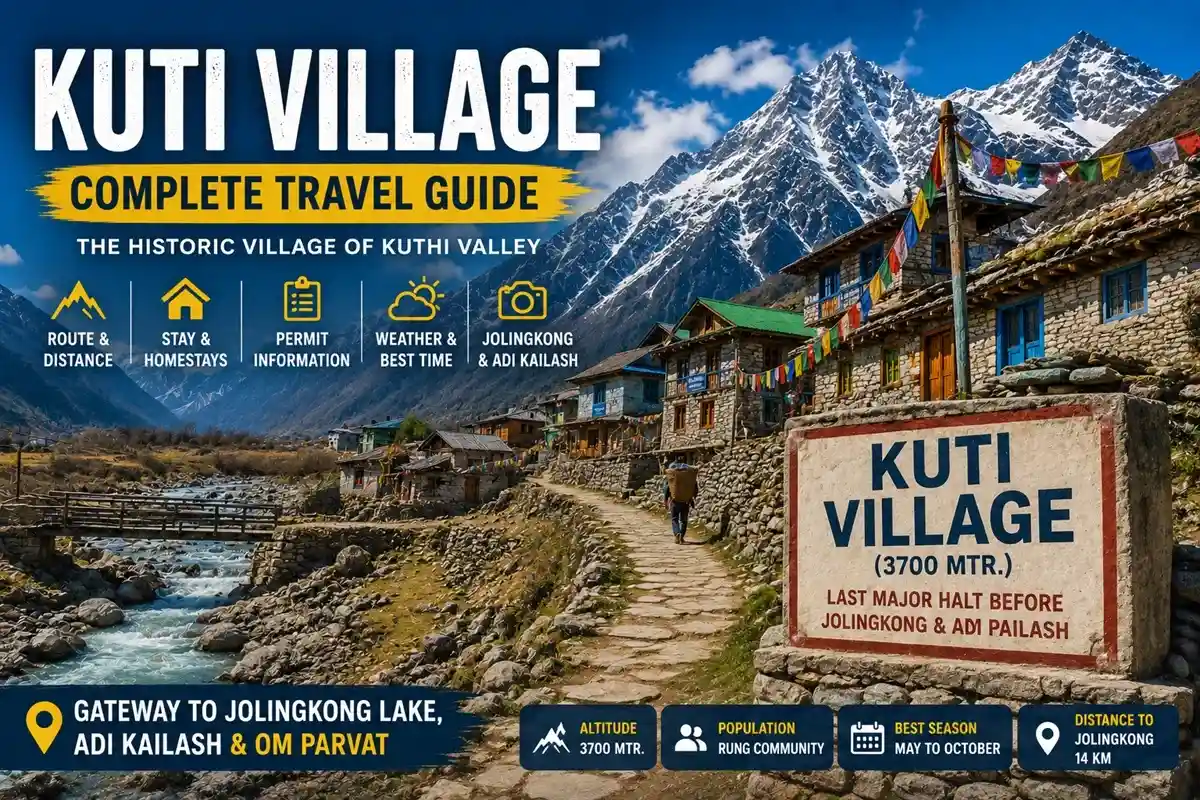
The last village of the route, and local tradition’s favourite: the name is linked to Kunti, mother of the Pandavas, and villagers point out Kunti fort ruins and Bheem ki Kheti — the field where Bheem is said to have grown wheat.
Plan it right: The stone-and-wood Bhotiya architecture here is the best-preserved on the circuit — worth 30 minutes on foot. A few homestays make Kuti the closest sleep point to Jolingkong for early starters.
11. Jolingkong — The Adi Kailash Darshan
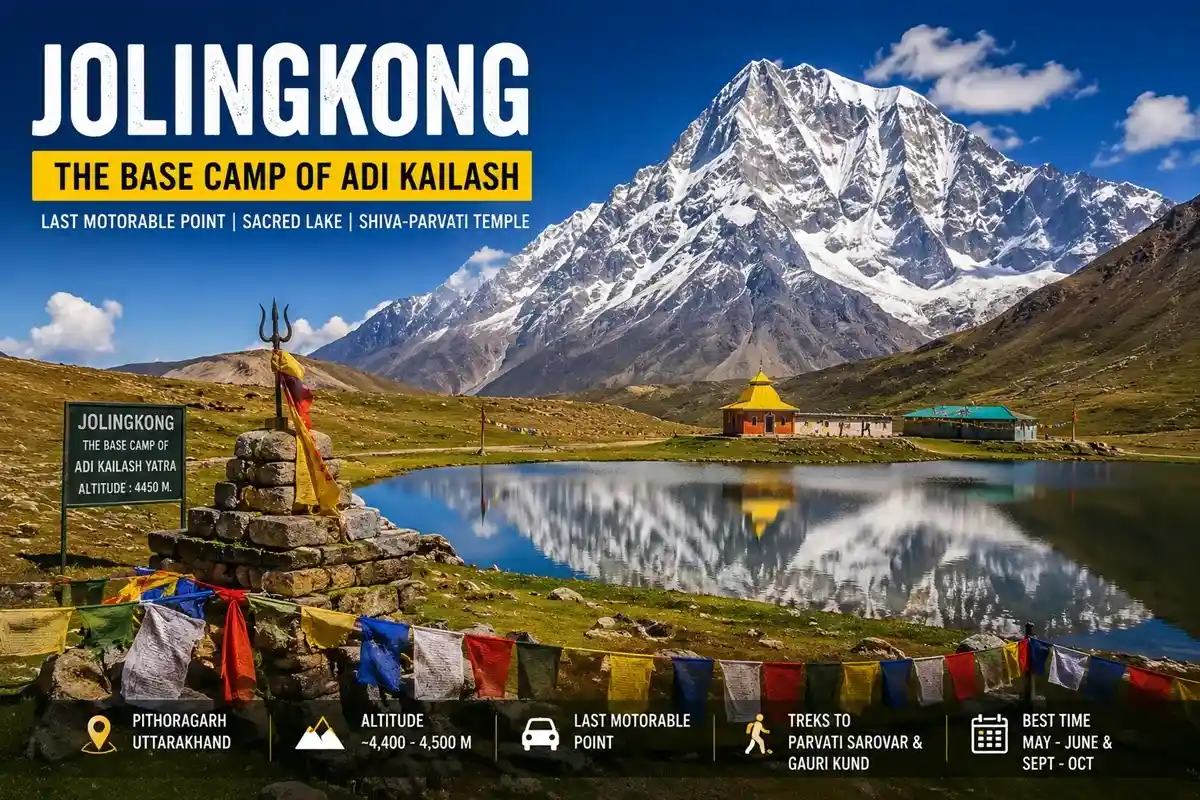
The last motorable point for pilgrims, at approximately 4,380–4,570 m (figures vary by source). The vehicle takes a final bend and Adi Kailash — commonly listed at 5,945 m, one of the Panch Kailash peaks — fills the windscreen.
Plan it right: Reach by 8 AM; afternoon clouds swallow the summit almost daily. Tourist vehicles stop here, so budget half a day including the lake walk. (Our full Jolingkong guide covers vehicles, stay and treks.)
12. Parvati Sarovar
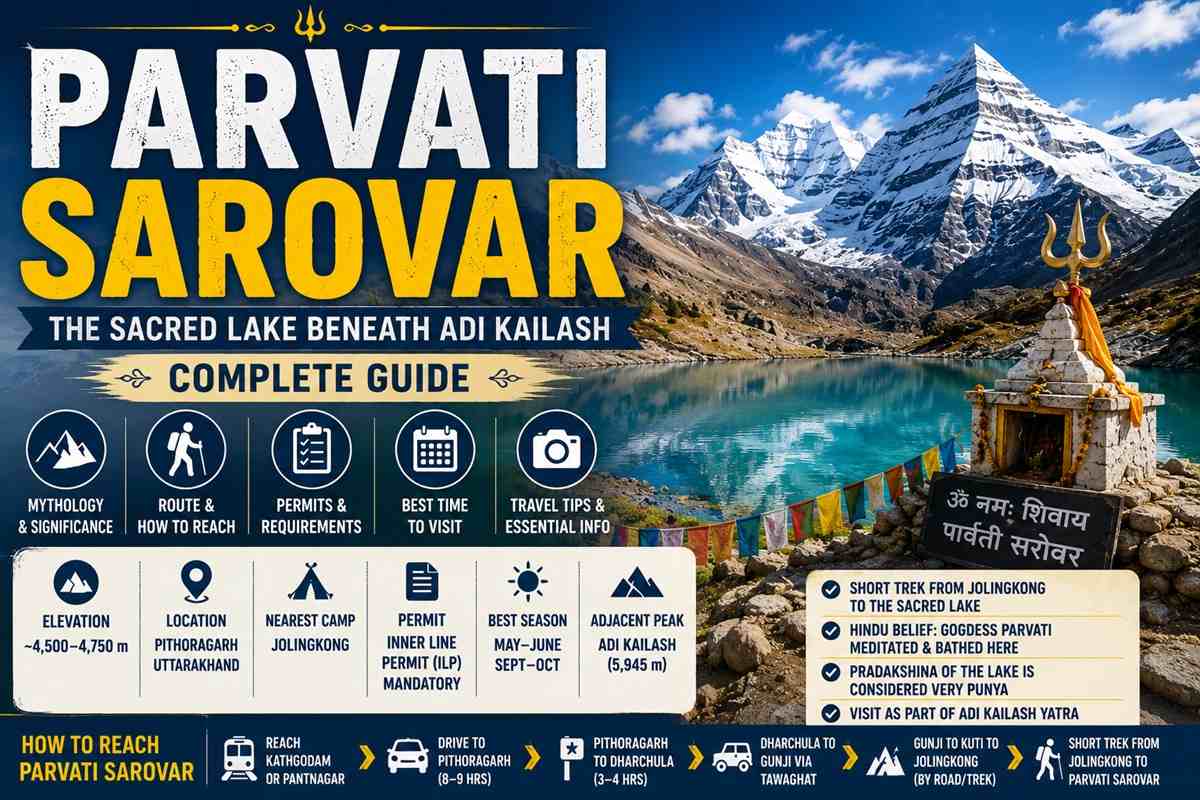
A short walk from the road-end (roughly 1–3 km depending on the drop point) brings you to the glacial lake beside the Shiva-Parvati temple. On still mornings the peak reflects in the water — the photograph every yatra album leads with.
Plan it right: The water stays 2–6°C even in summer; the reflection needs still air, so this is another argument for the early start. The lakeside darshan is complete in itself if AMS says stop here.
13. Gauri Kund
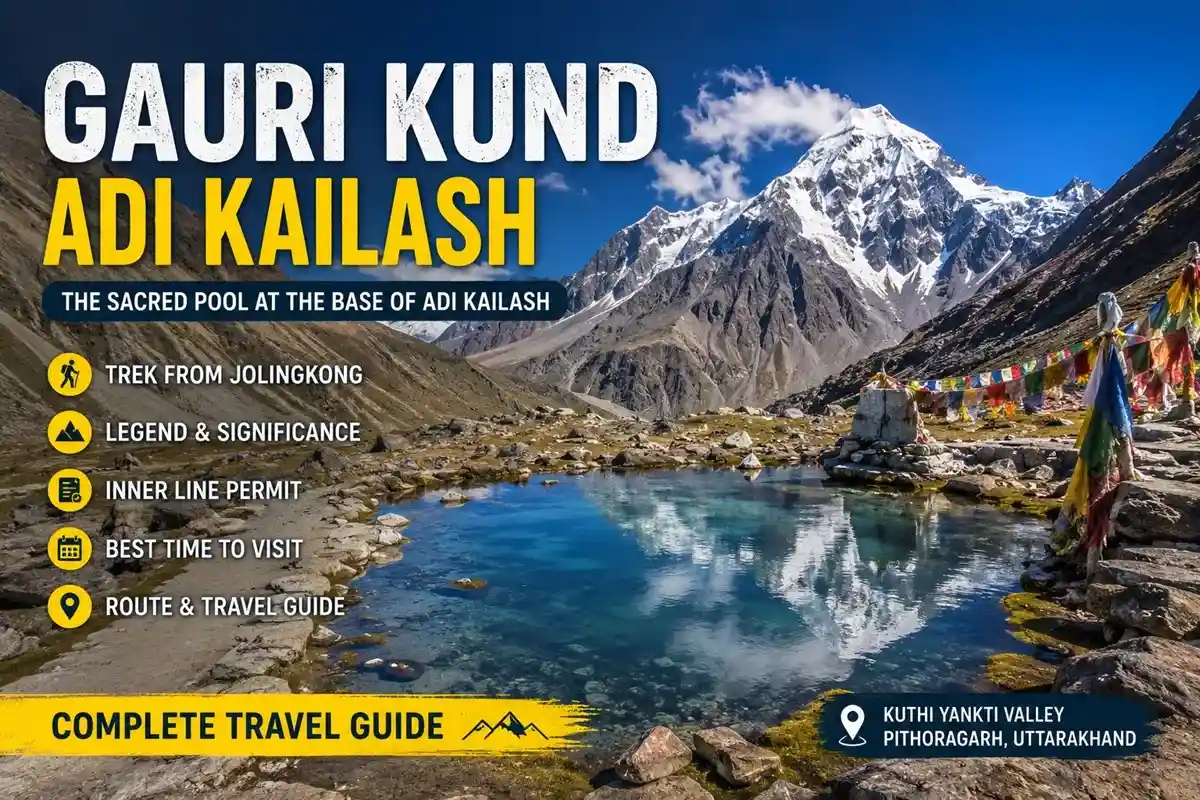
Above the Sarovar, approximately 3–4 km from Jolingkong, lies the pool where devotees believe Goddess Parvati performed penance to win Lord Shiva. This is the highest and most intense darshan of the circuit.
Plan it right: Visitors are generally advised not to enter the sacred waters; mules are available (roughly ₹2,000–4,000, indicative). Budget 3–4 hours round trip and turn back if breathlessness sets in. (See our dedicated Gauri Kund guide.)
14. Kalapani
On the Om Parvat side of the route stands the Kali temple at Kalapani — traditionally honoured as the origin point of the Kali river, with an ITBP post beside it. The temple’s setting, pressed between cliffs and the young river, is quietly powerful.
Plan it right: Yatris stop for a quick darshan and permit check en route to Nabhidhang — 20 minutes covers it. Photography rules near the post are strict; ask before shooting.
15. Nabhidhang — The Om Parvat Darshan
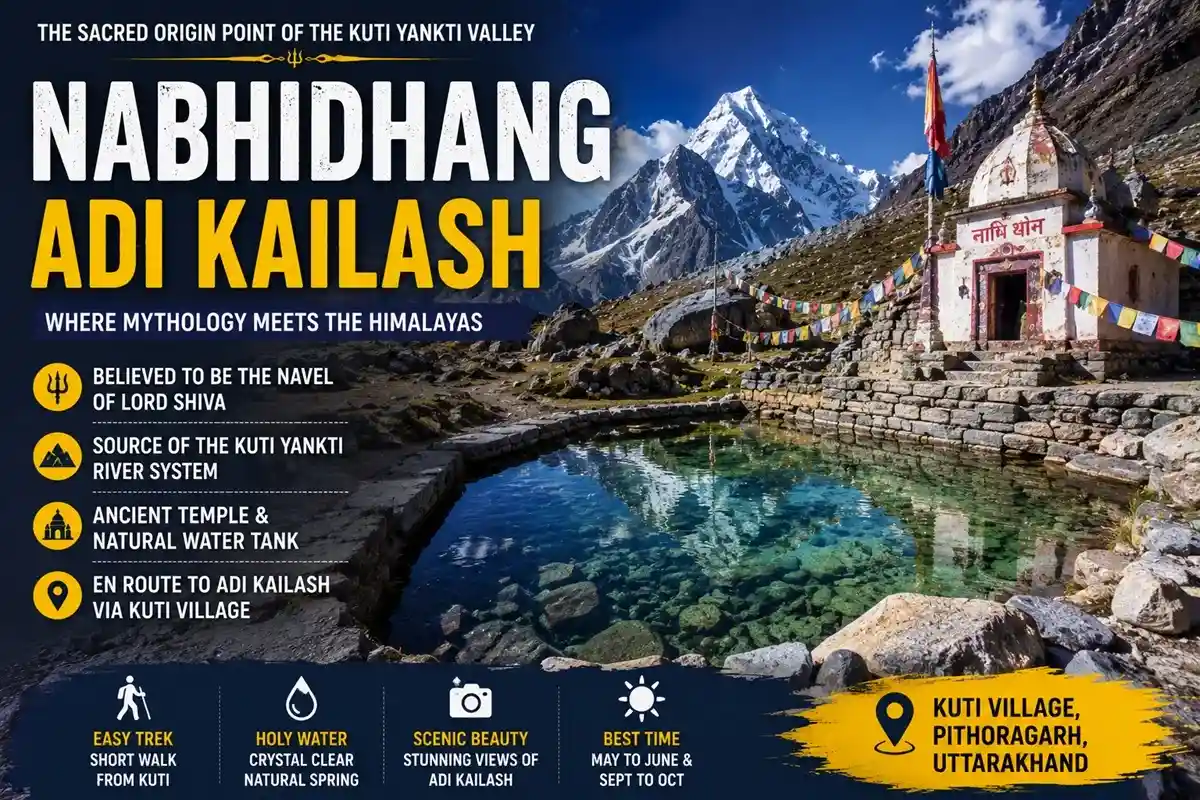
The grand finale of the Adi Kailash Yatra: from this camp at about 4,300 m near Lipulekh, snow settles on Om Parvat in a naturally formed ॐ — the district administration lists the peak at around 5,900 m, though figures vary by source.
Plan it right: Clear mornings make the symbol unmistakable; by late morning it’s often gone behind cloud. Leave Gunji by 5:30–6:00 AM and do this darshan on a separate day from Jolingkong. (Our Nabhidhang guide covers timing, road and permits in detail.)
Best Time for Adi Kailash Yatra
- May–June: Thickest snow on both sacred peaks — the ॐ at its boldest, the meadows still edged with white. Peak rush; Gunji’s limited rooms decide everyone’s dates, so book weeks ahead.
- September–October: Post-monsoon clarity, calm lakes for reflections, thinner crowds and colder nights. Most repeat travellers pick this window.
- July–August: Avoid — the district administration suspends permits during monsoon landslide risk, as happened again this season, and cloud cover hides both peaks anyway.
- November–April: The Vyas Valley closes; only the Kumaon-stretch places (1–5) remain visitable, and they’re lovely in winter.
Permit & Practical Notes
- Places 1–5 need no paperwork; everything beyond Dharchula requires an Inner Line Permit from the SDM office (ID, photos, medical certificate; fee nominal and subject to revision; 1–3 working days). Pre-registration runs online via KMVN/Uttarakhand tourist portals, but the physical permit is collected at Dharchula.
- 4×4 vehicles only beyond Gunji — small cars stop there; most travellers use registered local Boleros.
- Last fuel, ATMs and reliable network: Dharchula. Carry cash and offline maps beyond it.
- Acclimatise at Gunji before Jolingkong or Nabhidhang; AMS is the route’s biggest trip-spoiler.
- Senior citizens should prefer September, use mules for the Gauri Kund stretch, and treat Parvati Sarovar as a complete darshan.
What to Pack for the Adi Kailash Yatra
Windproof jacket and heavy woollens (nights near 0°C even in June), UV sunglasses and SPF 50 (high-altitude glare is brutal), sturdy broken-in shoes, personal medicines plus doctor-advised altitude medication, power bank and torch, cash from Dharchula onwards, 3 physical permit copies with digital backups, and a cloth bag for temple offerings. Leave drones at home — they’re prohibited in this border zone.
Common Mistakes on the Route
- Clubbing both darshans in one day. Jolingkong and Nabhidhang sit in different valleys; forcing both means seeing neither clearly.
- Skipping the Gunji rest day. More trips fail to AMS than to weather or roads.
- Late starts. Both peaks cloud over by late morning almost daily; 5:30 AM departures are the local standard for a reason.
- One permit copy. ITBP posts check repeatedly; a lost single copy has no on-site replacement.
- Treating the Kumaon stretch as filler. Kainchi, Jageshwar and Patal Bhuvaneshwar are destinations in their own right — rushing them wastes half the yatra’s value.
Suggested 7-Day Plan Covering All
- Day 1: Kathgodam → Kainchi Dham → Jageshwar → Chaukori (overnight)
- Day 2: Patal Bhuvaneshwar → Pithoragarh → Dharchula (permit formalities)
- Day 3: Dharchula → Chialekh → Garbyang → Gunji (acclimatisation)
- Day 4: Gunji → Kuti → Jolingkong → Parvati Sarovar → Gauri Kund → back to Gunji
- Day 5: Gunji → Kalapani → Nabhidhang (Om Parvat) → Gunji/Bundi
- Day 6: Return to Dharchula → Pithoragarh
- Day 7: Drive back to Kathgodam
Booking early is recommended during the May–June rush — Gunji’s limited rooms decide everyone’s dates.
Budget Snapshot (Indicative)
6–8 day packages from Kathgodam run ₹25,000–50,000 per person including transport, permits, stay and meals; KMVN’s official packages sit at the upper end. Independent travellers can trim costs with homestays (₹800–1,500 with meals) and shared 4x4s beyond Dharchula (₹3,000–5,000 per vehicle daily). All figures vary by operator and season.
Conclusion
The Adi Kailash Yatra rewards travellers who treat the road as the destination. The best plan is the 7-day Kathgodam circuit above — temples and caves on the way up, two nights at Gunji, and the twin darshans on separate clear mornings. It suits pilgrims, photographers and families with reasonable fitness; seniors manage well with mules, morning starts and the September window. Pick your five must-sees if time is short — but if you can, give this Chota Kailash pilgrimage its full week. The mountain deserves nothing less.
FAQs
Q-1: How many days are needed to cover all 15 places?
A 6–8 day circuit from Kathgodam covers everything comfortably, with two acclimatisation nights at Gunji.
Q-2: Which places need no permit?
Kainchi Dham, Jageshwar, Chaukori, Patal Bhuvaneshwar and Pithoragarh — the Inner Line Permit applies only beyond Dharchula.
Q-3: What is the best time for Adi Kailash Yatra?
May–June and September–October; the route closes in winter and permits pause during monsoon advisories.
Q-4: Can Adi Kailash and Om Parvat be done in one day?
No — Jolingkong and Nabhidhang lie in different valleys and are done on separate mornings from Gunji.
Q-5: What is the most important stop for acclimatisation?
Gunji (about 3,200 m) — every standard Adi Kailash Yatra itinerary spends two nights here before the high points.
Q-6: Can senior citizens do this circuit?
Yes — no trekking is compulsory; mules cover the Gauri Kund stretch, and Parvati Sarovar is a short walk.
Q-7: Where is the last fuel, ATM and network?
Dharchula — carry cash and offline maps for everything beyond it.
Q-8: Is Patal Bhuvaneshwar part of the main route?
It’s a short Kumaon-stretch detour via Gangolihat that most itineraries include on Day 2 — no permit needed.
Q-9: Can my own car do the full route?
Only up to Gunji at best; the Jolingkong and Nabhidhang stretches are 4×4-only, so most switch to local Boleros.
Q-10: Is there a helicopter option?
Yes — heli-assisted packages from Pithoragarh cover the Vyas Valley darshans with identical permit rules.


 Call
Call WhatsApp
 Enquiry