
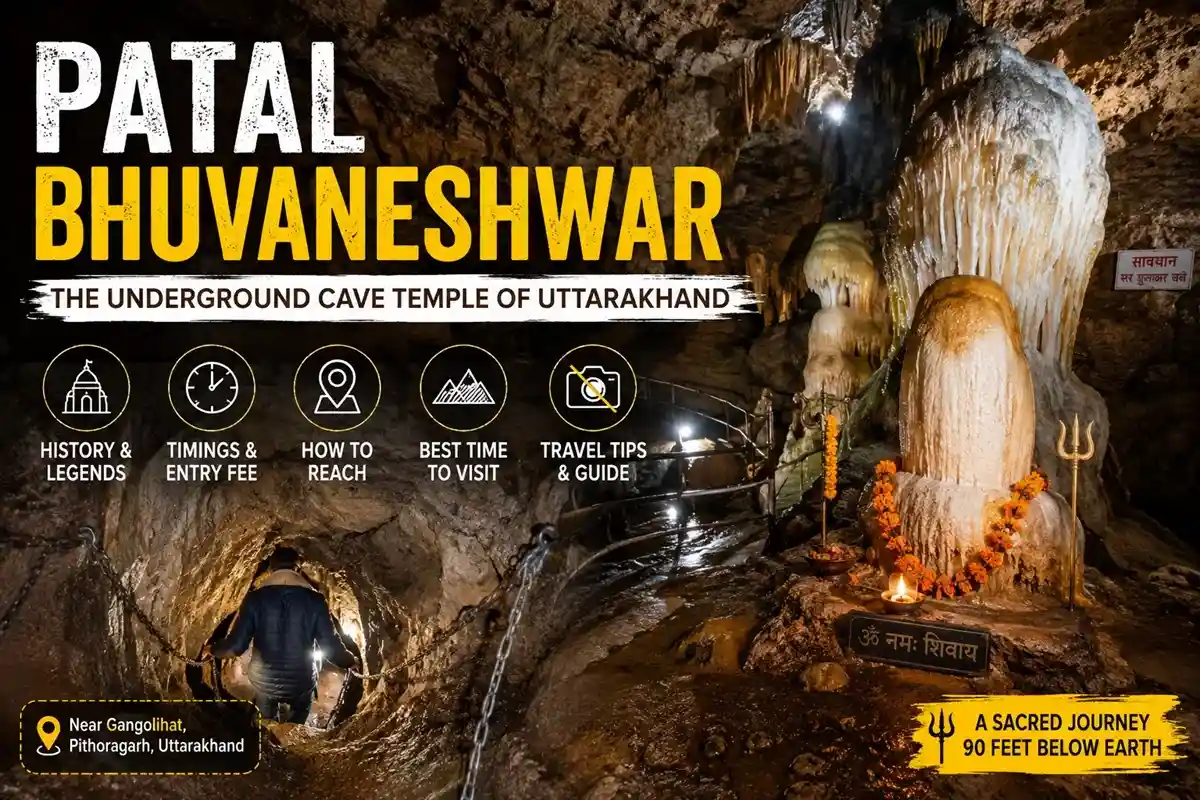
Some temples you walk into. Patal Bhuvaneshwar, you climb down into — roughly 90 ft below the earth, gripping iron chains, through an opening so narrow you wonder how anyone fits.
Then the cave opens up, the lamps glow, and you’re standing in what the Skanda Purana describes as the hidden abode of Lord Shiva. This limestone cave temple sits at about 1,350 m near Gangolihat in Pithoragarh district, Uttarakhand, roughly 14 km from Gangolihat town. The cave runs approximately 160 metres long according to temple and travel references, and tradition holds that 33 koti (crore) deities reside within it.
Many first-time visitors describe a similar feeling on the way out: they came for a temple and found another world. Here’s what you need to plan the visit — routes, entry process, and a few honest cautions.
Quick Facts:
- Difficulty: Easy walk to the temple; the cave descent itself is physically demanding, not the approach
- Family/child friendly: Generally yes — locals bring toddlers, though hesitant adults sometimes struggle more than kids
- Senior citizen friendly: Conditional — depends on knees and heart health; the surface temple is a fallback
- Wheelchair access: Not possible inside the cave; the temple complex itself is road-accessible
- Parking: Available near the temple complex in Bhubneshwar village
- Mobile network & ATM: Patchy network near the village; nearest reliable ATMs are in Gangolihat or Pithoragarh
- Food: Basic eateries near the temple and in Gangolihat; carry snacks for the road
- Worth visiting: Frequently rated among Kumaon’s most memorable stops by pilgrims and travel writers alike
What Is Patal Bhuvaneshwar? (History & Legend)
“Patal” means the netherworld; “Bhuvaneshwar” means Lord of the Universe. This underground shrine is treated in scripture as a doorway between worlds. The Manas Khand of the Skanda Purana praises the sacred Bhuvneshwar near the confluence of the Ramganga, Sarayu and Gupt-Ganga.
The Discovery Story
According to local tradition, King Rituparna of the Surya dynasty (Treta Yuga) was the first human to enter the cave. Legend says Sheshnag received him at the entrance and led him inside, where he beheld Lord Shiva and the assembled deities.
Local belief holds that the Pandavas meditated here before their final Himalayan journey. Temple tradition credits Adi Shankaracharya with reviving worship at the cave, though the exact historical period cited varies across sources, ranging from the 8th to the 12th century CE. Since then, priests of the Bhandari family have served as hereditary custodians.
The Doomsday Belief
Inside stands a rock formation revered as a slowly rising Shivling. According to temple tradition, the day it touches the cave ceiling, the world will end. Guides point out how little gap remains.
What You See Inside the Cave
The cave is a natural gallery of stalactite and stalagmite formations, each read by devotees as a chapter of Hindu cosmology. A mandatory guide interprets them as you move through the chambers:
- Sheshnag: A long ridged formation at the entry passage, seen as the serpent holding the three worlds.
- Adi Ganesh: A rock likened to Ganesha’s severed head, with a formation above it described as a 108-petal Brahma Kamal.
- Kal Bhairav’s tongue: A tunnel formation; crawling its length is believed to symbolise passing through Bhairav’s mouth toward liberation.
- Airavat: A white formation resembling Indra’s thousand-tusked elephant.
- The Dham formations: Rock clusters devotees identify with the great dhams — Kedarnath, Badrinath and Amarnath among them — which is why locals say a darshan here carries the punya of a Char Dham visit.
- The Four Yuga Doors: Randwar, Paapdwar, Dharmdwar and Mokshadwar. Temple tradition says Paapdwar closed after Ravana’s death and Randwar after the Mahabharata war; only Dharma and Moksha remain open.
- Shiva’s matted locks and Saptarishi: Ceiling formations read as Shiva’s jata and the seven sages.
Photography inside the cave is restricted — treat it as a rule. The formations are living rock; touching them is discouraged.
The Geology Behind the Faith
The cave is a natural limestone system. Rainwater seeping through the hillside dissolves calcium carbonate and redeposits it drop by drop over thousands of years, forming stalactites and stalagmites. That’s why guides insist nobody touches the formations: skin oils halt the mineral deposition, effectively killing a formation that took millennia to grow. Faith reads the shapes; geology explains why they’re still growing.
Best Time to Visit Patal Bhuvaneshwar
The cave temple stays open year-round — there’s no seasonal closure like the high Himalayan yatras. Two windows work best:
- March–June: Pleasant Kumaon weather, long daylight. Peak domestic season, so expect batch queues on weekends.
- September–November: Post-monsoon clarity, fewer crowds, and clear views of the Panchachuli peaks from the Gangolihat–Berinag belt.
July–August (monsoon): The cave stays open, but hill roads around Gangolihat can see landslips. Start early and keep buffer time if you travel then.
December–February: Cold but atmospheric, with occasional light snow. Cave timings are shorter in winter.
Reaching close to opening time generally means smaller batches and cooler cave air, avoiding the midday tour-group rush.
Timings, Entry Fee & Registration Process
- Timings: Widely reported as approximately 8 AM–5:30 PM in summer and 9 AM–4:30 PM in winter, though sources vary and gates may open earlier for the first batch. No single official schedule is published online, so confirm locally the evening before your visit.
- Aarti: Morning and evening aartis are held at the temple, commonly cited around 6 AM and 7 PM, aligned with cave access hours.
- Festivals: Mahashivratri and Sawan Mondays draw the year’s biggest crowds — reach at opening time or expect long batch queues.
- Batch entry: Visitors typically descend in guided groups of about 20–30, though batch size can vary with season and crowd levels. During peak season, waits of 30–60 minutes are common at midday.
- Entry fee: A nominal fee is charged and is subject to change; figures commonly reported online (~₹30–50) are not officially confirmed, so carry small cash and expect the actual amount to be collected at the counter.
- Guide: You cannot enter alone — a guide’s narration is part of the experience, and guides are typically from the custodian community.
- No permits needed: Unlike Adi Kailash or Om Parvat, Patal Bhuvaneshwar needs no Inner Line Permit. Just arrive, pay the entry fee, and join a batch.
Step-by-Step Entry Process
- Reach the temple complex and buy the entry ticket at the counter.
- Deposit shoes, bags, cameras and phones as directed (lockers/counters available).
- Wait for your batch; a guide briefs the group at the cave mouth.
- Descend the narrow passage — commonly cited as around 90 ft, via iron chains and carved footholds.
- Complete the guided circuit of the chambers (roughly 45–60 minutes) and climb back out the same passage.
How to Reach Patal Bhuvaneshwar
The cave sits in Bhubneshwar village, connected by motorable road right up to the temple area — no trek is needed to reach the complex.
- By train: Kathgodam and Tanakpur are the nearest major railheads, both well connected to Delhi and Lucknow.
- By air: Pantnagar is the nearest functional airport; Naini Saini (Pithoragarh) has limited flights.
- By road: Two standard approaches — via Almora–Berinag–Gangolihat from the Kathgodam side, or via Tanakpur–Pithoragarh–Gangolihat from the east. UTC buses run from Delhi/Haldwani toward Pithoragarh and Gangolihat; shared jeeps cover the last stretch.
- Local tip: Direct buses to the village itself are rare — most travellers get down at Gangolihat and take a shared cab for the final kilometres.
Distance Chart (Approximate — figures vary by route)
| From | Distance | Time |
| Gangolihat | ~14 km | 30–40 min |
| Berinag | ~20 km | ~1 hr |
| Chaukori | ~35 km | 1.5 hrs |
| Pithoragarh | ~90–91 km | 3 hrs |
| Almora | ~110–120 km | 4 hrs |
| Kathgodam | ~200–230 km by road (figures vary widely by route; some quote 190 km, others 270 km) | 6–8 hrs |
| Tanakpur | ~170–200 km (route dependent) | 6–7 hrs |
Road conditions near Gangolihat are generally good, but the final approach has narrow hill bends, so daylight travel is safer.
Suggested 2–3 Day Itinerary from Kathgodam
- Day 1: Kathgodam → Almora (Kainchi Dham en route) → Chaukori. Overnight with Panchachuli views.
- Day 2: Early drive to the cave (first batch), darshan and guided circuit, then Haat Kalika at Gangolihat. Return to Chaukori or move to Pithoragarh.
- Day 3: Return via Berinag–Almora, or continue toward Dharchula if joining an Adi Kailash itinerary.
Many travellers with their own vehicle base themselves at Chaukori for this plan; those on buses often base at Gangolihat instead.
Weather Information
At 1,350 m, the climate is classic mid-Himalayan: summers pleasant (15–28°C), winters cold (0–15°C, occasional light snow), monsoon wet and fog-prone. Inside, the cave holds its own microclimate — cool and damp year-round, with wet, slippery rock underfoot regardless of season. Dress in layers.
The Cave Experience: What to Know Beforehand
- The entry passage is genuinely narrow. You descend at angles, sometimes almost crawling, holding chains. People of many builds pass through it daily, but anyone with real claustrophobia should think honestly before committing.
- The floor is wet rock throughout. Go barefoot or in socks as directed, and take every step deliberately.
- The guided round itself takes under an hour, but the descent and climb demand knee and grip strength.
- The air is breathable but close. If you feel uneasy, tell the guide — batches move at the pace of the slowest member.
- This is general travel guidance, not medical advice; visitors with heart, lung or joint conditions should consult a doctor before attempting the descent.
Where to Stay
- Near the cave: KMVN Tourist Rest House at Patal Bhuvaneshwar plus a handful of guesthouses and homestays in Bhubneshwar village — simple, clean, limited in number.
- Gangolihat (14 km): Small hotels and lodges; also home to the famous Haat Kalika temple.
- Chaukori (~35 km): The area’s best resorts and Himalayan-view stays.
- Berinag / Pithoragarh: More options for onward travellers.
Availability is limited near the cave itself, so book early during the April–June rush and around Mahashivratri.
Budget Breakdown (Indicative)
- Entry + guide: typically under ₹100 per person, subject to revision
- Shared cab from Gangolihat: ~₹20–50 per seat
- Taxi day-trip from Chaukori/Berinag: ~₹1,500–2,500
- KMVN/homestay stay: ~₹800–2,000 per night
- Kathgodam-based 2–3 day circuit (taxi + stay + meals): roughly ₹6,000–12,000 per person
Prices vary by season and operator — treat these as indicative only.
Packing List
Comfortable grip footwear (easy to remove), warm layer for the cave chill, socks you don’t mind getting wet, small cash for entry and offerings, torch for the road (the cave itself is lit), personal medicines, and a cloth bag for temple offerings. Leave cameras and bulky bags in the vehicle.
Senior Citizen Tips
- The descent is the deciding factor: seniors with knee issues, severe arthritis or heart conditions should assess honestly — chains and crouching are unavoidable.
- Many fit seniors complete it comfortably by moving slowly and letting the batch go ahead.
- Weekday mornings work best, when batches are small and guides can give extra time at tight points.
- Those who skip the cave can still have a fulfilling darshan at the surface temple and nearby Haat Kalika.
Local Warnings & Safety Tips
- Don’t attempt entry without the official guide — it’s both the rule and basic sense in a dark, wet cave.
- Slippery rock is a common cause of minor injuries; keep three points of contact on the chains.
- Avoid heavy meals right before the descent.
- Respect photography restrictions and don’t touch formations — oils from hands damage living limestone.
- In monsoon, check road status for the Almora–Gangolihat and Pithoragarh–Gangolihat stretches before starting.
- Mobile network around the village is patchy; download offline maps in advance.
What Else to See Nearby
- Haat Kalika Temple, Gangolihat: The revered Shakti peeth linked to the Kumaon Regiment’s presiding goddess.
- Chaukori: Tea-garden ridge with front-row Panchachuli views.
- Berinag: Quiet market town en route with its own Nag temple tradition.
- Adi Kailash circuit link: Many Adi Kailash Yatra itineraries from Kathgodam include this cave temple along with Jageshwar Dham and Kainchi Dham.
Latest Updates (2026)
- The cave temple continues year-round darshan with batch-wise guided entry; expect longer waits around Mahashivratri and summer weekends.
- No official government fee schedule is published for 2026 — entry charges and timings remain locally administered and subject to change, so verify at the counter or with your hotel a day ahead.
- Road connectivity via Gangolihat is stable in fair weather; the usual monsoon advisories apply for Kumaon hill routes during July–August.
Conclusion
Patal Bhuvaneshwar isn’t a stop you tick off — it’s often the most memorable hour of a Kumaon itinerary. A good option is a 2–3 day circuit from Kathgodam via Almora, staying at Chaukori or the KMVN rest house, and entering the underground shrine with the first morning batch. It suits pilgrims, families, history lovers and curious travellers; only serious claustrophobia or knee trouble should give pause, and even then the surface temple rewards the journey. Book your stay early for the summer rush, keep cash handy for the counter, trust the guide, hold the chain — and let this subterranean temple tell you its story.
FAQs
Q-1: What is Patal Bhuvaneshwar famous for?
A limestone cave temple of Lord Shiva near Gangolihat, believed to house 33 koti deities in its natural rock formations.
Q-2: What is the Patal Bhuvaneshwar cave temple history?
Local tradition credits King Rituparna with discovering it in the Treta Yuga; Adi Shankaracharya later revived worship (dates cited vary, 8th–12th century CE).
Q-3: How deep and long is the cave?
Approximately 160 metres long and around 90 feet deep according to travel and temple references; the guided circuit takes 45–60 minutes.
Q-4: What are Patal Bhuvaneshwar timings and entry fee?
Roughly 8 AM–5:30 PM in summer and shorter in winter (sources vary); entry is nominal and subject to change — confirm locally.
Q-5: How to reach Patal Bhuvaneshwar?
Train to Kathgodam or Tanakpur (or fly to Pantnagar), then drive via Almora–Berinag–Gangolihat; the road is motorable up to the temple.
Q-6: What is the best time to visit Patal Bhuvaneshwar?
March–June and September–November, ideally with the first morning batch; the cave stays open year-round.
Q-7: Is the cave safe for claustrophobic people?
The chained entry descent is genuinely narrow; people of many builds pass daily, but serious claustrophobia warrants honest self-assessment.
Q-8: Can senior citizens visit?
Yes, if knees and heart permit — go slow on weekday mornings, or take darshan at the surface temple and Haat Kalika instead.
Q-9: What is the distance from Kathgodam to Patal Bhuvaneshwar?
Roughly 200–230 km by road, though quoted figures vary by route (6–8 hours); most travellers break the journey at Almora or Chaukori.
Q-10: Is mobile network or an ATM available near the cave?
Network is patchy near the village; the nearest reliable ATMs are in Gangolihat or Pithoragarh.
Q-11: Is food available near the temple?
Basic eateries operate near the complex and in Gangolihat — carry snacks for the road regardless.
Q-12: Do I need a permit, and is photography allowed?
No permit is needed, unlike Adi Kailash — just buy a ticket and join a batch. Photography inside is restricted; devices are deposited before entry.


 Call
Call WhatsApp
 Enquiry