
Mobile network availability in the Adi Kailash Yatra route is one of the most practical things to plan around before you leave, since this pilgrimage runs through a restricted Himalayan border zone where signal drops off sharply past a certain point. Telecom coverage in border regions shifts as infrastructure changes, so treat what follows as the generally reported pattern rather than a fixed guarantee, and always confirm current status with your operator closer to your travel date.
Quick Facts Box
| Location | Typical Network Status |
|---|---|
| Kathgodam, Pithoragarh | Reliable — Airtel, Jio, BSNL generally work normally |
| Dharchula | Most consistent multi-network point; also the practical last stop for ATMs and pharmacies |
| Gunji, Nabi | BSNL only, patchy and pocket-based; other carriers historically very limited |
| Jolingkong, Nabhidhang, Kalapani | Generally no signal reported |
| Kuti village | Some travel accounts report limited Jio 4G since 2023, not confirmed further ahead |
| Emergency backup | Some (not all) tour operators carry satellite communication devices |
Telecom coverage changes with weather, maintenance, and new infrastructure — this table reflects commonly reported conditions, not a permanent guarantee.
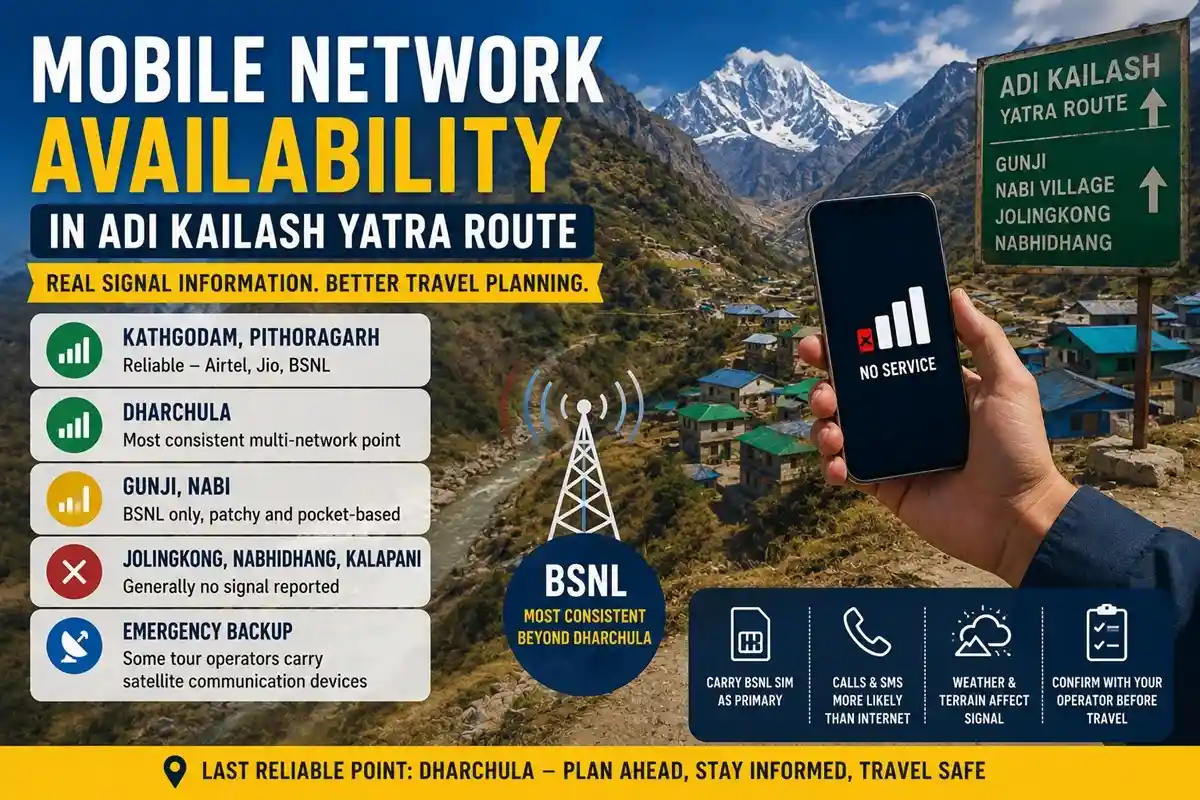
Where Network Works and Where It Doesn’t
The Adi Kailash Yatra route runs Kathgodam → Pithoragarh → Dharchula → Gunji → Nabi → Jolingkong, with a branch to Nabhidhang for Om Parvat darshan. Multiple independent tour operators and travel guides consistently describe the same broad pattern: reasonably normal coverage lasts until Dharchula, which also functions as the practical last stop for ATMs and pharmacies — so it’s your last reliable point for staying connected in every sense, not just phone signal.
Beyond Dharchula, the picture changes. Villages like Gunji and Nabi, both around 3,200 metres, are generally reported to get BSNL coverage only, and even that is described as patchy or pocket-based rather than constant. Coverage from Airtel, Jio, and Vi has historically been extremely limited or unavailable on this stretch. Push further to Jolingkong (around 4,500 metres) or Nabhidhang, and most travel guides report no signal at all — though, as with any border-area telecom claim, this can shift as infrastructure projects roll out.



Calls, SMS, WhatsApp and Internet Aren’t the Same Thing
It’s worth separating these, since “no network” doesn’t always mean the same thing for every function. Where BSNL’s patchy signal does connect near Gunji or Nabi, basic voice calls and SMS are more likely to work than data-heavy apps. WhatsApp messages, photo uploads, and video calls generally need a stronger, more stable data connection than a weak BSNL pocket typically provides, so don’t count on sending photos home in real time even where you do get a bar or two of signal. Treat any connection beyond Dharchula as good for a short text or call at best, not for browsing or uploads.
The Kuti Village Exception
Some travel accounts report a Jio 4G rollout reaching Kuti village, further along the route toward Jolingkong, around 2023. This hasn’t been independently confirmed through official telecom announcements, and it doesn’t appear to reliably extend to the final trekking stretch near Jolingkong. Treat any such pocket of coverage as a possible bonus rather than something to plan your communication around.
Which SIM Should You Carry?
Based on consistently reported patterns, a BSNL SIM is the most sensible one to carry for this route, since it’s the network most often mentioned as working at all beyond Dharchula. That said, carrying a second SIM from another carrier as backup for the Kathgodam-to-Dharchula stretch is reasonable, since coverage there is generally better across providers. Recharge and confirm your BSNL plan is active before leaving Dharchula, since you won’t find a recharge point beyond it.
Why Network Coverage Is Limited Here
This isn’t simply remoteness — the route runs through a restricted zone close to the India-China border, monitored by the Indo-Tibetan Border Police (ITBP). Telecom infrastructure in sensitive border regions typically expands more cautiously than in open tourist areas, and mountainous terrain makes towers harder to install and maintain. India’s Vibrant Villages Programme, a border-development scheme launched in 2023, does include telecom connectivity among its stated goals for villages in this belt, and neighboring Gunji has already seen tourism-related recognition under the programme — but no specific tower rollout for this route has been officially confirmed, so treat improved coverage as a policy direction rather than a promised timeline.
Emergency Communication and Medical Support
Basic medical support in Gunji is generally in the form of seasonal yatra medical camps and ITBP assistance rather than a full-scale hospital, so serious cases depend on evacuation rather than a phone consultation. Some tour operators carry satellite communication devices for emergencies, though this isn’t universal across every operator, so ask specifically about it when booking rather than assuming it’s included. Local administration and ITBP posts along the route are also a practical fallback for emergencies where personal phone signal fails.
A Family Communication Plan Before You Leave
Since you’ll likely be unreachable for several days once past Dharchula, agree on a simple check-in plan with family before departure — for instance, a expected call once you’re back within range, and a note that a two-to-four-day gap in contact is normal, not a cause for alarm. Download offline maps, save permit and ID copies as offline files, and note your tour operator’s emergency contact number on paper, not just in your phone. Carry a power bank, since charging points thin out beyond Dharchula.
Key Takeaways
- Dharchula generally offers the most reliable multi-network coverage on the Adi Kailash Yatra route.
- Beyond Dharchula, BSNL has traditionally been the most workable option, though patchy, while other carriers are historically very limited.
- Voice calls and SMS are more likely to work than data or WhatsApp where any signal exists.
- A reported Jio pocket near Kuti village isn’t officially confirmed and shouldn’t be relied on.
- Some tour operators carry satellite backup for emergencies, but this varies by operator, not guaranteed universally.
Given how consistently mobile network availability on the Adi Kailash Yatra route drops off past Dharchula, the safest approach is to plan the stretch beyond it as effectively offline, with a clear family communication plan in place before you go.
FAQs
Q1. Does Jio work in Adi Kailash?
Generally no beyond Dharchula, aside from an unconfirmed, limited pocket reported near Kuti village.
Q2. Is there network in Gunji?
Only patchy BSNL coverage is generally reported; don’t rely on it for calls or data.
Q3. Which SIM works best on this route?
BSNL is the most commonly reported working option beyond Dharchula.
Q4. Can I use WhatsApp on the yatra route?
Unlikely beyond Dharchula, since WhatsApp needs a stronger data connection than typical BSNL pockets provide.
Q5. What is the last point with reliable network?
Dharchula generally offers the most consistent multi-network coverage before the restricted zone.
Q6. Can I use UPI or cards beyond Dharchula?
No, carry sufficient cash, since digital payments are unreliable beyond Dharchula.
Q7. Do all tour operators carry satellite phones?
No, only some do — confirm this specifically with your operator before booking.
Q8. Is there any signal at Jolingkong or Nabhidhang?
Generally none is reported, though this can change with future infrastructure work.
Q9. Why is solo travel discouraged on this route?
Mainly due to permit and border-security rules, with limited network adding to the safety case for group travel.
Q10. Will network improve here in future years?
Possibly — the Vibrant Villages Programme includes telecom goals for this region, though no confirmed rollout timeline exists.
Q11. Should I tell my family I’ll be unreachable?
Yes, agree on a check-in plan in advance, since a multi-day gap in contact is normal on this route.
Q12. Is network coverage the same every season?
Not necessarily — conditions can shift with weather, maintenance, and new infrastructure, so confirm current status before travel.






 Call
Call WhatsApp
 Enquiry