
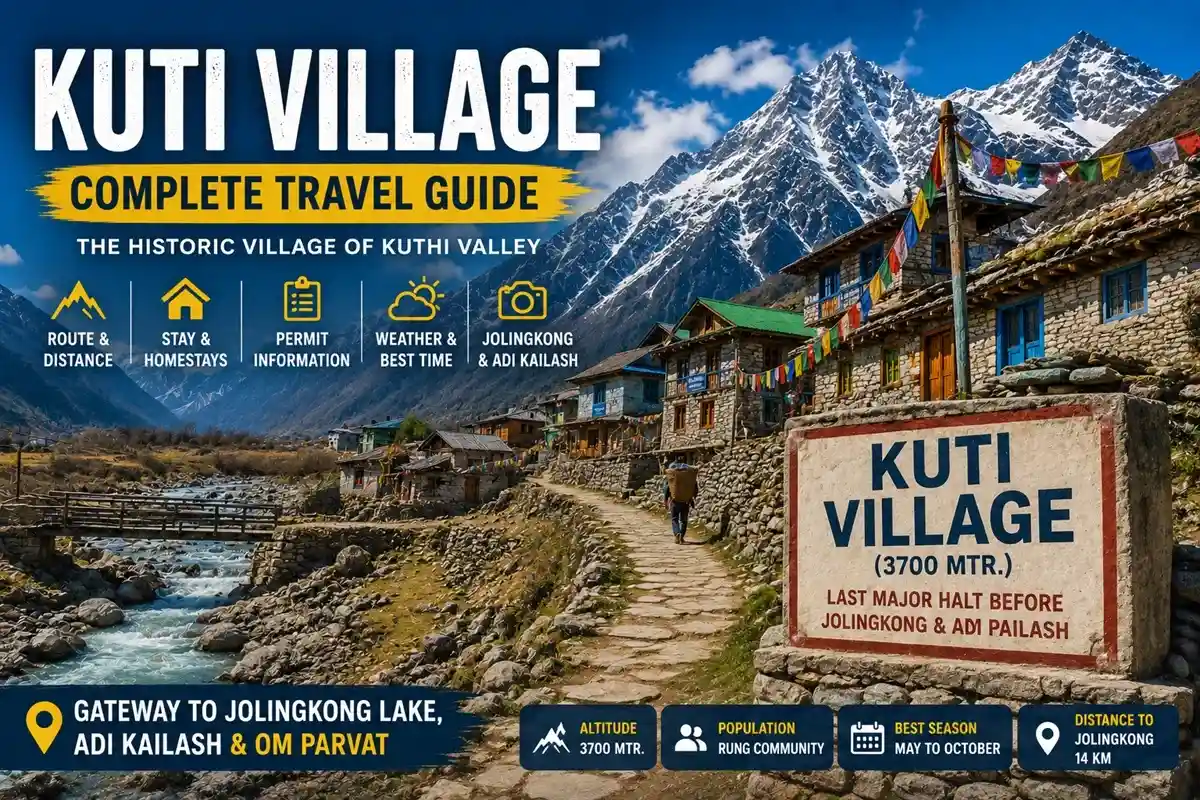
Kuti Village (also spelled Kuthi or Kutti) is one of the last inhabited settlements in the Kuthi Valley of Pithoragarh district, Uttarakhand, roughly 14 km short of Jolingkong, the lake and camp that serves as the darshan point for Adi Kailash. Most pilgrims pass through or overnight here on the final stretch of the Adi Kailash Yatra, often in a heritage home rather than a hotel. This guide covers what Kuti Village actually is, how to reach it, and what makes it different from the other halts along this route.
Quick Facts
| Detail | Information |
|---|---|
| District | Pithoragarh, Uttarakhand |
| Valley | Kuthi Valley, part of the wider Byans region |
| Altitude | Roughly 3,600–3,700 m, similar to the valley’s overall elevation |
| Best season | May–June, September–October |
| Permit | Inner Line Permit (Indian citizens only) |
| Distance to Jolingkong | ~14 km (approximate, varies by route) |
| Nearest big town | Dharchula |
| Stay options | Heritage homestays |
Key Takeaways
- Kuti Village is popularly believed to be named after Kunti, mother of the Pandavas — a devotional legend, not a verified historical fact.
- It’s one of the last inhabited villages before the high Himalayan passes, home to the Bhotiya (Rung) community for roughly six months a year.
- For many itineraries, Kuti serves as the final overnight halt before Jolingkong, though this can vary by operator and season.
- A 2020 BRO road connecting Gunji toward Limpiyadhura has cut travel time through this stretch, though the approach beyond Kuti is still rough and partly off-road.
- Part of the wider Kuthi Valley has been the subject of a boundary claim by Nepal since 2020 — a geopolitical fact worth knowing, even though it doesn’t typically affect a permitted pilgrim’s itinerary.


Where Is Kuti Village?
Kuti is a small Himalayan village at the eastern end of the Kuthi Valley, itself part of the broader Byans ethnographic region, which also includes the Kali River valley and Nepal’s Tinkar Valley. The valley sits at roughly 3,700 m, and the village’s own elevation is usually cited in a similar 3,600–3,700 m range — figures shift slightly depending on which exact point in the settlement is measured.
Estimates of the village’s size vary by source — some describe around 60 families staying six months a year, others cite over 115 traditional houses — so treat exact figures as approximate. Like nearby Gunji, Kuti is only actively inhabited during the travel season; winters push residents down toward Dharchula, and the village empties out until snow clears again around May.
Where Kuti Sits on the Map
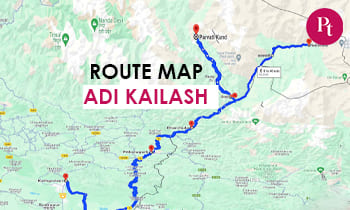
Coming from Dharchula, the route passes through Tawaghat and Gunji before reaching Kuti, which sits just before the final push to Jolingkong. Nabhidhang, the Om Parvat viewpoint, and Lipulekh Pass lie on a separate branch of the route that splits off at Gunji, so Kuti and Jolingkong belong specifically to the Adi Kailash side of the circuit.
The Kunti Legend and Local Mythology
Local tradition holds that Kuti is named after Kunti, mother of the Pandavas in the Mahabharata, who is said to have stayed in this region during a period of exile. Nearby, the ruins known as Pandav Fort and a peak called Kunti Parvat are popularly linked to the same story. These are devotional and oral traditions passed down through generations, not documented historical claims, so it’s worth enjoying them as living folklore rather than settled fact.
Why Kuti Village Matters on the Adi Kailash Route
For many itineraries, Kuti serves as the final overnight halt before Jolingkong, the lake and camp that functions as the darshan point for Adi Kailash, roughly 14 km further along. Operators choosing this halt do so for two reasons: acclimatization, and the experience of staying in a genuinely old Himalayan home rather than a basic camp.
The route through Kuti also passes Brahma Parvat and offers early views of the valley leading toward Adi Kailash, making it a meaningful stop rather than just a name on the itinerary.
History and People of Kuti
The Bhotiya (Rung) community has lived in this valley for generations, historically combining agriculture, herding, and trans-Himalayan trade with Tibet before the 1962 border closure disrupted that trade route. Villagers grow hardy crops like barley and potatoes during the short summer window, alongside seasonal income from portering, guiding, and homestays tied to the yatra season.
Some homes in Kuti, including the well-known Tate Gurudev homestay, are reported by their owners and local operators to be over a century old — a claim worth noting as local record rather than an independently verified fact. It reflects a long, continuous presence in this remote corner of the Himalayas regardless of the exact age.
Part of the wider Kuthi Valley became the subject of a boundary claim by Nepal in 2020 over the source of the Kali River. This remains an unresolved diplomatic matter and is worth knowing as context, though it doesn’t typically affect a permitted Indian pilgrim’s travel plans.
Best Time to Visit Kuti Village
Most pilgrims travel through Kuti between May and October, in line with the Adi Kailash Yatra season.
- May–June: Village reopens after winter migration; roads and trails are freshly cleared.
- July–August (monsoon): Landslide risk is high on approach roads; avoid if possible.
- September–October: Generally the most stable window for clear views and settled paths.
- November–April: The village is largely empty and inaccessible for civilian travel.
Route, Road Conditions, and Distance Chart
The standard route runs: Dharchula → Tawaghat → Narayan Ashram → Gunji → Kuti → Jolingkong. Since the Gunji–Limpiyadhura BRO road opened in July 2020, much of this stretch is motorable, though beyond Kuti the road turns rougher and partly off-road, with stream crossings such as Ganesh Nala that can become riskier during heavy monsoon flow.
| From | To | Approx. Distance |
|---|---|---|
| Dharchula | Gunji | ~70–90 km |
| Gunji | Kuti | ~10–14 km |
| Kuti | Jolingkong | ~14 km |
These figures are approximate; some itineraries route via Pangla and Mangti Nala instead, with a longer trekking component, and exact stopping points vary by operator. A sturdy SUV or 4×4 is recommended for the Kuti-to-Jolingkong stretch; sedans generally aren’t suitable, and self-drive here is only advisable for experienced mountain drivers. If the road closes due to landslides, build in at least one buffer day rather than assuming a fixed return date.
A Sample 3-Day Window Around Kuti
- Day 1: Dharchula to Gunji, permit checks and acclimatization halt.
- Day 2: Gunji to Kuti, afternoon rest, overnight in a heritage homestay.
- Day 3: Kuti to Jolingkong for Adi Kailash darshan, then return toward Gunji.
Actual pacing varies by operator and weather, so treat this as a rough template rather than a fixed schedule.
Weather in Kuti Village
At this altitude, expect a cold alpine climate even during the travel season. Daytime temperatures in May–June and September–October generally stay in single digits to the mid-teens Celsius, dropping sharply after sunset. Wind chill makes it feel colder than the thermometer suggests, cloud cover can roll in quickly, and light snow is possible even outside winter — so pack for sudden shifts rather than the seasonal average.
Connectivity, Food, and Basic Facilities
- Mobile network: Occasional BSNL signal at best, no reliable 4G; carry offline maps as backup.
- ATM and cash: No ATM this far into the valley — the last reliable one is in Dharchula.
- Fuel: No fuel station in Kuti; fill up fully in Dharchula before heading in.
- Food and water: Simple home-cooked vegetarian meals at homestays; carry packaged snacks and a water bottle with purification tablets as backup.
- Toilets: Basic facilities at homestays; expect simpler, shared arrangements rather than attached washrooms.
- Electricity: Limited and inconsistent; carry a power bank.
Permit and Registration Process
An Inner Line Permit (ILP) is mandatory for every Indian traveler heading beyond Dharchula into this border zone, arranged through the Pithoragarh or Dharchula SDM office or an authorized yatra operator.
- Carry a valid photo ID, photographs, and (for organized yatras) a medical fitness certificate.
- Register at ITBP checkposts along the way, including at Gunji, before continuing toward Kuti.
- Permit fees and documentation requirements are revised periodically, so confirm current details locally rather than relying on older listings.
- Foreign-national access depends on current Government of India regulations and is generally restricted in this corridor; check the latest guidance before planning.
How to Reach Kuti Village
There’s no direct rail or air link to Kuti. The nearest airport with limited flights is Pantnagar, and Pithoragarh’s small Naini Saini airport has occasional, weather-dependent connections; most travelers instead fly into Delhi and continue via Kathgodam, the nearest major railhead.
From Kathgodam, the road runs through Pithoragarh and Dharchula to Gunji, and onward toward Kuti — largely motorable since the 2020 road project, though the final stretch can still involve rough patches and stream crossings depending on the season.
Where to Stay in Kuti Village
- Heritage homestays: The main option here; some, like Tate Gurudev, take direct bookings through travel platforms, while others are arranged only through yatra operators — confirm ahead, since connectivity makes last-minute changes difficult.
- Organized yatra camps: Some tour operators arrange temporary camping or shared stays during peak season.
Expect simple rooms, shared washrooms, and basic electricity; hot water usually depends on the homestay’s own arrangement rather than being guaranteed.
Budget Breakdown (Approximate, per person)
| Expense | Estimated Cost (INR) |
|---|---|
| Permit and paperwork | Varies, revised periodically |
| Transport (Dharchula to Gunji/Kuti) | 3,000–6,000 |
| Homestay and meals (per night) | 1,000–2,000 |
| Porter/guide charges (if hired) | 800–1,500/day |
Costs vary by season, group size, and whether transport is independent or bundled into a package.
Packing List
- Essential: ILP and ID copies, personal medication, layered woollens, sturdy trekking shoes.
- Recommended: Power bank, ORS, basic first-aid kit, cash in small denominations.
- Optional: Trekking poles, a personal water filter, spare batteries.
Do’s and Don’ts
- Do carry your ILP and photo ID at every checkpost.
- Do keep a buffer day for weather or road delays.
- Don’t litter around homestays or trails; carry your waste back out.
- Don’t photograph ITBP posts, bridges, or personnel in this border zone, and check current drone rules with your operator before carrying one.
Senior Citizen and Health Tips
Since Kuti sits at a significant altitude beyond Gunji, only attempt this stretch after a proper acclimatization halt lower down — not on the same day you arrive in the region. Watch for AMS symptoms like headache, nausea, and breathlessness; rest and hydration are the first response if they appear. Anyone with asthma, heart disease, or high blood pressure should get medical clearance before attempting this leg, and senior citizens should prefer organized batches with built-in rest days.
Safety and Local Warnings
- Altitude sickness is a real risk this far into the valley; don’t skip acclimatization at Gunji beforehand.
- Medical facilities are minimal and coordinated through the nearest ITBP post rather than a civilian hospital, so carry essential medicines, since evacuation from this stretch can take time.
- Register at every ITBP checkpost; this is both a legal requirement and a safety measure in this sensitive border zone.
- Respect local customs and avoid photographing security installations, given the area’s proximity to the international border.
Latest Updates
The Gunji-to-Limpiyadhura BRO road, completed in July 2020, continues to see periodic maintenance and has made the Kuti stretch far more accessible than the historic 200 km trek, though the section beyond Kuti remains rougher and weather-dependent. The Nepal-India boundary claim over part of the Kuthi Valley, raised in 2020, remains an unresolved diplomatic matter; travelers should confirm current administrative guidance closer to their travel dates rather than relying on older reports.
Kuti vs Gunji vs Jolingkong
| Feature | Kuti | Gunji | Jolingkong |
|---|---|---|---|
| Role | Heritage halt near Adi Kailash | Acclimatization + route junction | Adi Kailash darshan point |
| Distance to Adi Kailash | ~14 km | ~24–28 km | Darshan point itself |
| Stay options | Heritage homestays | KMVN guesthouses | Seasonal camps only |
| Population | Small, seasonal | Seasonal, ~335 (2011 census) | Not a settlement |
Frequently Asked Questions
Q-1: Why is Kuti Village named after Kunti?
Legend says Kunti stayed here during her exile, though this is folklore, not documented history.
Q-2: How far is Kuti Village from Adi Kailash?
Roughly 14 km from Jolingkong, the lake and camp used for darshan.
Q-3: Do I need a permit to visit Kuti Village?
Yes, an Inner Line Permit is mandatory for all Indian travelers in this zone.
Q-4: What is the best time to visit Kuti Village?
May–June and September–October offer the most stable weather and roads.
Q-5: Is Kuti Village inhabited year-round?
No, it’s seasonal; residents move to Dharchula during winter.
Q-6: Can I stay in Kuti without booking a full package?
Some homestays accept direct bookings, though many trips are arranged through operators.
Q-7: Can I drive myself to Kuti Village?
Yes with an SUV and mountain driving experience, though the stretch beyond Kuti is rough.
Q-8: Is camping allowed near Kuti?
Some operators arrange seasonal camping, alongside the more common homestay option.
Q-9: Is mobile network available in Kuti?
Only occasional, unreliable signal; carry offline maps as backup.
Q-10: Can children or solo travelers visit Kuti Village?
Yes with proper acclimatization and permits, though the remoteness suits prepared travelers best.
Q-11: What is Pandav Fort near Kuti Village?
A ruined structure locally linked to the Pandavas’ exile in Mahabharata folklore.
Q-12: Is there a border dispute involving this valley?
Yes, Nepal raised a boundary claim over part of the Kuthi Valley in 2020, still unresolved.
Q-13: Can foreign tourists visit Kuti Village?
Access depends on current Government of India regulations and is generally restricted here.
Q-14: How difficult is the journey to Kuti Village?
Moderately demanding due to altitude and rough terrain, though the 2020 road has eased much of the route.
Conclusion
Kuti Village is more than a waypoint — it’s where Mahabharata folklore, a genuinely old Himalayan way of life, and the final approach to Adi Kailash all meet in one small settlement. Pilgrims and trekkers who take the time to stay a night here, rather than rushing through, usually come away calling it one of the most memorable parts of the entire yatra. Plan around the May–October window, keep your permits and acclimatization sorted at Gunji first, and Kuti Village becomes a genuinely rewarding stop rather than just a name on the route map.
Must Reads on:


 Call
Call WhatsApp
 Enquiry