
Most people planning Adi Kailash Yatra for the first time search for weeks and still end up confused. Which month is safe? How do you get the ILP? Can senior citizens do it? What does the whole thing cost? This guide answers all of that — clearly, without fluff.
Adi Kailash — also called Chota Kailash or Baba Kailash — is a sacred peak in the Pithoragarh district of Uttarakhand, located near the India-Tibet border. The Adi Kailash Yatra generally operates from May to October, subject to weather conditions and administrative permissions. You don’t need a passport. You don’t need ₹2 lakh. Everything happens inside India — in the Kumaon Himalayas.
The full circuit covers Adi Kailash (Jolingkong viewpoint) and Om Parvat (Nabhidhang viewpoint). Together, they represent two of the most spiritually charged sights in the Indian Himalayas — and in 2026, the route from Gunji to Jolingkong is motorable, The improved road connectivity has made the yatra more accessible for many senior citizens, subject to medical fitness.
If you are planning this seriously, start the process at least 6–8 weeks before your intended departure. Permits, vehicles, and accommodation in Gunji and Nabi fill up fast in May–June. Below is everything you need.
Quick Overview
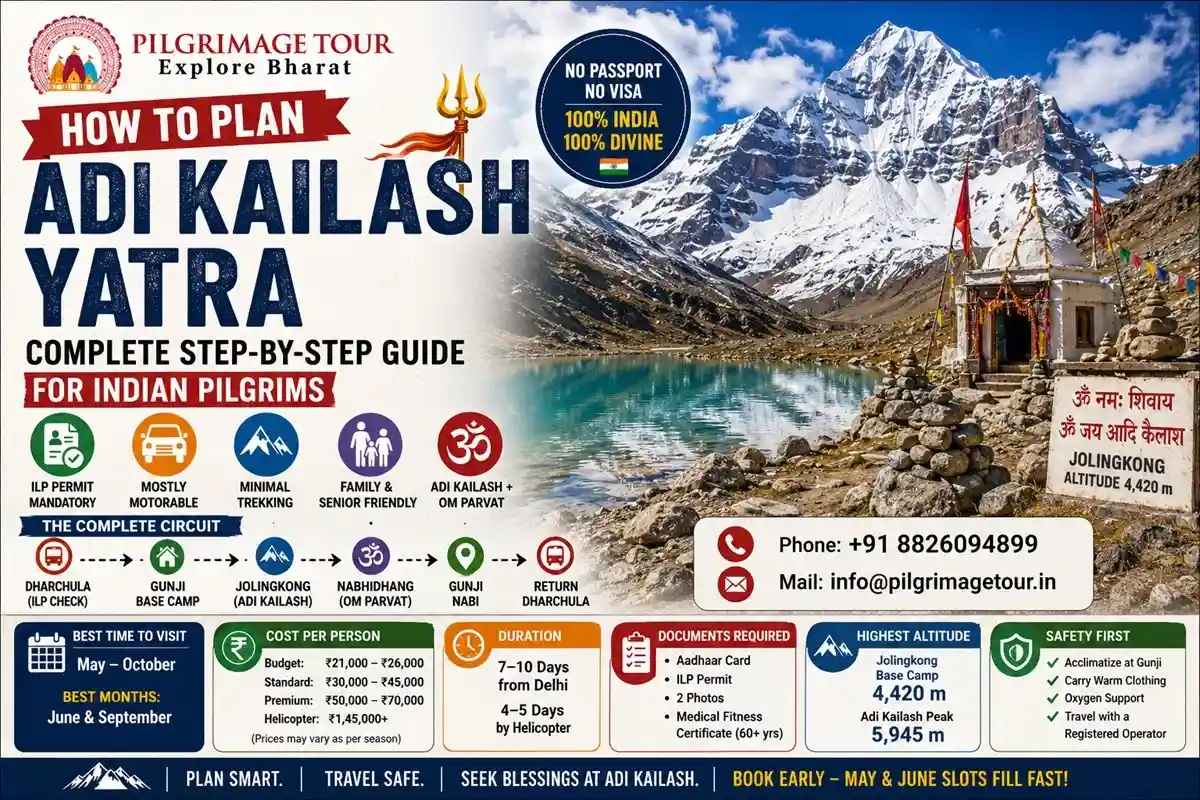
What Is Adi Kailash Yatra — and Why Are Pilgrims Choosing It in 2026
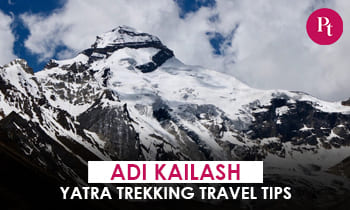
Adi Kailash is one of the five sacred peaks in the Panch Kailash circuit — the five sacred Kailash peaks spread across the Himalayas. It stands at 5,945 m in the Pithoragarh district of Uttarakhand, near the Indo-Tibet border, and bears a striking physical resemblance to Mount Kailash in Tibet.
The Yatra to Adi Kailash combines three sacred sites in one circuit: the Jolingkong viewpoint of Adi Kailash with its Shiva-Parvati temple and Parvati Sarovar glacial lake, and the Om Parvat viewpoint at Nabhidhang where the natural ‘OM’ (ॐ) symbol forms in snow on the mountain face.
What most people don’t realize is that the Adi Kailash Yatra now competes directly with the Kailash Mansarovar Yatra for the same spiritual seekers — but at a fraction of the cost and without any international travel. No passport. No China visa. No ₹2 lakh+ budget. And since 2020, the road from Gunji to Jolingkong has been significantly improved, making the journey accessible to families and seniors who previously couldn’t consider it.
| Feature | Adi Kailash (India) | Kailash Mansarovar (Tibet) |
|---|---|---|
| Location | Pithoragarh, Uttarakhand — India | Tibet, China |
| Documents needed | Aadhaar card + ILP only | Passport + China visa + MEA registration |
| Cost (approx.) | ₹21,000 – ₹70,000 per person | ₹2,00,000 – ₹2,50,000 per person |
| Duration from Delhi | 7–10 days | 21–28 days |
| Trekking required | Minimal — mostly motorable | Significant — 52 km parikrama |
| Season 2026 | May 13 – October 2026 | May–September (limited batches) |
| Senior friendly | Yes (with helicopter/vehicle options) | Physically demanding throughout |
Best Time to Visit Adi Kailash in 2026 — Month-by-Month Guide
The Adi Kailash season runs from mid-May to October. But not all months are equal. Here’s exactly what to expect:
| Month | Weather at Gunji | Weather at Jolingkong | Road Condition | Verdict |
|---|---|---|---|---|
| May (from 13th) | Day: 8–14°C | Night: -2 to 2°C | Day: 2–8°C | Night: -8 to -4°C | Good — some snowmelt patches | Best — fresh season, fewer crowds |
| June | Day: 10–15°C | Night: -2 to 3°C | Day: 3–9°C | Night: -7 to -3°C | Most reliable of the season | Best — Om symbol fully visible, clear skies |
| July–August | Warm days, heavy rains | Clouds, poor visibility | Landslide risk — dangerous | Avoid — view blocked, route risky |
| September | Day: 5–10°C | Night: -4 to 0°C | Day: -1 to 5°C | Night: -10 to -5°C | Good post-monsoon | Excellent — crystal clear, less crowded |
| October | Cold, sharp | Very cold, snow returning | Closing soon — uncertain | Last chance — book early, plan buffer days |
On the ground, June and September are the most consistent choices. June gives you the best Om symbol visibility — the snow is still well-defined on Om Parvat’s face. September gives you sharper photographs and thinner crowds. May is perfect for early-season pilgrims who want a quieter experience, but carry extra woolens — Jolingkong nights in May regularly drop to -8°C.
How to Plan Adi Kailash Yatra — Step-by-Step Process
Step 1 — Decide Your Travel Window and Duration
For a complete Adi Kailash and Om Parvat circuit, plan for 8–10 days from Delhi or 6–8 days from Kathgodam. The minimum sensible duration is 7 days — anything shorter skips acclimatization and increases altitude sickness risk. Most pilgrims do it in 8 days, which is the most common itinerary offered by tour operators.
- Families with seniors or children: 9–10 days — extra buffer for rest
- Fit pilgrims (30s–50s): 7–8 days works comfortably
- Helicopter package from Pithoragarh: 4–5 days (no extended road journey)
Step 2 — Choose Your Starting Point
Three common starting points for the Adi Kailash Yatra from India:
| Starting Point | How to Reach | Travel Time to Dharchula | Best For |
|---|---|---|---|
| Delhi | Train to Kathgodam + road to Dharchula | 2 days | Most common — overnight train + 1 day drive |
| Kathgodam | Train from Delhi, Mumbai, Lucknow | ~7–8 hrs by road | Those already in Uttarakhand |
| Pantnagar | Flight from Delhi (~1 hr) + road to Dharchula | 6–7 hrs by road | Faster option — fly + drive |
From Kathgodam or Pantnagar, the road to Dharchula passes through Pithoragarh. Most operators handle the full transfer. If you want budget travel: the Delhi to Dharchula direct UTC bus from Anand Vihar ISBT departs at 4:30–5:30 PM daily and costs ₹1,070–₹1,130 — arrives in 21–24 hours.
Step 3 — Book a Registered Tour Operator
This is not optional. Beyond Dharchula, private vehicles are not permitted into the ILP zone. You must travel with a KMVN-operated vehicle or through a registered tour operator. Attempting independent travel at the Dharchula checkpoint without proper operator documentation will stop you cold.
When choosing an operator, verify:
- Valid GSTIN and tourism license registration
- ILP permit processing included in the package
- 4×4 vehicle confirmed for Dharchula to Gunji stretch
- Accommodation at Gunji/Nabi pre-booked — not just promised
- Oxygen cylinders and first aid on vehicle — especially important above 10,000 ft
- Clear cancellation policy — weather delays are common on this route
Step 4 — Get the Inner Line Permit (ILP)
The ILP is mandatory for every Indian national. The Adi Kailash circuit lies in a restricted zone near the Indo-Tibet border, and every checkpoint from Dharchula onward verifies it. There are no exceptions.
| ILP Detail | Information |
|---|---|
| Who needs it | All Indian nationals (Age eligibility may vary depending on operator policies and medical fitness requirements.) |
| Where to get it | SDM Office, Dharchula | Pithoragarh DM portal (online) | Through tour operator |
| Cost | ₹300–₹600 per person (for self-arranged); usually included in tour packages |
| Documents needed | Original Aadhaar card + 2 passport-size photographs |
| Processing time | Same-day at Dharchula SDM if you arrive in person; operators can arrange in advance |
| Foreign nationals of Indian origin | Same ILP rules apply — Aadhaar or OCI card |
| Non-Indian foreign nationals | Protected Area Permit (PAP) required — apply 60+ days in advance via MEA-authorized operator |
| 2026 ILP Note: Registration for the 2026 season typically opens in late February to early April. The ILP is issued by SDM Dharchula and you must arrive in Dharchula at least 1 day before your onward departure to Gunji — permits, vehicle check, and supply stocking all happen here. Do not arrive at Dharchula on the same morning you plan to depart for Gunji. |
Step 5 — Plan Your Route
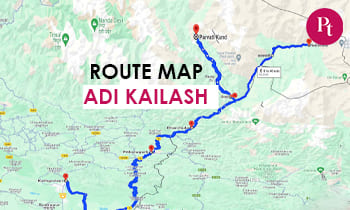
The standard Adi Kailash and Om Parvat circuit follows this sequence from Kathgodam:
| Day | Route | Key Stops | Night Stay |
|---|---|---|---|
| Day 1 | Kathgodam → Pithoragarh | Kainchi Dham, Chitai Temple, Jageshwar Dham | Pithoragarh |
| Day 2 | Pithoragarh → Dharchula | Jwaleshwar Temple, Narayan Ashram, ILP collection | Dharchula |
| Day 3 | Dharchula → Gunji | Tawaghat, Malpa, Chiyalekh meadows, valley views | Gunji |
| Day 4 | Acclimatization at Gunji | Rest day — short walks, local village exploration | Gunji |
| Day 5 | Gunji → Jolingkong → Gunji | Adi Kailash darshan, Parvati Sarovar, Gauri Kund, temple puja | Gunji/Nabi |
| Day 6 | Gunji → Nabhidhang → Nabi | Om Parvat darshan, Kalapani Kali Temple, Vyas Gufa, Lipulekh area | Nabi/Gunji |
| Day 7 | Gunji/Nabi → Dharchula | Return descent, temple stops at Tawaghat | Dharchula |
| Day 8 | Dharchula → Kathgodam | Via Pithoragarh or Chaukori scenic route | Departure |
Step 6 — Prepare Physically
The Adi Kailash Yatra is rated Easy-Moderate for 2026. The route is mostly motorable — the actual walking on any given day is 3–5 km. But altitude is the real challenge. You spend multiple nights above 3,000 m, with Jolingkong at 4,420 m.
- Start 4–6 weeks before: daily walks of 5 km building up to 10 km
- Stair climbing: 3–4 floors repeatedly is great preparation for mountain terrain
- Consult a doctor: essential if above 60 years, or with heart, BP, or respiratory conditions
- Altitude acclimatization: mandatory rest day at Gunji before going higher — non-negotiable
Adi Kailash Yatra 2026 — Complete Cost and Budget Breakdown
The total cost of your Adi Kailash Yatra depends on your package type, group size, and mode of travel. Here’s a realistic breakdown:
| Package Type | Price Per Person | What’s Included | Best For |
|---|---|---|---|
| Budget Package | ₹21,000 – ₹26,000 | Shared 4×4, dormitory-style stays, dal-rice meals, ILP | Solo travelers, young pilgrims |
| Standard Package | ₹30,000 – ₹45,000 | Private/shared vehicle, twin-sharing rooms, all meals, ILP, guide | Families, most pilgrims |
| Premium Package | ₹50,000 – ₹70,000 | Private vehicle, better homestays, full meals, guide, oxygen support | Comfort seekers, seniors |
| Helicopter Package | ₹1,45,000+ | 4-day circuit by helicopter from Pithoragarh, ATV rides, all meals | Senior citizens, limited time |
Additional costs to account for:
- Travel to Kathgodam: Sleeper train from Delhi ₹300–₹800 | AC train ₹800–₹2,500
- Flight to Pantnagar from Delhi: ₹2,500–₹5,000 one way
- ILP fee (if self-arranged): ₹300–₹600 per person
- Pony/doli service at Jolingkong: ₹500–₹1,500 per person
- Temple puja/prasad: ₹200–₹1,000
- Personal expenses and cash for dhabas: ₹2,000–₹3,000 (carry in small notes)
- Travel insurance: ₹500–₹1,500 — strongly recommended
| Cost Warning: Extremely cheap packages (under ₹15,000) often skip oxygen cylinders, proper 4×4 vehicles, or pre-booked accommodation — which creates real risk in a high-altitude restricted zone. In this region, logistics are expensive. A package that looks too cheap usually has cuts in exactly the safety areas that matter. |
Where to Stay — Accommodation on the Adi Kailash Route
| Location | Accommodation Type | What to Expect | Booking |
|---|---|---|---|
| Pithoragarh | Hotels (2–3 star) | Proper rooms, attached bathrooms, hot water | Book in advance for peak season |
| Dharchula | Hotels and guesthouses | Basic rooms, good food, shops nearby | Book in advance — fills fast |
| Gunji | KMVN rest house + local homestays | Shared bathrooms, floor mattresses with quilts, simple meals | Through operator — no direct booking |
| Nabi / Kuti | Homestays | Traditional Rung community houses, very basic, culturally rich | Through operator only |
| Jolingkong | Fiber huts + tented camps | No permanent guesthouses; operator-arranged tents in season | Only available through registered operators |
From practical experience on this route: the homestays in Gunji and Nabi are basic but genuinely warm. The Rung community here is hospitable, the food is hot and filling, and sleeping under quilts at 3,300 m with the mountain silence around you is an experience in itself. Don’t expect hotel comfort — expect something better.
What to Pack — Adi Kailash Yatra Packing List 2026
Clothing (Non-Negotiable)
- Heavy down jacket or woollen jacket — Jolingkong nights hit -8°C even in June
- Thermal inner wear — top and bottom — mandatory from Gunji onward
- Rain poncho or waterproof jacket — weather changes fast at altitude
- Trekking shoes with ankle support and good grip
- Gloves, wool cap, muffler — essential above 3,000 m
- Sunglasses (UV400) — Himalayan sun at altitude is intense
Health and Safety
- Personal medicines — at least 10-day supply
- Diamox (acetazolamide) if prescribed for altitude sickness — consult doctor first
- ORS sachets — for rehydration at high altitude
- Portable pulse oximeter — to monitor oxygen saturation; critical above 4,000 m
- Sunscreen SPF 50+
- Basic first aid kit — antiseptic, bandages, paracetamol, antacids
Documents
- Original Aadhaar card — mandatory for ILP and hotel check-in at every stop
- 2 passport-size photographs — for ILP processing
- Printed ILP (once issued) — carry 3 copies
- Medical fitness certificate — required if above 60 years or with any health condition
- Tour operator booking confirmation
Other Essentials
- Portable power bank — no charging points beyond Dharchula in remote stays
- Cash ₹3,000–₹5,000 in small notes — no ATMs or UPI beyond Dharchula
- Dry fruits and energy bars — for high-altitude snacking
- Jio or BSNL SIM — best network coverage on this route; other operators lose signal at Dharchula
Adi Kailash Yatra for Senior Citizens — Special Planning Guide
A growing number of pilgrims above 55–65 years are choosing Adi Kailash Yatra specifically because the route is now motorable. Here’s what seniors need to plan:
- Helicopter package (₹1,45,000+): Pithoragarh to Gunji by air — skips the 80 km rough mountain road entirely. Best option for those with joint or cardiovascular concerns.
- ATV rides at Jolingkong: Available from Gunji to the Parvati Sarovar area — covers the rocky section so seniors don’t need to walk on uneven terrain.
- Medical certificate: Required for pilgrims above 65 years or with any cardiac/respiratory history. Bring a recent ECG and blood pressure report.
- Acclimatize fully: A mandatory rest day at Gunji before going to Jolingkong is non-negotiable for seniors. Skipping this is the most common cause of AMS (Acute Mountain Sickness) on this route.
- Oxygen support: Confirm with your operator that portable oxygen cylinders are available on the vehicle. Reputable operators carry these as standard.
- Pulse oximeter: Carry one. At Jolingkong (4,420 m), oxygen saturation drops. If readings go below 85%, descend immediately.
What Actually Happens on the Ground — Real Scenario
Most first-time pilgrims underestimate how quickly the weather can shift. In June 2025, a group traveling with an operator from Delhi had clear skies at Gunji at 7 AM — by 11 AM at Nabhidhang, cloud cover had completely obscured Om Parvat. Their operator had kept a half-day buffer built into the itinerary, which let them wait it out and get a clear view by 3 PM.
That buffer — one extra night at Gunji — is the difference between completing the Yatra and returning without seeing Om Parvat. During peak season (late May, June), always ask your operator if the itinerary has weather buffer days. If the answer is no, that’s a red flag.
Another thing most people don’t realize: at Jolingkong, even when the sun is out, the wind chill makes it feel like -5°C below the thermometer reading. Pilgrims who arrive in just a fleece or light jacket suffer. Bring the down jacket even if June in Delhi is 40°C — the mountain doesn’t care about your departure city’s weather.
Common Mistakes People Make While Planning Adi Kailash Yatra
| Mistake | Why It Happens | What to Do Instead |
|---|---|---|
| Booking too late | Thinking permits are easy to get last minute | Book operator and ILP 6–8 weeks before. May–June slots fill in March–April. |
| No acclimatization day at Gunji | Wanting to rush the itinerary | Mandatory rest day at Gunji. Skipping causes AMS at Jolingkong. |
| Cheap package with no oxygen support | Trying to save ₹5,000–₹10,000 | Oxygen cylinders are safety, not luxury. Confirm with operator before booking. |
| Going in July–August | Flexibility with school holidays | Landslide risk on Dharchula–Gunji road is real. September is equally good and safer. |
| Not checking Jio/BSNL SIM | Assuming all SIMs work | Airtel and Vi lose coverage at Dharchula. Carry Jio or BSNL for border zone connectivity. |
| No weather buffer day | Tight schedule | Om Parvat clouds over by noon daily. Without a buffer, there’s no second chance. |
| Ignoring medical certificate requirement | Thinking it’s just a formality | Checkpoints can turn back pilgrims over 65 without a valid fitness certificate. |
Pro Tips — From People Who Have Done This Yatra
- Start Jolingkong darshan by 6 AM. The mountain is clearest in the first 3–4 hours after sunrise. Late starters often find cloud build-up has started by 10 AM.
- At Nabhidhang for Om Parvat, position yourself to the right side of the viewpoint (facing the mountain) — the Om symbol on the rock face is slightly off-center and clearer from that angle.
- Dharchula market has good woollen shops if you realize you’ve underpacked. Local Kumaoni woolens are inexpensive and excellent quality. Prices here are far lower than Pithoragarh or Almora.
- Keep your puja materials (flowers, incense, diyas) for the Shiva-Parvati temple at Jolingkong. The temple priest can guide the proper puja process — it takes about 15–20 minutes and is worth every minute.
- The road from Dharchula to Gunji takes 3–4 hours officially, but can stretch to 5–6 hours if BRO (Border Roads Organisation) is doing road work. Always start this stretch by 7 AM.
- At high altitude, eat less but eat often. Heavy meals suppress oxygen-carrying capacity and cause nausea. Stick to light, warm food — soups, khichdi, and dal-chawal.
- Download Google Maps offline for Uttarakhand before you leave Delhi. Network disappears beyond Dharchula, and offline maps are the only navigation you’ll have in the restricted zone.
Why Plan Your Adi Kailash Yatra with PilgrimageTour.in
Planning a Himalayan Yatra in a restricted border zone requires more than just booking tickets. You need an operator who knows exactly what happens when the road to Gunji gets blocked at 4 PM, or when the SDM office delays an ILP batch. PilgrimageTour.in has managed Adi Kailash Yatras for thousands of pilgrims from across India.
- Fully registered tour operator with all necessary KMVN and government authorizations
- ILP permit processing handled end-to-end — no scrambling at Dharchula checkpoints
- 4×4 vehicles with experienced mountain drivers familiar with the Dharchula–Gunji stretch
- Pre-booked accommodation at Gunji and Nabi — not dependent on walk-in availability
- Oxygen cylinders and pulse oximeters on every vehicle above 3,000 m
- 24×7 support — our on-ground team stays in contact throughout the Yatra
- Flexible itineraries with weather buffer days built in — not just promised
- Senior citizen and helicopter packages available — customized plans for every pilgrim profile
If you are planning the 2026 season, book by April. May–June batches fill up fast, and operators who wait until the last week of April to open bookings often can’t guarantee preferred dates or accommodation quality.
Key Takeaways
| Adi Kailash Yatra 2026 season: May 13 – OctoberBest months: June (Om symbol clear, reliable roads) and September (post-monsoon clarity)Route: Delhi → Kathgodam → Pithoragarh → Dharchula → Gunji → Jolingkong + NabhidhangDuration: 7–10 days from Delhi | 4–5 days by helicopter from PithoragarhCost: ₹21,000 (budget) to ₹70,000+ (premium) | Helicopter: ₹1,45,000+ILP: Mandatory for all Indian nationals — ₹300–₹600 or included in packageJolingkong base camp altitude: 4,420 m | Adi Kailash peak: 5,945 mNo passport, no visa, no international travel — fully within IndiaKey requirement: Book operator 6–8 weeks in advance for peak season dates |
Frequently Asked Questions — How to Plan Adi Kailash Yatra 2026
Q1. When does the Adi Kailash Yatra 2026 start?
The Adi Kailash Yatra 2026 officially starts on May 13. However, ILP permits are typically issued from the second or third week of May once the SDM Dharchula office opens the window for the season. Most tour operators begin their first batches between May 13–20. The season stays open through October.
Q2. Do I need a passport for Adi Kailash Yatra?
No. Adi Kailash is entirely within India, in the Pithoragarh district of Uttarakhand. You do not need a passport or visa. You need only an Aadhaar card and an Inner Line Permit (ILP). This is one of the biggest advantages of Adi Kailash over the Kailash Mansarovar Yatra in Tibet, which requires a passport and China visa.
Q3. What is the Inner Line Permit for Adi Kailash Yatra and how do I get it?
The Inner Line Permit (ILP) is a government-issued document allowing you to enter the restricted border zone beyond Dharchula. All Indian nationals need it. You can get it at the SDM Office in Dharchula, through the Pithoragarh District ILP online portal, or have your tour operator arrange it. Cost is ₹300–₹600 per person for self-arranged permits; most tour packages include it.
Q4. What is the total cost of Adi Kailash Yatra 2026?
Package costs range from ₹21,000 (budget) to ₹70,000+ (premium) per person, covering permits, 4×4 transport, accommodation, meals, and guide. The helicopter package from Pithoragarh costs ₹1,45,000+ per person. Add ₹3,000–₹8,000 for train/flight to Kathgodam/Pantnagar and ₹2,000–₹3,000 for personal expenses and cash on route.
Q5. How many days does Adi Kailash Yatra take?
The standard Adi Kailash and Om Parvat circuit takes 7–10 days from Delhi. An 8-day itinerary from Kathgodam is the most common. The helicopter package from Pithoragarh covers the same circuit in 4–5 days. Going faster than 7 days risks skipping the acclimatization day at Gunji, which significantly increases altitude sickness risk.
Q6. Is Adi Kailash Yatra safe for senior citizens?
Yes, with proper planning. The route is now mostly motorable, with ATV rides available for the Jolingkong section. Seniors with heart, BP, or respiratory conditions should consult a doctor and carry a medical fitness certificate. The helicopter package is the most comfortable option for seniors above 65 — it eliminates the rough 80 km road from Dharchula to Gunji entirely.
Q7. Can I do Adi Kailash Yatra without a tour operator?
No — not practically. Beyond Dharchula, private vehicles are restricted and entry requires operator documentation and ILP. Independent travel at this scale, in a high-altitude restricted border zone, is both logistically difficult and not permitted at vehicle checkpoints. All reputable Adi Kailash Yatras are done through KMVN or registered private operators.
Q8. What is the difficulty level of Adi Kailash Yatra?
The 2026 Adi Kailash Yatra is rated Easy-Moderate. The route from Gunji to Jolingkong is motorable, with walking limited to 3–5 km per day on any given site. The challenge is altitude — spending multiple nights above 3,000 m, with Jolingkong at 4,420 m. Basic fitness (able to walk 5 km on flat ground) is sufficient. High altitude, not distance, is the main challenge.
Q9. What documents are required for Adi Kailash Yatra 2026?
Original Aadhaar card (most widely accepted ID for checkpoints and homestays), 2 passport-size photographs for ILP, ILP document once issued (carry 3 printed copies), and a medical fitness certificate for anyone above 60 years or with cardiac/respiratory conditions. Your operator booking confirmation is also needed at some checkpoints.
Q10. Is July–August a good time for Adi Kailash Yatra?
No. July and August are monsoon months. The Dharchula to Gunji road passes through gorges and mountain slopes that are highly prone to landslides during heavy rain. Many batches get delayed or cancelled. More importantly, cloud cover at Nabhidhang during monsoon often blocks the Om Parvat view entirely. September is the better post-monsoon option with clear skies and stable roads.
Q11. What is the difference between Adi Kailash and Om Parvat?
Adi Kailash (also called Chota Kailash) is the sacred peak at 5,945 m, viewed from the Jolingkong base camp at 4,420 m — it is the main spiritual destination of the Yatra. Om Parvat is a different, adjacent peak where snow naturally forms the shape of ‘OM’ (ॐ) on the rock face — visible from Nabhidhang viewpoint at 3,600 m. Most Yatra itineraries include both sites in the same circuit.
Q12. How do I reach Dharchula from Delhi?
Three options: (1) Train from Delhi to Kathgodam (Ranikhet Express, 22:05 from Delhi, arrives 05:30 — 7.5 hours) + road from Kathgodam to Dharchula (7–8 hours) — most popular. (2) Flight Delhi to Pantnagar (~1 hour) + road to Dharchula (6–7 hours). (3) Direct UTC bus from Anand Vihar ISBT to Dharchula — departs 4:30–5:30 PM, takes 21–24 hours, costs ₹1,070–₹1,130. Your operator typically handles the Kathgodam–Dharchula transfer.
Q13. What is Parvati Sarovar?
Parvati Sarovar is a glacial lake at Jolingkong, at the base of Adi Kailash, sacred to Goddess Parvati. It is 1–2 km short walk from the Jolingkong vehicle drop point, and the Shiva-Parvati temple stands beside it. The lake’s crystal-clear water reflects Adi Kailash on clear days. Pilgrims take darshan here and collect the water as holy prasad.
Q14. Can I see Om Parvat clearly in every season?
The Om symbol on Om Parvat is formed by snow accumulating in the rock crevices on the mountain face. It is clearest in May–June when snow cover is maximum. In September–October, it is still visible but with less definition as some snow has melted. In July–August, cloud cover usually obscures the view. Morning hours (7 AM–11 AM) at Nabhidhang give the clearest sighting on any given day.
Q15. What is the best Adi Kailash Yatra package for families?
For families with children and mixed age groups, a standard or premium 8–9 day package from Kathgodam works well. Include an acclimatization day at Gunji. If the family includes seniors above 60, the helicopter package from Pithoragarh is the most comfortable option. Confirm with your operator that ATV rides are available for the Jolingkong section — they eliminate the rocky approach walk for children and older family members.
Final Recommendation
Adi Kailash Yatra is one of the most accessible high-altitude pilgrimages in India right now. The route improvements since 2020 have opened it up to people who previously couldn’t consider it — families, seniors, pilgrims with limited trekking experience.
If you’ve been considering the Kailash Mansarovar Yatra but were put off by the cost, the passport requirement, or the physical demands — Adi Kailash gives you the same spiritual substance at a fraction of the barrier. Same sacred geography. Same Himalayan presence. Entirely within India.
The best time to go is June for first-timers — clear skies, full Om symbol, reliable roads. September is ideal for those who want a quieter experience with sharper mountain photography. Book your operator by March–April for May–June departure. For September, you have until July, but don’t push it.
This is not a trek to rush. Build in that acclimatization day. Carry the down jacket. Keep some cash. And when you stand at Jolingkong at 4,420 m with Adi Kailash reflected in Parvati Sarovar — you’ll understand exactly why pilgrims have been making this journey for centuries.


 Call
Call WhatsApp
 Enquiry