
Kedarnath Temple sits at 3,583 metres above sea level. That altitude is not incidental to the pilgrimage — it is inseparable from it. The thin mountain air, the cold, the long climb from Gaurikund — all of it is part of what makes this yatra both demanding and sacred. But at 3,583 metres, the oxygen available to your lungs is roughly 35–40% less than what you breathe at sea level. And that gap, if not respected, can turn a spiritual journey into a medical emergency.
Altitude sickness in Kedarnath is not a rare or fringe problem. Real experience from the 2026 season confirms that approximately 10 to 15 percent of pilgrims experience some degree of Acute Mountain Sickness during the yatra. In 2022, following a two-year Covid-related closure, 120 pilgrims died in just 27 days of the Kedarnath season — a number that prompted the Union Health Ministry to deploy drones carrying emergency medicines, stroke vans, and ambulances across the Char Dham route. In the years before Covid — 2017, 2018, 2019 — the full-season death counts were 112, 102, and 90 respectively. These are not freak occurrences. They are the predictable outcome of underprepared pilgrims at high altitude.
The good news, which every mountain doctor will confirm, is that altitude sickness is almost entirely preventable with the right preparation. This guide gives you everything you need: how AMS works, its symptoms in order of severity, a verified 2026 acclimatization strategy, Diamox dosage and when to use it, SpO2 benchmarks, the government health advisory for 2026, and what to do in a genuine emergency on the Kedarnath route.
Key Takeaways
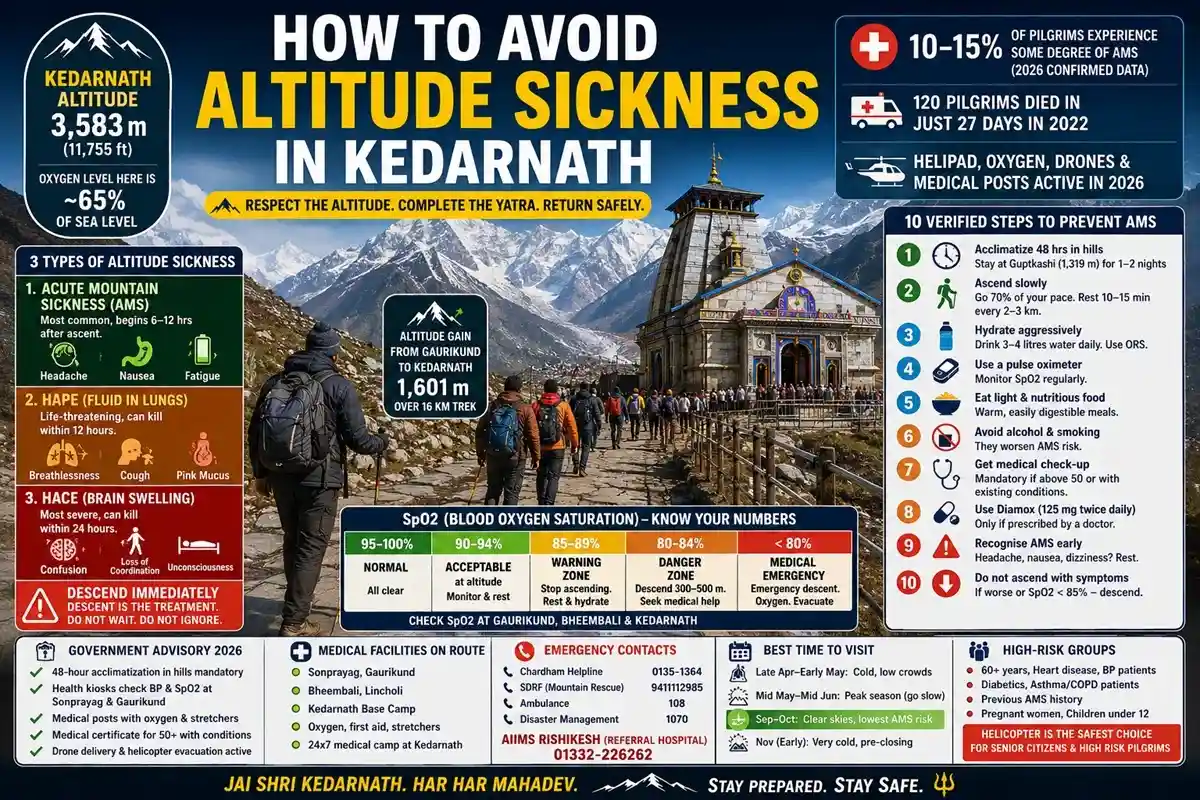
- Kedarnath altitude: 3,583 m (11,755 ft) — oxygen level here is approximately 65% of sea level
- 10-15% of Kedarnath pilgrims experience some degree of AMS during the yatra season (2026 confirmed data)
- 2026 Government health advisory: mandatory 48-hour acclimatization in hills before reaching Kedarnath; health kiosks at Sonprayag and Gaurikund conduct BP and SpO2 checks
- AMS begins as early as 6-12 hours after reaching altitude — symptoms include persistent headache, nausea, dizziness, fatigue
- HAPE (fluid in lungs) can kill within 12 hours; HACE (brain swelling) can kill within 24 hours — both require immediate descent
- SpO2 benchmarks: above 90% = acceptable | below 90% = rest and monitor | below 85% = descend immediately | below 80% = medical emergency
- Diamox (Acetazolamide 125 mg twice daily) is the medically confirmed standard preventive dose — requires a doctor’s prescription; do not self-medicate
- The most effective single prevention: ascend slowly and do not rush the 16 km trek — AMS is primarily caused by too-fast ascent
- Emergency oxygen, stretchers, and first aid are available at Sonprayag, Gaurikund, Bheembali, Lincholi, and Kedarnath camp
- Helicopter evacuation from Kedarnath to Phata and AIIMS Rishikesh is available for serious cases — 21 pilgrims were airlifted to AIIMS in 2022 alone
What Is Altitude Sickness and Why Does Kedarnath Make It Likely?
Altitude sickness, medically known as Acute Mountain Sickness (AMS), is your body’s response to reduced oxygen availability at high elevations. As you climb higher, atmospheric pressure drops and the air becomes thinner. At sea level, every breath delivers a certain volume of oxygen to your blood. At Kedarnath’s 3,583 m, that same breath delivers roughly 35–40% less oxygen than your body is used to at sea level — confirmed by multiple 2026 health sources and consistent with standard high-altitude physiology at this elevation.
Most healthy adults can eventually adapt to lower oxygen levels — but the key word is eventually. Acclimatization takes time. Your body needs to gradually increase red blood cell production, adjust breathing patterns, and recalibrate its oxygen delivery system. When you ascend faster than your body can adapt, AMS follows.
Kedarnath’s pilgrimage pattern makes AMS particularly common for three specific reasons. First, most pilgrims travel directly from sea-level or low-altitude cities — Delhi, Mumbai, Bengaluru, Chennai — to a high-altitude starting point without any gradual altitude gain. Second, the 16 km trek from Gaurikund (1,982 m) to Kedarnath (3,583 m) involves a 1,601 m altitude gain, much of it in the steeper upper sections. Third, and most critically, pilgrims are often emotionally motivated to push through discomfort — treating fatigue and headache as spiritual tests rather than physiological warning signals. That specific mistake has cost lives every season.
CRITICAL FACT: AMS can affect anyone regardless of age, fitness level, or previous high-altitude experience. Being young and physically fit does not protect you. The deciding factor is the speed of ascent and individual physiological response — both of which are partially unpredictable. Never assume you are immune.
Three Types of Altitude Sickness — From Manageable to Life-Threatening
Type 1: Acute Mountain Sickness (AMS) — Most Common
AMS is the mildest and most common form. It typically begins 6-12 hours after reaching a new altitude and feels, as many pilgrims describe it, like a bad hangover. Symptoms include a persistent headache (the most common and reliable indicator), nausea, dizziness, unusual fatigue, and disrupted sleep. Most cases of AMS are manageable with rest, hydration, and not ascending further until symptoms resolve.
AMS is not dangerous if caught early and managed correctly. It becomes dangerous when ignored — when pilgrims continue to ascend despite symptoms, hoping to ‘push through it.’ Untreated AMS can progress to HAPE or HACE within hours.
Type 2: High Altitude Pulmonary Edema (HAPE) — Life-Threatening
HAPE occurs when fluid accumulates in the lungs, severely compromising breathing. It typically develops 2-5 days after reaching high altitude, though it can appear more rapidly in rapid ascent scenarios. HAPE can be fatal within 12 hours if untreated. Warning signs: breathlessness even at rest (not just exertion), a persistent dry cough that progresses to producing pink or frothy mucus, and extreme fatigue beyond what exercise alone explains.
HAPE is a medical emergency. The only definitive treatment is immediate descent. Every 300 metres of descent helps. If descent is not immediately possible, supplemental oxygen and medications like Nifedipine (prescribed) can be administered while arranging evacuation. The medical posts at Kedarnath have oxygen for emergency stabilisation.
Type 3: High Altitude Cerebral Edema (HACE) — Most Severe
HACE is swelling of the brain caused by fluid accumulation at altitude. It is the most severe form of altitude sickness and can be fatal within 24 hours. HACE typically develops from untreated AMS. Warning signs: ataxia (loss of coordination — the ‘walk the line’ test; ask the person to walk heel-to-toe in a straight line), confusion, altered mental state, severe headache unresponsive to paracetamol, and eventually loss of consciousness.
HACE is a medical emergency requiring immediate descent and evacuation. Dexamethasone (prescribed) can be administered to reduce brain swelling while preparing for evacuation. Do not leave a person with suspected HACE alone. Helicopter evacuation from Kedarnath to Phata is the fastest path to AIIMS Rishikesh.
Altitude Sickness Symptoms — From Early Warning to Emergency
| Severity Level | Symptoms | What to Do | What NOT to Do |
| Mild AMS (common) | Persistent headache, mild nausea, unusual fatigue, poor sleep, mild dizziness | REST at current altitude. Hydrate (ORS + water). Take paracetamol for headache. Do NOT ascend further until all symptoms resolve. | Do not continue upward. Do not ignore headache as ‘just tiredness’. |
| Moderate AMS | Severe headache not responding to paracetamol, persistent vomiting, noticeable fatigue at rest, worsening dizziness | Descend 300-500 m immediately. Seek medical post assistance. Administer supplemental oxygen if available. | Do not take more pain medication and continue climbing. Do not leave the person alone. |
| HAPE (severe) | Breathlessness at rest, dry cough progressing to pink/frothy mucus, extreme fatigue, blue lips or fingernails (cyanosis) | EMERGENCY: Descend immediately. Every metre of descent helps. Oxygen support. Seek evacuation (helicopter if needed). Nifedipine if prescribed. | Do not wait and see. Do not let the person sleep through worsening symptoms. Delay is fatal. |
| HACE (severe) | Loss of coordination, confusion, altered mental state, severe headache, drowsiness, loss of consciousness | EMERGENCY: Descend immediately. Dexamethasone (if prescribed). Oxygen. Call for helicopter evacuation. Do not leave alone. | Do not assume the person is ‘just tired’. HACE can kill within 24 hours. Act immediately. |
SpO2 (Blood Oxygen Saturation) at Kedarnath — What the Numbers Mean
A pulse oximeter is a small device (available for Rs.300-600) that clips onto your finger and measures your blood oxygen saturation (SpO2) within seconds. It is the single most useful objective health tool you can carry on the Kedarnath trek. At altitude, SpO2 gives you a number that cuts through the subjectivity of ‘I feel okay’ and tells you what your body is actually doing.
| SpO2 Reading | What It Means | Action Required |
| 95% – 100% | Normal (sea level healthy range) | All clear — no concern |
| 90% – 94% | Acceptable at 3,000+ m altitude; mild physiological adaptation underway | Monitor every few hours. Rest before ascending further. |
| 85% – 89% | Warning zone — body struggling to adapt | Stop ascending immediately. Rest. Hydrate. Do not continue upward until SpO2 improves above 90%. If no improvement in 30 minutes: descend. |
| 80% – 84% | Danger zone — risk of serious AMS/HAPE | Descend 300-500 m immediately. Seek medical post. Oxygen support if available. |
| Below 80% | Medical emergency | Emergency descent. Helicopter evacuation. Oxygen support immediately. AIIMS Rishikesh is the referral centre. |
Practical tip from experienced Kedarnath pilgrims: Check your SpO2 at Gaurikund before starting the trek, at Bheembali (midpoint), and on arrival at Kedarnath. Write down the readings. Any drop below 90% means stop and rest. Do not be embarrassed to turn back — the mountain will be there next year. You need to be too.
2026 Official Government Health Advisory for Kedarnath Pilgrims
The Uttarakhand government issued a specific health advisory for Kedarnath Yatra 2026 that includes the following mandatory and strongly recommended measures:
- 48-hour acclimatization period: Pilgrims are advised to spend at minimum 48 hours in the hills — specifically at Guptkashi or similar altitude (1,000-1,500 m) — before beginning the final approach to Kedarnath. This is the most significant change in the 2026 advisory compared to previous years.
- Health kiosk checks at Sonprayag and Gaurikund: Government health kiosks operating from 6 AM to 8 PM check BP and SpO2 for all pilgrims. Those with SpO2 below 85% at Sonprayag’s altitude may be advised not to proceed.
- Medical certificate for 50+ pilgrims: Pilgrims above 60 years of age, or above 50 with pre-existing conditions (cardiac, BP, asthma, diabetes), must carry a medical fitness certificate from a registered doctor.
- Emergency medical posts: First-aid stations with oxygen, stretchers, and basic medicines are confirmed active at Sonprayag, Gaurikund, Jungle Chatti, Bheembali, Lincholi, and Kedarnath camp.
- Drone medical delivery: Following the 2022 death spike, the Union Health Ministry confirmed drone deployment for emergency medicine delivery on the Kedarnath route — operative since 2023 and continuing in 2026.
- Helicopter evacuation: Standing arrangement for emergency helicopter evacuation from Kedarnath to Phata helipad, with AIIMS Rishikesh as the primary referral hospital.
How to Avoid Altitude Sickness in Kedarnath — 10 Verified Steps
Step 1: Plan for 48-Hour Acclimatization — Do Not Rush the Ascent
The single most effective prevention for altitude sickness is the rate of ascent. Your body can adapt to altitude remarkably well — but it needs time. The Uttarakhand government’s 2026 advisory specifically recommends a 48-hour acclimatization period at moderate altitude (1,000-1,500 m) before approaching Kedarnath. GEO planning tip: Pilgrims flying into Jolly Grant Airport, Dehradun (the nearest airport, ~248 km from Gaurikund) should plan an overnight halt at Rishikesh or Rudraprayag before proceeding. Pilgrims arriving by train at Haridwar Junction (well-connected from Delhi, Mumbai, Lucknow, Howrah) should similarly build an intermediate night. Do not arrive at Haridwar by overnight train and attempt to reach Gaurikund the same day — that compresses the altitude gain into 24 hours. In practical terms, this means spending at least one night at Guptkashi (1,319 m) — ideally two — before beginning the Gaurikund trek.
Most pilgrims who develop serious AMS at Kedarnath followed the same pattern: Delhi or Mumbai flight to Dehradun, road to Sonprayag the same or next day, trek to Kedarnath on day 2 or 3. That is a 0-to-3,583-m jump in 48-72 hours. It overwhelms the body’s adaptation capacity.
Recommended 2026 pre-trek acclimatization schedule: Day 1 — Haridwar to Rudraprayag (~145 km, overnight halt at ~900 m). Day 2 — Rudraprayag to Guptkashi (44 km, overnight at 1,319 m). Day 3 — Guptkashi to Sonprayag to Gaurikund (trek starts here). This two-night approach dramatically reduces AMS risk.
Step 2: Ascend Slowly on the Trek — Pace Yourself, Not Others
The Kedarnath trek is 16 km one-way with a 1,601 m altitude gain. The upper sections above Bheembali (3,050 m) are where altitude effects become most pronounced. Most pilgrims are aware of this intellectually — and then proceed to climb as fast as their legs will carry them because they are motivated by devotion and competition with other pilgrims on the trail.
Local trekking guides and experienced pilgrims consistently give the same advice: go slow enough that you can hold a conversation without becoming breathless. The ideal trek pace for altitude safety is not your fastest comfortable pace — it is approximately 70% of that. Take a rest of 10-15 minutes every 2-3 km. Do not compare your pace with others on the trail. The pilgrims climbing fast past you are the ones you will pass, exhausted, above Bheembali.
- Rest rule: 10-15 minutes of rest for every 2-3 km climbed on the Kedarnath trek
- Breathing rule: if you cannot speak in full sentences without pausing for breath, slow down immediately
- First half vs second half: the trek becomes significantly steeper and more demanding above Bheembali — conserve energy in the first 7 km
- Start early: beginning the trek before 5 AM during peak season reduces heat-related fatigue and gives you time to rest at altitude
Step 3: Hydrate Aggressively Throughout the Journey
Dehydration makes altitude sickness significantly worse. At altitude, your body loses water faster than at sea level through increased breathing rate and lower humidity. The critical issue is that altitude also suppresses the sensation of thirst, so you do not feel as dehydrated as you are. Many pilgrims arriving at Kedarnath with headache and nausea are, at least in part, dehydrated rather than purely altitude-sick.
The standard recommendation for high-altitude hydration is 3-4 litres of water per day. On trek day, drink consistently — a few sips every 20-30 minutes regardless of whether you feel thirsty. ORS (Oral Rehydration Salts) dissolved in water helps maintain electrolyte balance, which is important given the physical exertion and sweat of the climb. The GMVN free water refill point at Bheembali makes hydration on the trek practical and cost-free.
- 3-4 litres of water minimum per day on the Kedarnath route
- Carry ORS sachets — dissolve one in 1 litre of water during the trek
- Avoid carbonated drinks at altitude — they cause bloating and worsen discomfort
- Avoid alcohol entirely — it is a powerful dehydrant and dramatically worsens AMS
- Coffee and black tea are mild diuretics — limit to 1-2 cups; compensate with extra water
Step 4: Carry and Use a Pulse Oximeter
A pulse oximeter is a small fingertip device that reads blood oxygen saturation in seconds. At Rs.300-600, it is one of the best investments for any high-altitude pilgrim. Without it, you are making guesses about your body’s oxygen status. With it, you have an objective measure that tells you whether to rest, continue, or descend. The SpO2 reference table earlier in this article gives you the exact thresholds.
Check SpO2 at three key points: at Gaurikund before the trek, at Bheembali during the trek, and on arrival at Kedarnath. Note the readings. Any value below 90% at Kedarnath means rest and delay further activity until the number improves. If a reading drops below 85% and does not recover with 20-30 minutes of rest — descend.
Step 5: Eat Light, Nutritious, and Easily Digestible Food
At altitude, digestion slows significantly. Heavy, oily, or very spicy food is harder for the body to process in thin air and often triggers nausea. Many pilgrims who eat large, greasy meals at Gaurikund before the trek struggle with nausea and indigestion on the upper sections of the climb. The traditional Garhwali diet is actually ideal for high altitude — light, warm, dal-based, and minimally spiced.
- Best pre-trek meal: Aloo Paratha with ghee and ginger tea at Gaurikund — easily digestible, high carbohydrates, warming
- On the trek: energy bars, dry fruits, ORS, glucose biscuits — not a full meal mid-climb
- At Kedarnath: eat after resting 30-45 minutes; light dal-rice or khichdi first; full thali after
- Avoid: fried food, very spicy curries, large meals immediately before or during the trek
Step 6: Avoid Alcohol and Smoking
Alcohol is a respiratory depressant — it reduces the body’s drive to breathe deeply, which is precisely what you need at altitude to compensate for lower oxygen levels. Even one drink at Guptkashi or Gaurikund the night before the trek impairs acclimatization. Multiple drinks are a reliable precursor to AMS.
Smoking damages the lungs’ oxygen exchange capacity. Even social smokers should abstain for the entire duration of the Kedarnath route. The already-compromised oxygen delivery at 3,583 m becomes significantly more dangerous with lungs operating below full capacity.
Step 7: Get a Medical Check-Up Before Departure
Cardiac arrest is the most common cause of Kedarnath pilgrimage deaths — not direct AMS, not accidents, but cardiac events triggered by altitude stress in pilgrims who had undiagnosed or inadequately managed heart conditions. The most dangerous pilgrim is one who ‘feels fine’ at sea level but has borderline hypertension, mild coronary artery disease, or an undetected cardiac arrhythmia — none of which cause obvious daily problems at low altitude, but all of which become critical risks at 3,583 m.
- All pilgrims above 50: Full cardiac evaluation, BP check, and SpO2 baseline before travel
- All pilgrims with existing conditions (heart disease, BP, diabetes, asthma, COPD): specialist clearance mandatory
- Medical fitness certificate required for pilgrims above 60, and for those above 50 with declared conditions at registration
- Health kiosks at Sitapur, Sonprayag, and Gaurikund provide free on-site checks during the yatra season
Step 8: Know When to Use Diamox (Acetazolamide) — Prescription Only
Diamox (Acetazolamide) is a prescription medication proven to help the body acclimatize to high altitude. It works by causing the kidneys to excrete bicarbonate, which makes the blood slightly more acidic, which in turn stimulates deeper and more frequent breathing — helping the body absorb more oxygen at altitude.
Diamox is a PRESCRIPTION medication. Never self-medicate. It has real side effects (tingling in fingers/toes/face, frequent urination, altered taste of carbonated drinks) and is contraindicated for people with sulfa drug allergies. It is a diuretic — if you use it, you must drink extra water to compensate. Always consult a doctor before use.
Confirmed 2026 Diamox protocol (prescription only):
| Use Case | Dose | Timing | Duration |
| Prevention of AMS | 125 mg twice daily (orally) | Start 24 hours before ascent (ideally the night before) | Continue 2-3 days after reaching peak altitude, then stop |
| Treatment of AMS (if prescribed) | 250 mg twice daily | Begin at first AMS symptoms | Continue until descending to safe altitude |
| Children (if prescribed by paediatrician) | 2.5 mg/kg body weight, max 125 mg twice daily | Same timing as adults | Same duration |
Important: The standard prevention dose is 125 mg twice daily — not 250 mg twice daily. Higher doses increase side effects without proportionally increasing benefit. The 62.5 mg dose has been studied and found to be below the effective threshold. 125 mg twice daily (250 mg total per day) is the medically confirmed optimal prevention dose as of 2026.
Who should consider Diamox: First-time high-altitude travellers with no previous Kedarnath experience, pilgrims with previous AMS history, and those ascending rapidly to Kedarnath without acclimatization days. Not everyone needs it — proper acclimatization is more effective than medication.
Step 9: Recognise AMS Symptoms Early and Act Decisively
The critical skill on the Kedarnath trek is recognising the difference between normal exertion fatigue and altitude sickness. Exertion fatigue improves with a 10-minute rest. AMS does not improve with rest alone — the headache persists, nausea continues, and overall discomfort remains.
The Lake Louise Score is the standard clinical tool for AMS assessment. For practical pilgrim use, the questions are simple: Do you have a headache? Has it persisted more than 30 minutes after resting? Do you also have nausea, dizziness, or fatigue beyond what the exertion explains? If yes to these — you have AMS. Stop ascending. Rest. Hydrate. Check SpO2. And if symptoms do not improve within 30-60 minutes of rest — descend.
The one rule experienced Himalayan guides give every new trekker: ‘If in doubt, descend.’ No darshan, no matter how sacred the destination, is worth a medical emergency at 3,583 m. Descent of even 300-500 m provides immediate physiological relief. You can return when you are well.
Step 10: Do Not Ascend with AMS Symptoms — The Most Commonly Violated Rule
This final step is the most important and the most frequently ignored. Every season, pilgrims who are experiencing mild AMS symptoms at Gaurikund or Bheembali choose to continue upward because they have ‘come so far,’ because their family is watching, because the temple is so close, because they believe devotion will carry them through.
It will not. Ascending with AMS symptoms is how mild AMS becomes HAPE. It is how pilgrims who would have recovered completely with one night of rest at lower altitude instead end up as one of the season’s fatality statistics. The mountain does not negotiate. The body does not make exceptions for pilgrimage status.
If you have AMS symptoms on the trek — stop. Not slow down. Stop. Rest at the current point, re-check in one hour. If better, you can consider continuing cautiously. If the same or worse — descend. Pony and palki services operate on the descent as well as the ascent. The Kedarnath helicopter can take you out if needed. None of these options are a defeat. They are common sense.
Best Time to Visit Kedarnath to Minimise Altitude Sickness Risk
Season directly affects your AMS risk. Cold stress combined with rapid altitude gain is most dangerous when pilgrims are unprepared and rush the ascent.
Late April to early May: Low crowds, cold (2-8 degrees C), fresh snow on upper trail. Less peer pressure to rush ascent. Good for fit, well-prepared pilgrims.
Mid-May to mid-June (peak season): Most popular, warmest (8-15 degrees C). High crowds create social pressure to move fast – the primary trigger for rushed ascent and AMS. Go slow regardless of who passes you.
Late June to August (monsoon): Cold, wet, difficult trail. AMS risk elevated by cold and exertion. Not recommended for first-time or health-vulnerable pilgrims.
September to October – Lowest AMS Risk: Clear skies, moderate temperatures (5-12 degrees C), clean trail, fewer crowds. Pilgrims pace without pressure. Most experienced repeat Kedarnath visitors choose this window specifically to minimise AMS risk. Strongly recommended for senior citizens and first-time pilgrims.
November (early, pre-closing): Very cold (0-5 degrees C). Short window before closing 11 November 2026. Well-prepared pilgrims only.
Altitude Sickness Do’s and Don’ts — Kedarnath 2026 Quick Reference
| DO This | DO NOT Do This |
| Spend at least 1-2 nights at Guptkashi (1,319 m) before the trek | Ascend directly from Haridwar to Kedarnath in 2 days |
| Trek slowly — 70% of your normal pace; rest 10-15 min every 2-3 km | Push through headache, nausea, or breathlessness by continuing to ascend |
| Drink 3-4 litres of water per day; use ORS on trek day | Rely on coffee, tea, or soft drinks for hydration |
| Carry a pulse oximeter; check SpO2 at Gaurikund, Bheembali, Kedarnath | Assume you feel fine without objective SpO2 measurement |
| Eat light, warm, easily digestible food before and during the trek | Eat heavy, oily, or very spicy food before or during the trek |
| Get a medical check-up before departure if above 50 or with health conditions | Assume your sea-level fitness level protects you at 3,583 m |
| Take Diamox only if prescribed by a doctor before travel | Self-medicate with Diamox or take it without prescription |
| Recognise AMS symptoms early and act: rest, hydrate, do not ascend | Dismiss headache and nausea as ‘just tiredness’ and continue climbing |
| Descend if SpO2 drops below 85% or AMS symptoms worsen after rest | Continue upward because ‘you’ve come too far to turn back’ |
| Use pony, palki, or helicopter if physical condition warrants it | Feel shame about using assisted transport — it is the safe choice |
| Avoid alcohol completely on the entire Kedarnath route | Drink alcohol the night before or during the trek |
Medical Facilities on the Kedarnath Route 2026
Government-operated medical infrastructure on the Kedarnath route has improved significantly since 2022. In 2026, the following confirmed medical facilities are operational:
| Location | Altitude | Facilities Available | Operating Hours |
| Sitapur (health kiosk) | ~830 m | BP check, SpO2 check, basic consultation | 6 AM – 8 PM during yatra season |
| Sonprayag (health kiosk) | ~1,829 m | BP, SpO2, basic check; can stop pilgrims with dangerous readings | 6 AM – 8 PM |
| Gaurikund (medical post) | 1,982 m | First aid, oxygen, stretcher, basic medicines, ambulance coordination | 6 AM – 8 PM (longer during peak) |
| Jungle Chatti (~4 km) | ~2,600 m | Basic first aid, rest area | Dawn to dusk during season |
| Bheembali (~7 km) | ~3,050 m | Medical post, oxygen support, stretcher, GMVN water point | Dawn to dusk |
| Lincholi (~11 km) | ~3,200 m | Medical post, oxygen, stretcher, GMVN rest point | Dawn to dusk |
| Kedarnath Base Camp | ~3,450 m | Full medical camp, oxygen, stretcher, helicopter evacuation coordination | 24 hours during peak season |
| Kedarnath Temple area | 3,583 m | Medical camp, oxygen, basic treatment, helicopter access | 24 hours during season |
Helicopter evacuation from Kedarnath goes to Phata helipad. Serious cases are then transferred to AIIMS Rishikesh — the primary referral hospital for Kedarnath medical emergencies. In 2022 alone, 21 pilgrims were airlifted from Kedarnath to AIIMS Rishikesh. This system is active in 2026.
Who Is Most at Risk of Altitude Sickness at Kedarnath?
While AMS can affect anyone, certain groups are at significantly higher risk. Understanding which category you or your family members fall into helps you calibrate preparation level:
| Risk Category | Risk Level | Key Precautions |
| First-time high-altitude travellers | High | 48-hour acclimatization at Guptkashi; consider Diamox (with prescription); slow ascent |
| Pilgrims above 60 years of age | Very High | Cardiac check mandatory; consider helicopter; pulse oximeter essential; medical certificate required |
| Those with heart disease or BP | Very High | Specialist clearance before travel; helicopter strongly recommended; avoid Tapt Kund cold dip |
| Diabetics | High | Blood sugar monitoring; altitude can cause unexpected drops; carry glucose tablets |
| Asthma / COPD patients | Very High | Specialist clearance; carry prescribed inhaler; consider helicopter; oxygen levels will challenge breathing |
| Previous AMS history | Moderate-High | Diamox (with prescription); slow ascent; acclimatization nights essential |
| Pregnant women | High | Not recommended for Kedarnath trek; consult OB/GYN before any high-altitude travel |
| Children under 12 | Moderate | Difficult to assess own symptoms; careful monitoring; helicopter if possible |
| Young and fit adults (first time) | Moderate | AMS is not prevented by fitness; ascend slowly; do not assume immunity |
| Smokers | Moderate-High | Already compromised oxygen exchange; abstain from smoking throughout route |
Emergency Treatment if Altitude Sickness Strikes
If Symptoms Are Mild (AMS)
- Stop ascending immediately
- Rest at current altitude — do not go up
- Drink 500 ml of water with ORS
- Take paracetamol 500 mg for headache (not ibuprofen — it can affect kidney function at altitude)
- Check SpO2 — if above 90%, rest and monitor; if below 90%, prepare to descend
- Do not ascend again until fully symptom-free for at least 12 hours
If Symptoms Are Moderate (Worsening AMS)
- Descend 300-500 metres immediately
- Do not wait for helicopter — descend by foot, pony, or palki
- Seek the nearest medical post for oxygen support
- Take Diamox 250 mg if prescribed (treatment dose, not prevention dose)
- Ensure the person is never left alone
If HAPE or HACE Is Suspected — EMERGENCY
- DESCEND IMMEDIATELY — do not wait, do not sleep, do not ‘see how they are in the morning’
- Call for emergency evacuation — Kedarnath emergency: 0135-1364 | SDRF: 9411112985 | Ambulance: 108
- Administer supplemental oxygen if available at medical post
- For HAPE: Nifedipine 30 mg (extended release tablet) if prescribed by a doctor — this is the confirmed standard emergency dose for HAPE stabilisation while awaiting helicopter evacuation. Prescription mandatory; never self-administer.
- For HACE: Dexamethasone 8 mg initial dose (oral or injectable) if prescribed, followed by 4 mg every 6 hours — reduces brain swelling while awaiting helicopter evacuation. Prescription mandatory; never self-administer.
- Helicopter evacuation from Kedarnath to Phata is available — coordinated through the medical camp and DM Rudraprayag
NEVER wait and see with HAPE or HACE. ‘Wait and see’ is how HAPE kills within 12 hours and HACE kills within 24. Descent is the treatment. Descent is the treatment. Descent is the treatment. This bears repeating because the most common fatal error is believing that the person just needs rest. They do not. They need lower altitude immediately.
Budget for Altitude Safety Preparation
| Item | Cost | Notes |
| Pulse Oximeter | Rs.300 – Rs.600 | Essential — buy before travel, not at Gaurikund where stock is limited |
| ORS Sachets (pack of 10) | Rs.80 – Rs.150 | Buy at medical shop in Guptkashi or Haridwar |
| Diamox (if prescribed) | Rs.80 – Rs.200 per strip | Prescription required — consult doctor at home, not on route |
| Paracetamol 500 mg (strip) | Rs.20 – Rs.40 | For headache management; available everywhere |
| Pre-travel cardiac check (above 50) | Rs.500 – Rs.2,000 | ECG + BP + SpO2 baseline at a government or private hospital |
| Trekking pole (altitude fatigue reduction) | Rs.400 – Rs.1,500 | Significantly reduces knee load on descent; helps pacing on ascent |
| Acclimatization hotel night at Guptkashi | Rs.700 – Rs.2,500 | Non-negotiable health investment; GMVN available at gmvnonline.com |
| TOTAL preparedness budget | ~Rs.2,000 – Rs.6,000 | The cost of not spending this is far higher |
Senior Citizens & High-Risk Pilgrims — Specific Guidance
The Kedarnath pilgrimage has enormous spiritual significance for older devotees — many of whom have been planning this visit for decades. The preparation guidance for senior citizens must be specific and honest, not reassuring in ways that create false safety.
- Helicopter to Kedarnath (heliyatra.irctc.co.in) is the single most responsible choice for pilgrims above 65 or with any cardiac history — it eliminates the 1,601 m altitude gain on foot
- If trekking above 60: pony from Gaurikund for ascent at minimum; palki as the safest option; never attempt the full 16 km on foot without a fitness check and realistic self-assessment
- Tapt Kund dip at Kedarnath: avoid if you have cardiac conditions or unstable BP — the cold water shock at 3,583 m is a proven cardiac trigger; Vimla Ben’s 2022 cardiac death occurred immediately after deboarding a helicopter, before any physical exertion
- Carry medical records and a medication list in your wallet — if you are unconscious, medical staff need to know your cardiac history and medications
- Travel with a companion who knows your medical history and what medications you take
- If SpO2 drops below 88% on arrival at Kedarnath: skip the trek to Bhairavnath, skip Gandhi Sarovar, do darshan and descend the same day
When to Seek Help — Emergency Contacts
| Service | Number | Notes |
| Chardham Yatra Helpline | 0135-1364 | 24/7 during season — primary contact for medical queries |
| SDRF Uttarakhand (Mountain Rescue) | 9411112985 | High-altitude rescue coordination |
| Ambulance | 108 | 24/7 |
| Police | 100 | 24/7 |
| Disaster Management | 1070 | 24/7 |
| Kedarnath Medical Camp (via DM Rudraprayag) | Contact at Kedarnath base camp | Helicopter evacuation coordination |
| AIIMS Rishikesh (referral hospital) | 01332-226262 | Primary hospital for Kedarnath medical evacuations |
Frequently Asked Questions
Q1. Is altitude sickness common at Kedarnath?
Yes. Real 2026 pilgrimage data confirms that approximately 10-15% of Kedarnath pilgrims experience some degree of Acute Mountain Sickness. Kedarnath at 3,583 m sits above the threshold where AMS becomes likely for unacclimatized pilgrims. It is not rare and it is not a sign of weakness — it is a physiological response to reduced oxygen. The good news is that with proper preparation and slow ascent, most cases are preventable.
Q2. What are the first signs of altitude sickness at Kedarnath?
The first and most reliable sign of AMS is a persistent headache that begins 6-12 hours after reaching a new altitude and does not fully resolve with paracetamol. Other early signs include mild nausea, unusual fatigue that seems disproportionate to the exertion, dizziness, and poor sleep. If you have a headache at Kedarnath that does not respond to paracetamol and rest — treat it as AMS, not as tiredness.
Q3. Can I take Diamox without a prescription for Kedarnath?
No. Diamox (Acetazolamide) is a prescription medication in India. It has real contraindications — it is not safe for people with sulfa drug allergies, and it has side effects including tingling extremities and frequent urination. Taking it without medical guidance, especially at altitude with an undiagnosed condition, carries risk. Consult a general physician or travel medicine specialist before your trip and get a proper prescription if it is appropriate for you.
Q4. What SpO2 level is dangerous at Kedarnath?
Below 90% SpO2 at Kedarnath requires you to stop ascending and rest. Below 85% requires descent. Below 80% is a medical emergency requiring immediate descent and evacuation. To know your SpO2, carry a pulse oximeter — available for Rs.300-600. Without this device, you are making subjective guesses about an objective physiological measurement. At 3,583 m, that guesswork is dangerous.
Q5. How long should I acclimatize before doing the Kedarnath trek?
The 2026 government health advisory recommends a minimum 48-hour acclimatization period in the hills before reaching Kedarnath. In practical terms: spend at least one night (ideally two) at Guptkashi (1,319 m) before beginning the trek. This gives your body time to begin producing additional red blood cells and adjusting breathing patterns before encountering the serious altitude gain of the Kedarnath climb.
Q6. Is the Kedarnath trek safe for heart patients?
Not without specialist clearance and significant modifications. The 16 km trek at 3,583 m involves sustained cardiovascular effort at low oxygen. For confirmed cardiac patients, helicopter service (heliyatra.irctc.co.in) is the responsible choice — it eliminates the physical exertion of the trek while still allowing the spiritual experience of darshan. Even the helicopter itself reaches 3,583 m — altitude stress begins on arrival, not just on the trek. Consult a cardiologist before planning any Kedarnath visit.
Q7. What happens if I faint on the Kedarnath trek?
Medical posts are located at Bheembali (7 km) and Lincholi (11 km) with oxygen support and stretchers. Other pilgrims and trek staff will assist — the route is well-monitored. Alert a staff member or nearby pilgrim immediately if you feel faint. Do not be alone on the trek if you have any health vulnerability. Once at a medical post, the team can assess whether descent or evacuation is needed. Emergency helicopter evacuation from Kedarnath is coordinated through the base camp medical team and the DM Rudraprayag office.
Q8. Can I avoid altitude sickness by drinking lots of water?
Hydration significantly reduces the severity of AMS but does not eliminate the risk by itself. Dehydration makes altitude sickness worse, and good hydration supports acclimatization. But the primary driver of AMS is the rate of ascent relative to acclimatization — water alone cannot compensate for ascending too fast. Hydration (3-4 litres daily) combined with slow ascent, acclimatization at Guptkashi, and SpO2 monitoring is the correct prevention combination.
Q9. Is HAPE or HACE possible on a short Kedarnath trip?
Yes. HAPE typically develops 2-5 days after reaching altitude, but can appear sooner with rapid ascent to 3,583 m in unacclimatized individuals. HACE follows untreated AMS. Both are possible even in pilgrims who spend only 1-2 nights at Kedarnath. The key is recognising AMS symptoms early and not ascending with them. AMS that is managed with rest at current altitude is far less likely to progress to HAPE or HACE than AMS that is pushed through.
Q10. Should I descend if I have a mild headache at Kedarnath?
Not immediately for a mild headache alone — but treat it seriously. Take paracetamol 500 mg, drink a litre of water with ORS, rest for 30-60 minutes, and check SpO2. If the headache resolves fully, you can continue. If the headache persists, worsens, or is accompanied by nausea and dizziness — do not ascend further and prepare to descend if no improvement. A headache that you dismiss as trivial at 3,583 m is what becomes the AMS that becomes HAPE overnight.
Q11. What is the altitude difference between Gaurikund and Kedarnath?
Gaurikund sits at 1,982 m and Kedarnath temple is at 3,583 m. The altitude gain on the 16 km trek is 1,601 m. This is a significant physiological challenge — equivalent to ascending from sea level to above the AMS risk threshold in a single day, on foot, after a long road journey. The steepest and most altitude-challenging section is the upper portion above Bheembali (3,050 m), where oxygen levels drop most noticeably.
Q12. Is altitude sickness worse for pilgrims from south India?
South Indian pilgrims — travelling from cities like Bengaluru, Chennai, Hyderabad, and Kochi which are at very low altitudes — face the same AMS risk as any other low-altitude resident. There is no evidence that regional origin specifically affects AMS risk beyond the altitude of one’s home city. What matters is the altitude you are acclimatized to and your rate of ascent. A pilgrim from Delhi (216 m) and a pilgrim from Chennai (6 m) face similar AMS risk at Kedarnath — both need proper acclimatization.
Final Word
The Kedarnath pilgrimage is one of the most sacred journeys in Hindu tradition. Lord Shiva chose to reside at 3,583 m — and that altitude is part of the experience. Reaching this temple is genuinely demanding. The climb tests you. The altitude tests you. The cold tests you. These are not barriers placed against you. They are the journey.
But the mountain also has its own terms. At 3,583 m, the body operates under constraints that devotion cannot override. The pilgrims who complete this yatra safely and return transformed — not those who are airlifted out with HACE — are the ones who treated the altitude with the same respect they brought to the darshan.
Acclimatize at Guptkashi. Carry a pulse oximeter. Drink enough water. Go slow on the trek. Know the AMS warning signs. Do not push through a headache at altitude. Use pony or helicopter if your body asks for it. And if symptoms worsen — descend. Every step downward at altitude is a step toward safety. The temple will be here next year. Make sure you are too.
- Suggested Tour: Kedarnath Tour Packages


 Call
Call WhatsApp
 Enquiry