
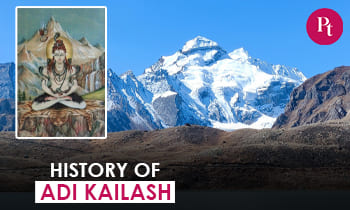
Adi Kailash, also known as Chhota Kailash (Little Kailash), is a sacred Himalayan peak revered as an abode of Lord Shiva in Hindu tradition. Located in the Kumaon Himalayas of Uttarakhand, the history of Adi Kailash weaves together ancient mythology, sacred pilgrimage traditions, and centuries of devotion.
This guide covers the spiritual significance of Adi Kailash, its connections to Hindu scripture and epics, its role in the Panch Kailash tradition, its location and altitude, and the sacred sites in its surrounding landscape.
⚡ Adi Kailash – Key Facts: Location: Pithoragarh district, Uttarakhand | Altitude: ~5,945 m (19,505 ft) | Also known as: Chhota Kailash, Shiva Kailash, Baba Kailash, Jyolingkong Peak | Part of: Panch Kailash (five sacred Kailash peaks) | Base camp: Jyolingkong (~4,700 m) | Sacred river nearby: Kali River (Kali Ganga) | Best season: May–June, September–October | Permit: Inner Line Permit (ILP) required
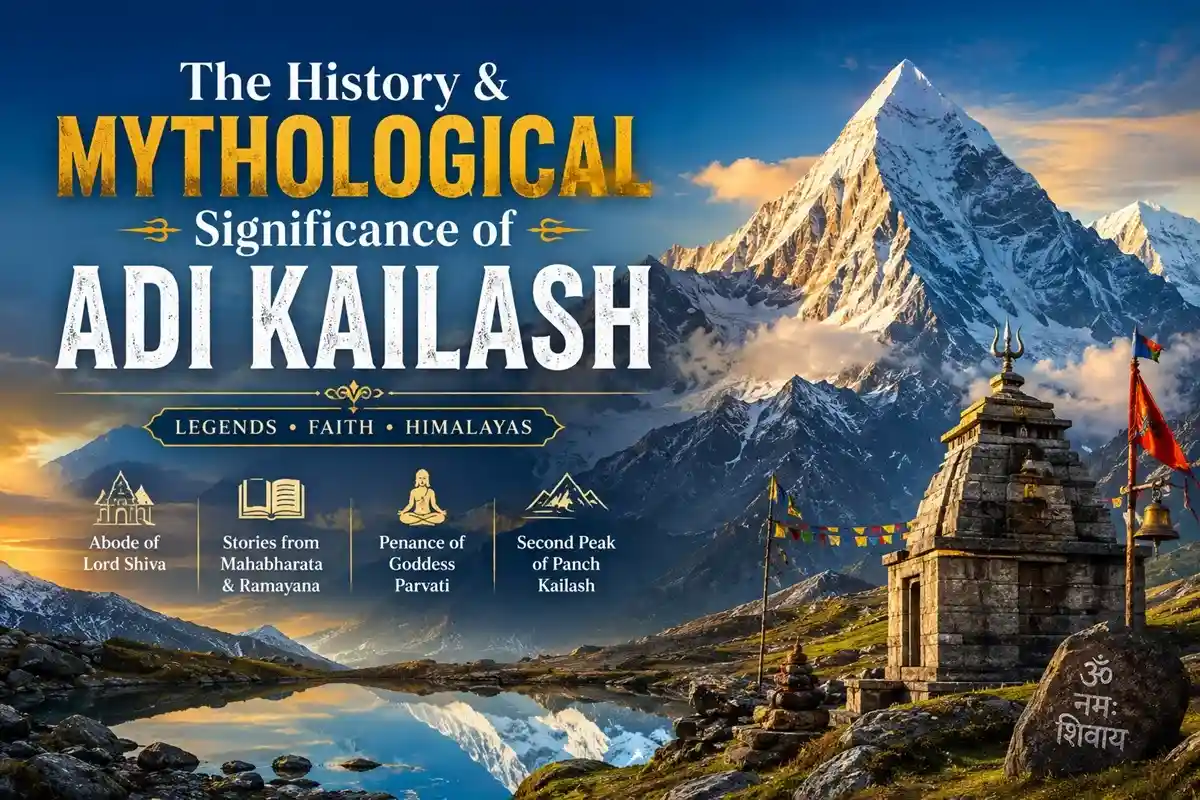
Location and Geography of Adi Kailash
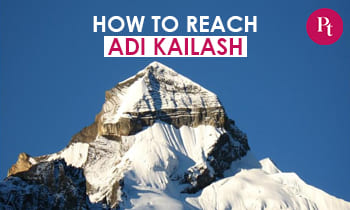
Adi Kailash is located in the Pithoragarh district of Uttarakhand, India, in the Kumaon Himalayas. It lies in the Dharchula subdivision near the Indo-Tibet border.
- Altitude: ~5,945 metres (19,505 feet) above sea level
- Base camp: Jyolingkong (Jolingkong), ~4,700 m — a high-altitude meadow with a Shiva-Parvati temple
- Nearest town: Dharchula (~91 km from Jyolingkong by road)
- Key river: Kali River (Kali Ganga) — flows through Kalapani valley on the India-Nepal border
- Permit: Inner Line Permit (ILP) mandatory; issued at the SDM Office, Dharchula
- Nearest pass: Lipulekh Pass — historic trade route; used for Kailash Mansarovar Yatra

What is Adi Kailash? – Significance in Hinduism
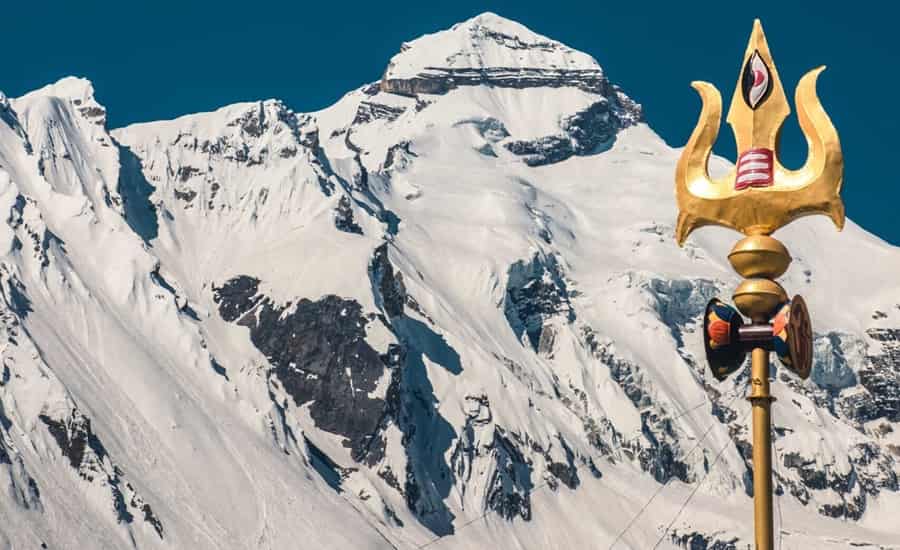
Adi Kailash is revered by devotees as an earthly abode of Lord Shiva — the supreme deity of the Shaiva tradition. The mountain’s distinctive pyramidal shape closely resembles that of Mount Kailash in Tibet, which is why it has earned the name Chhota Kailash (Little Kailash).
In Hindu tradition, Adi Kailash is considered a highly sacred Shiva kshetra (sacred Shiva zone) in the Kumaon Himalayas.
It is one of the five peaks known collectively as the Panch Kailash. For seekers unable to reach Mount Kailash in Tibet, Adi Kailash serves as a spiritually equivalent and more accessible destination within India.
Mythological Reference of Adi Kailash
The Chhota Kailash region finds references in ancient Hindu sacred traditions. The Shiva Purana describes the Himalayas as the abode of Lord Shiva, and the Kumaon range has been revered as a sacred Shiva zone since antiquity.
Local oral traditions, pilgrimage guides (mahatmyas), and regional texts have long identified Adi Kailash as a sacred Shiva tirtha (pilgrimage site). Despite their distant locations, Mount Kailash in Tibet and Adi Kailash in Uttarakhand share a deep devotional bond — both pyramidal, both sacred to Hindus, Buddhists, and Jains.
Panch Kailash – The Five Sacred Kailash Peaks
Adi Kailash is one of the five peaks known as the Panch Kailash in Hindu tradition — five Himalayan peaks each revered as a sacred abode of Lord Shiva. The five peaks are:
| Peak | Location | Key Feature |
| Mount Kailash (Kailash Mansarovar) | Tibet (China) | Primary sacred abode of Shiva; Kailash Parikrama; revered by Hindus, Buddhists, Jains, Bonpos |
| Adi Kailash (Chhota Kailash) | Pithoragarh, Uttarakhand | Pyramidal peak resembling Mount Kailash; Jyolingkong base camp; Om Parvat nearby |
| Shrikhand Mahadev Kailash | Kullu, Himachal Pradesh | Natural Shiva Lingam at 5,155 m; challenging trek from Jaon village |
| Kinnaur Kailash | Kinnaur, HP | Iconic 79-ft rock Shiva Lingam near Kalpa; revered by Hindus and Buddhists |
| Manimahesh Kailash | Chamba, HP | Sacred Manimahesh Lake; annual Manimahesh Yatra in September |
Note: There is no officially recognised ranking among the Panch Kailash peaks. Each is revered in its own regional devotional tradition. Mount Kailash in Tibet is universally regarded as the primary sacred peak.
Mythological Importance of Adi Kailash
Adi Kailash is revered by devotees as one of the earthly abodes of Lord Shiva in the Kumaon Himalayas. Hindu tradition holds that the entire Himalayan range is sacred to Shiva, and Adi Kailash is considered one of its most potent Shiva tirthas.
The faith in Adi Kailash as a Shiva kshetra forms the very foundation of the Adi Kailash Yatra. The sacred journey is viewed as an important religious pilgrimage, with seekers coming from across India and abroad to obtain the divine blessings of Lord Shiva.
Connection to Mount Kailash (Kailash Parvat)
Adi Kailash, also called Shiva Kailash, shares a profound sacred bond with Mount Kailash in Tibet. The striking pyramidal shape of both mountains — and their shared association with Lord Shiva — is why devotees call Adi Kailash the Chhota Kailash (Little Kailash).
Mount Kailash is simultaneously venerated by Hindus, Buddhists, Jains, and Bonpos as one of the most sacred mountains on earth. Adi Kailash, located entirely within India, provides a spiritually meaningful and more accessible alternative for those who cannot obtain Chinese permits or undertake the Tibet journey.
Adi Kailash in the Mahabharata Tradition
According to local traditions and regional oral beliefs, the five Pandava brothers — Yudhishthira, Bhima, Arjuna, Nakula, and Sahadeva — along with Draupadi, are believed to have visited the Adi Kailash region during their final Himalayan journey (the Mahaprasthanika Parva).
The Mahabharata’s Mahaprasthanika Parva describes the Pandavas’ final journey toward the Himalayas after the Kurukshetra war. Local tradition holds that their path passed through the Kumaon Himalayan region, and Adi Kailash is associated with this sacred Himalayan pilgrimage route.
Near Kutti village, there is a local structure called Pandav Kila, associated by local communities with this Pandava legend. These traditions add historical depth and meaning to the Adi Kailash Yatra for pilgrims today.
Ravana and the Kailash Tradition
Some local legends and devotional traditions of the Kumaon region associate Ravana’s legendary devotion to Lord Shiva with the broader Kailash tradition. Ravana is widely celebrated in Hindu mythology as one of the greatest devotees of Lord Shiva.
While primary scriptural sources specifically associate Ravana’s Shiva penance with Mount Kailash in Tibet, regional oral traditions of the Kumaon area include Ravana in the sacred narrative of the Kailash landscape.
The broader lesson from Ravana’s story — that even extraordinary devotion must be accompanied by wisdom and humility — remains a powerful spiritual message for pilgrims at Adi Kailash.
In Hindu mythology, Goddess Parvati and Lord Shiva are inseparably associated with the Kailash landscape. Local beliefs and devotional traditions of the Kumaon Himalayas hold that the goddess meditated in this sacred region.
In Hindu mythology, Goddess Parvati and Lord Shiva are inseparably associated with the entire Kailash landscape. Local beliefs and devotional traditions of the Kumaon Himalayas hold that Goddess Parvati meditated in the Kailash region to win the love of Lord Shiva.
The presence of Gauri Kund (also known as Jolingkong Lake) — named after Gauri, one of Goddess Parvati’s names — and Parvati Sarovar at the base of Adi Kailash reflects this deep sacred association. The names of these glacial lakes themselves carry the mythological imprint of the goddess.
The story of devotion, patience, and spiritual discipline that Parvati represents is a guiding inspiration for every pilgrim who undertakes the Adi Kailash Yatra.
Philosophical Teachings from the Sacred Traditions
The mythology and sacred traditions woven into Adi Kailash carry deep philosophical messages:
- The Pandava tradition: Sacred pilgrimage cleanses the soul and connects one to the divine. The journey itself is the transformation.
- The Ravana tradition: Even profound devotion requires wisdom and humility. Power without dharma leads to downfall.
- The Parvati tradition: Steadfast, patient devotion is rewarded. The highest spiritual goals require dedication and self-discipline.
- The Shiva tradition: The entire Himalayan landscape is sacred. Lord Shiva is present in the mountain, the river, and the high-altitude silence.
Sacred Sites on the Adi Kailash Pilgrimage Route
The Adi Kailash Yatra encompasses a remarkable cluster of sacred and historically significant sites:
| Site | Altitude | Significance |
| Adi Kailash / Jyolingkong Peak | ~5,945 m | Sacred pyramidal peak; Lord Shiva’s abode; resembles Mount Kailash |
| Jyolingkong (Base Camp) | ~4,700 m | Sacred meadow; ancient Shiva-Parvati temple; pilgrims’ darshan point |
| Gauri Kund (Jolingkong Lake) | ~4,608 m | Sacred glacial lake; named after Goddess Parvati (Gauri) |
| Parvati Sarovar | ~5,600 m | Sacred lake; associated with Goddess Parvati; believed to grant blessings |
| Om Parvat | ~5,600 m | Sacred peak with natural ‘Om’ (ॐ) symbol formed by snow; viewed from Nabidhang |
| Nabidhang | ~4,500 m | Viewpoint for Om Parvat; last camp before Lipulekh Pass |
| Vyas Gufa | Near Kalapani | Cave associated with Sage Vyas; believed to be where the Mahabharata was composed |
| Kalapani (Kali Mata Temple) | ~3,600 m | Ancient Kali Mata shrine at confluence of Kali Ganga and Dhauliganga |
| Pandav Kila | Near Kutti | Ruins associated with Pandava legend; local pilgrimage site |
| Gunji village | ~3,200 m | Last major village before restricted zone; acclimatisation point |
| Kutti village | ~3,650 m | Traditional Tibetan-Bhotiya community; heritage houses |
Historical Importance of Adi Kailash
The Adi Kailash region has been a sacred destination since the earliest periods of Hinduism. The ancient pilgrimage tradition to the Kailash range is referenced in texts including the Shiva Purana and the Skanda Purana, which describe the Himalayas as the dwelling of Lord Shiva.
Through the centuries, pilgrims from across the Indian subcontinent traversed the Kali River valley and the high-altitude passes of the Kumaon Himalayas to seek divine blessings at this sacred Shiva kshetra. The historical significance of Adi Kailash is inseparable from the broader history of Himalayan pilgrimage in India.
In contemporary times, the construction of a motorable road to Jyolingkong has made the Adi Kailash Yatra significantly more accessible, while preserving its sacred character.
Continuity of Spirituality at Adi Kailash
The Adi Kailash Yatra stands as a symbol of humankind’s enduring search for the divine. Every pilgrim who walks the Kali River valley and gazes upon the pyramidal summit of Chhota Kailash becomes part of an unbroken chain of devotees stretching back millennia.
Modern pilgrims walk the same sacred paths as ancient seekers — connected by shared faith, the landscape of the Kumaon Himalayas, and the presence of Lord Shiva in the mountain silence.
Adi Kailash Yatra – Practical Information
- Best season: May–June and September–October. Avoid July–August (monsoon, landslide risk on Kali River valley roads).
- Duration: Typically 8–10 days from Delhi; 6–8 days from Kathgodam.
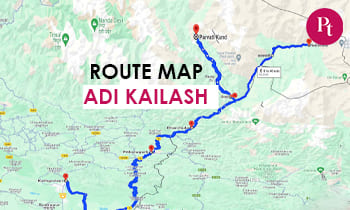
- Route: Delhi/Kathgodam → Pithoragarh → Dharchula → Tawaghat → Gunji → Kutti → Jyolingkong (Adi Kailash).
- Permits: Inner Line Permit (ILP) issued at SDM Office, Dharchula. Mandatory for all Indian citizens.
- Transport: 4×4 vehicles (Bolero/Scorpio/Camper) mandatory beyond Dharchula; new motorable road reaches Jyolingkong.
- Altitude: Jyolingkong base camp at ~4,700 m. Acclimatisation at Dharchula or Gunji essential.
- Can seniors visit: Yes, with medical clearance. The motorable road to Jyolingkong makes it accessible for senior citizens and those with limited mobility. 4×4 vehicle carries pilgrims to the base camp.
Conclusion
The history of Adi Kailash is a rich tapestry of mythology, devotion, and Himalayan sacred tradition. From its identity as a Shiva tirtha to the sacred lakes of Gauri Kund and Parvati Sarovar — every element reflects the depth of Hindu spiritual culture.
Standing at ~5,945 metres in Pithoragarh, Uttarakhand, this Chhota Kailash — the sacred Shiva Kailash of the Kumaon Himalayas — continues to draw pilgrims from across India.
The Kali River valley, the sacred lakes, and the high peaks near the Indo-Tibet border make this one of the most transformative pilgrimage landscapes in India.
Frequently Asked Questions
Q1. What is the history of Adi Kailash?
Adi Kailash has been a sacred site since ancient times, revered as an abode of Lord Shiva in the Kumaon Himalayas. Referenced in regional traditions of the Shiva Purana and Skanda Purana, it has drawn pilgrims for centuries.
In modern times, the motorable road to Jyolingkong has made this sacred Shiva kshetra accessible to a wider audience.
Q2. Why is Adi Kailash called Chhota Kailash?
Adi Kailash is called Chhota Kailash (Little Kailash) because its pyramidal shape closely mirrors that of Mount Kailash in Tibet. Both are revered as abodes of Lord Shiva, sacred to Hindus, Buddhists, and Jains. Adi Kailash serves as India’s most accessible sacred alternative to Mount Kailash.
Q3. What is the altitude of Adi Kailash?
Adi Kailash stands at approximately 5,945 metres (19,505 feet) above sea level. The base camp at Jyolingkong is at ~4,700 metres. Om Parvat, visible from Nabidhang viewpoint, stands at approximately 5,600 metres.
Q4. Where is Adi Kailash located?
Adi Kailash is in the Pithoragarh district of Uttarakhand, India, in the Kumaon Himalayas, near the Indo-Tibet border. The Kali River (Kali Ganga) flows through the valley below. An Inner Line Permit (ILP) is required for all visitors.
Q5. What is the significance of Adi Kailash in Hinduism?
Adi Kailash is revered as a Shiva tirtha and an important sacred destination in the Kumaon Himalayas. It is part of the Panch Kailash.
The Adi Kailash Yatra attracts seekers from across India and abroad who come to receive the divine blessings of this sacred landscape.
Q6. Is Adi Kailash mentioned in the Puranas?
The Shiva Purana and Skanda Purana describe the entire Himalayan region as the sacred domain of Lord Shiva. The Kumaon Himalayan range, including the Kailash peaks, is referenced as a Shiva kshetra in these ancient texts. The specific name ‘Adi Kailash’ appears in regional mahatmya (pilgrimage glorification) texts and local sacred traditions.
Q7. What is the connection between Adi Kailash and the Pandavas?
According to local traditions and oral beliefs, the five Pandavas — Yudhishthira, Bhima, Arjuna, Nakula, and Sahadeva — along with Draupadi, are believed to have passed through the Kumaon Himalayan region during their final Himalayan journey (Mahaprasthanika Parva). Pandav Kila near Kutti village is a local site associated with this tradition.
Q8. What is the Ravana and Adi Kailash connection?
Some local legends of the Kumaon region associate Ravana’s legendary devotion to Lord Shiva with the broader Kailash tradition. Scriptural sources primarily associate Ravana’s Shiva penance with Mount Kailash in Tibet; the connection to Adi Kailash specifically comes from regional oral traditions.
Q9. What is Panch Kailash and is Adi Kailash part of it?
Panch Kailash refers to five sacred Himalayan peaks revered as abodes of Lord Shiva: Mount Kailash (Tibet), Adi Kailash (Uttarakhand), Shrikhand Mahadev Kailash (HP), Kinnaur Kailash (HP), and Manimahesh Kailash (HP). Adi Kailash is one of these five sacred peaks; there is no officially established ranking among them.
Q10. Why is Adi Kailash considered sacred?
Adi Kailash is revered as a Shiva kshetra in the Kumaon Himalayas. Its pyramidal shape mirrors Mount Kailash in Tibet.
Sacred glacial lakes Gauri Kund and Parvati Sarovar sit at its base. The natural Om symbol on nearby Om Parvat adds further spiritual depth.
Q11. What are the sacred sites near Adi Kailash?
Key sacred sites near Adi Kailash: Gauri Kund (Jolingkong Lake), Parvati Sarovar, Om Parvat (visible from Nabidhang), Vyas Gufa (cave near Kalapani), Kali Mata Temple (Kalapani), Pandav Kila (near Kutti), and the ancient Shiva-Parvati temple at Jyolingkong base camp.
Q12. What is the best time to visit Adi Kailash?
Best time: May–June and September–October. May–June has clear skies and pleasant weather. September–October offers post-monsoon clarity. Avoid July–August (heavy rain, landslides on Kali River valley roads) and November–April (extreme cold, route closed).
Q13. What is the difference between Adi Kailash and Mount Kailash?
Mount Kailash (6,638 m) is in Tibet (China) and requires a Chinese permit; Adi Kailash (5,945 m) is in Uttarakhand, India, and requires only an Inner Line Permit. Both are pyramidal in shape and sacred to Shiva devotees. Adi Kailash is far more accessible and within India.
Q14. Who discovered Adi Kailash?
Adi Kailash has been known to local Kumaoni and Bhotiya communities for centuries as a sacred pilgrimage site.
The first recorded modern climb was attempted in 2002 by Martin Moran’s team. The first successful summit was achieved in October 2004 by a British-Scottish-American team, who stopped 10 metres short out of respect for the peak’s holy status.
Q15. Is Adi Kailash older than Mount Kailash as a pilgrimage site?
Both Mount Kailash (Tibet) and Adi Kailash (Uttarakhand) have ancient pilgrimage traditions rooted in the earliest periods of Hinduism. Mount Kailash is universally considered the primary sacred peak in Hindu, Buddhist, Jain, and Bon traditions. Adi Kailash is revered as its sacred counterpart in the Indian Himalayas, and both have been pilgrimage destinations since antiquity.
Q16. Can senior citizens visit Adi Kailash?
Yes. A motorable road now reaches Jyolingkong base camp, making Adi Kailash accessible for senior citizens and those with limited trekking ability. 4×4 vehicles carry pilgrims from Dharchula to Jyolingkong. Medical fitness clearance is recommended. The best season for seniors is May–June or September.
Q17. What permits are required for Adi Kailash Yatra?
An Inner Line Permit (ILP) is mandatory for all Indian citizens. Issued at the SDM Office in Dharchula, Pithoragarh. Carry government photo ID (Aadhaar preferred) and passport photos. ILP is verified at multiple checkposts en route. Foreign nationals require separate permissions from the Ministry of Home Affairs.
Q18. What is Om Parvat and is it near Adi Kailash?
Om Parvat is a sacred peak at ~5,600 metres, located near the Nabidhang viewpoint on the Kailash Mansarovar Yatra route. It is renowned for the natural ‘Om’ (ॐ) symbol formed by snow on its face. Om Parvat and Adi Kailash are both in the Pithoragarh district and can be combined in a single itinerary.
Q19. What is Vyas Gufa near Adi Kailash?
Vyas Gufa is a sacred cave near Kalapani on the Adi Kailash route, traditionally believed to be the place where Sage Vyas (Vyasa) composed the Mahabharata. It is a small but deeply significant pilgrimage stop for devotees and spiritual seekers on the Adi Kailash Yatra.
Q20. How does the Adi Kailash Yatra compare to Kailash Mansarovar Yatra?
Adi Kailash Yatra (8–10 days, within India, ILP only) is significantly shorter, cheaper, and easier to plan than Kailash Mansarovar Yatra (Tibet, 15–22 days, Chinese permits, higher cost). Adi Kailash offers a spiritually comparable experience and is especially recommended for first-time Himalayan pilgrims or those unable to obtain Tibet permits.




 Call
Call WhatsApp
 Enquiry