
Planning your Chardham Yatra in 2026 and need the exact road route, distances between each dham, and a clear sequence of how to travel? This is the only guide you need. The Chardham Yatra route map covers four sacred shrines in the Garhwal Himalayas of Uttarakhand — Yamunotri, Gangotri, Kedarnath, and Badrinath — connected by mountain highways that demand careful planning.
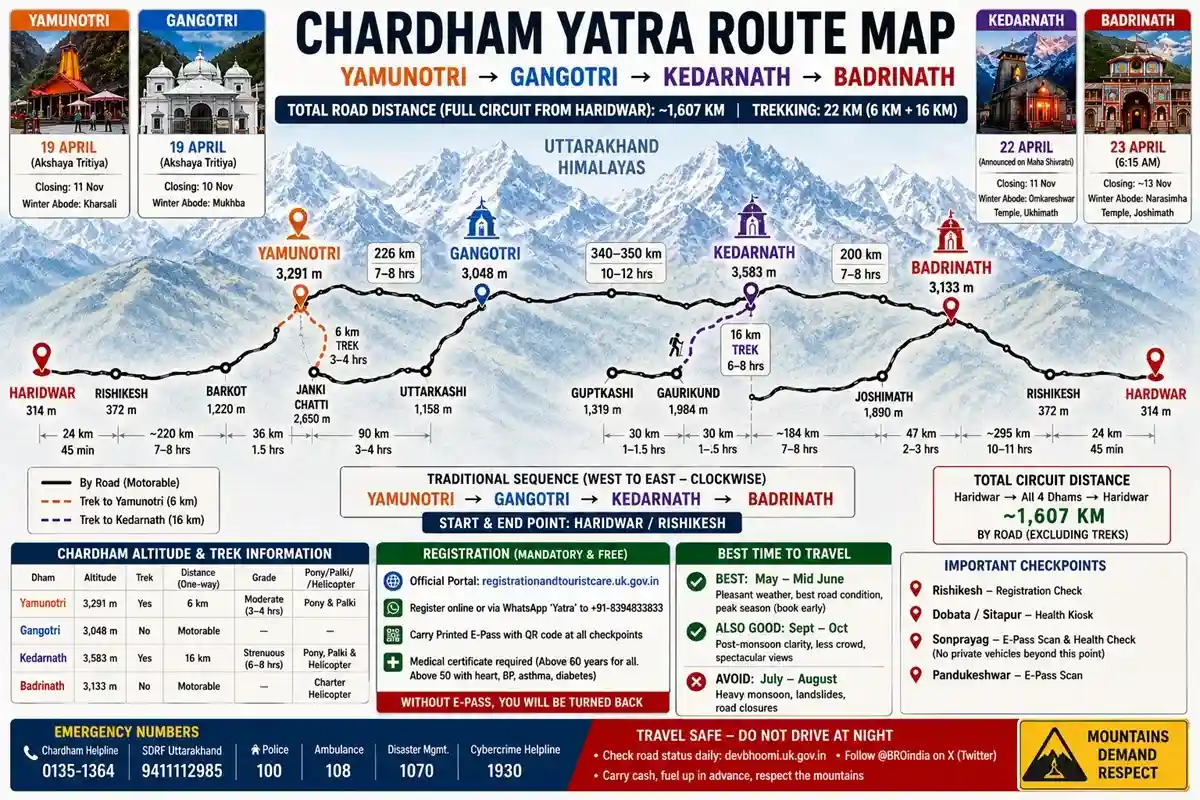
The 2026 Chardham Yatra season has officially begun. Yamunotri and Gangotri opened on 19 April, Kedarnath on 22 April, and Badrinath on 23 April at 6:15 AM. The total road distance from Haridwar covering all four dhams and returning to Haridwar is approximately 1,607 km. All four dhams are accessible by road, with two treks involved: 6 km from Janki Chatti to Yamunotri, and 16 km from Gaurikund to Kedarnath.
This guide gives you the correct 2026 route with verified segment distances, the mandatory registration process, best travel months, transport options, and safety warnings — everything you need before your first day on the mountain.
Key Takeaways
- 2026 opening dates confirmed: Yamunotri & Gangotri — 19 April | Kedarnath — 22 April | Badrinath — 23 April at 6:15 AM
- Tentative closing dates: Gangotri — 10 November | Yamunotri — 11 November | Kedarnath — 11 November | Badrinath — ~13 November 2026
- Traditional route sequence: Yamunotri → Gangotri → Kedarnath → Badrinath (west to east, clockwise)
- Total distance from Haridwar (full circuit): ~1,607 km by road
- Only two treks required: Janki Chatti to Yamunotri (6 km) and Gaurikund to Kedarnath (16 km) — Gangotri and Badrinath are fully motorable
- Yatra registration MANDATORY for all four dhams — free at registrationandtouristcare.uk.gov.in; carry printed E-Pass at all checkpoints
- Medical fitness certificate required for pilgrims above 50 with pre-existing heart, BP, diabetes, or respiratory conditions
- 30+ active landslide zones on Rishikesh–Devprayag stretch as of April 2026 — night driving strictly prohibited
- WhatsApp registration: send ‘Yatra’ to +91-8394833833 | Helpline: 0135-1364
Why Does the Chardham Yatra Follow This Specific Sequence?
The traditional Chardham Yatra sequence — Yamunotri first, Gangotri second, Kedarnath third, Badrinath last — is not arbitrary. It follows a west-to-east clockwise direction through the Garhwal Himalayas, which is both spiritually prescribed and geographically logical given the road network.
According to Hindu tradition, you begin at the source of the Yamuna (Yamunotri), move to the source of the Ganga (Gangotri), seek blessings of Lord Shiva at Kedarnath, and conclude at Lord Vishnu’s abode at Badrinath. The clockwise direction mirrors the pradakshina ritual. Practically, this sequence also minimizes unnecessary road backtracking across the mountain terrain.
Route 1: Haridwar / Rishikesh to Yamunotri Dham
Yamunotri Dham is dedicated to Goddess Yamuna and sits at an altitude of 3,291 metres in the Uttarkashi district. It is the westernmost and first dham of the Chardham circuit. The road journey ends at Janki Chatti, from where a 6 km trek leads to the Yamunotri temple.
Route via Rishikesh (Standard Route — Recommended)
Rishikesh → Narendra Nagar → Chamba → Barkot → Syana Chatti → Hanuman Chatti → Janki Chatti → [6 km trek] → Yamunotri
From Rishikesh, the distance to Janki Chatti is approximately 235 km. Drive time: 8–9 hours. Barkot (55 km before Janki Chatti) is the most convenient overnight halt on this route. Most pilgrims stay one night at Barkot and begin the trek to Yamunotri the next morning.
Route via Dehradun (Scenic but Longer)
Dehradun → Mussoorie → Naugaon → Barkot → Syana Chatti → Hanuman Chatti → Janki Chatti → [6 km trek] → Yamunotri
This route is scenic, passing through Mussoorie hill station. Hanuman Chatti is on this route but is NOT the starting point for the Yamunotri trek — that role now belongs to Janki Chatti, approximately 7 km further up the road from Hanuman Chatti.
The Yamunotri Trek: 6 km from Janki Chatti
The motorable road ends at Janki Chatti (2,650 m). From here, the 6 km one-way trek to Yamunotri temple (3,291 m) involves an altitude gain of approximately 641 m and takes 3–4 hours at an easy pace. The trek passes through Phool Chatti. Pony and palki (palanquin) services are available from Janki Chatti for those who need assistance.
IMPORTANT 2026 CORRECTION: The Yamunotri trek starting point is Janki Chatti — NOT Hanuman Chatti. Hanuman Chatti is a road junction 7 km before Janki Chatti. The road has been extended to Janki Chatti, making that the current motorable endpoint and trek starting point.
Places to see along the way: Janki Chatti, Phool Chatti, Surya Kund (natural hot spring where pilgrims cook rice as prasad), Divya Shila, Yamunabai Kund, Kharsali village (Yamunotri winter abode), Hanuman Chatti, Saptarishi Kund.
Route 2: Yamunotri to Gangotri Dham
After completing darshan at Yamunotri and returning to Janki Chatti, pilgrims drive back to Barkot and then continue to Uttarkashi, the base town for Gangotri. Gangotri Dham is dedicated to Goddess Ganga and sits at 3,048 m. The motorable road extends all the way to Gangotri temple — no trek required. Note: The Gangotri temple remains closed daily between 2:00 PM and 3:00 PM. Plan your darshan timing to avoid arriving during this midday window. Note: The Gangotri temple remains closed daily between 2:00 PM and 3:00 PM. Plan your darshan timing to avoid arriving during this midday window.
Route: Janki Chatti → Barkot → Dharasu Bend → Uttarkashi → Harsil → Bhaironghati → Gangotri
The distance from Yamunotri (Janki Chatti) to Gangotri is approximately 226 km by road and takes 7–8 hours. Uttarkashi (~100 km from Gangotri) is the best overnight halt option — it has hotels, ATMs, and a medical facility. The 25 km stretch from Harsil to Gangotri is the most scenic but also most weather-sensitive segment.
Pro Tip: Most experienced pilgrims prefer to spend one night at Uttarkashi rather than pushing to Gangotri and back in a single day. The Vishwanath Temple in Uttarkashi is also worth visiting. Early morning darshan at Gangotri means reaching the temple before 9 AM — queue is short and the Himalayan scenery is at its most spectacular.
2026 caution zone: The Bhatwari stretch between Uttarkashi and Harsil has been flagged for roadwork and landslide risk in the 2026 season. Cross this section before noon.
Places to see: Gaumukh Glacier (19 km trek from Gangotri — separate trip), Jalmagna Shivlinga, Tapovan, Harsil valley, Bhaironghati, Dharali.
Route 3: Gangotri to Kedarnath Dham
Kedarnath Dham is dedicated to Lord Shiva and is one of the 12 Jyotirlingas. It sits at 3,583 m near the Mandakini River in Rudraprayag district. The route from Gangotri to Kedarnath is the longest inter-dham segment of the entire circuit.
Route: Gangotri → Harsil → Uttarkashi → Dharasu Bend → Chamba → Devprayag → Srinagar (Garhwal) → Rudraprayag → Agastmuni → Tilwara → Guptkashi → Sonprayag → Gaurikund → [16 km trek] → Kedarnath
Distance from Gangotri to Gaurikund: approximately 340–350 km by road (via Uttarkashi–Rudraprayag–Guptkashi–Sonprayag). Drive time: 10–12 hours from Gangotri. This is the longest single leg of the Chardham circuit. Guptkashi (30 km before Sonprayag) is the most popular overnight halt for this leg — good hotels, close to Kedarnath helicopter helipads at Phata and Sirsi. Most pilgrims prefer arriving at Guptkashi the evening before and starting for Sonprayag at 5 AM the next morning.
Sonprayag to Gaurikund: The Critical Checkpoint
Sonprayag is the last point where public transport operates. From Sonprayag, government shuttle services run to Gaurikund (5 km). Private vehicles are not permitted beyond Sonprayag for Kedarnath. Your Chardham registration E-Pass is scanned at Sonprayag — without it, you are turned back.
Health kiosks at Sonprayag check BP and SpO2. Pilgrims with SpO2 below 85% may be advised not to proceed. These kiosks operate from 6 AM to 8 PM.
The Kedarnath Trek: 16 km from Gaurikund
The motorable road ends at Gaurikund (1,984 m). The 16 km one-way trek to Kedarnath temple (3,583 m) involves a steep altitude gain of 1,599 m and takes 6–8 hours at a comfortable pace. This is a physically demanding trek at high altitude. Pony, palki, and pitthu (porter) services are available from Gaurikund. Helicopter services operate from Phata, Sirsi, and Guptkashi helipads — book only at heliyatra.irctc.co.in.
Most pilgrims stay one night at or near Kedarnath to recover, attend morning aarti at the temple the next day, and then descend. Accommodation is available at Kedarnath base camp.
Places to see: Gandhi Sarovar (also called Chorabari Tal, 3 km above Kedarnath), Vasuki Tal (6 km further, strenuous), Shankaracharya Samadhi inside the temple complex.
Route 4: Kedarnath to Badrinath Dham
Badrinath Dham is dedicated to Lord Vishnu (Badrinarayan) and sits at 3,133 m on the banks of the Alaknanda River. It is the final dham of the circuit and is fully motorable — no trek required. Badrinath is the most visited of the four dhams.
Route: Gaurikund → Rudraprayag → Chamoli → Pipalkoti → Joshimath → Badrinath
Distance from Gaurikund to Badrinath: approximately 200 km. Drive time: 7–8 hours. Joshimath (47 km before Badrinath) is strongly recommended as the overnight halt before proceeding to Badrinath — it allows natural acclimatization at 1,890 m before ascending to 3,133 m. One night at Joshimath can significantly reduce altitude sickness risk at Badrinath.
After Badrinath darshan, most pilgrims return via Joshimath → Chamoli → Rudraprayag → Devprayag → Rishikesh → Haridwar, completing the full circuit.
2026 caution zones on this route: Lambagad stretch between Pipalkoti and Joshimath, Helang bypass, Vishnuprayag bridge — active landslide risk areas. Cross in daylight only.
Places to see: Tapt Kund (natural hot spring before temple entry), Brahma Kapal, Mana Village (last Indian village before Tibet border, 3 km), Vyas Guha, Narad Kund, Charan Paduka, Saraswati River confluence at Mana.
Chardham Yatra Route Map with Distances 2026 — Complete Segment Chart
The following verified distance table covers the complete Chardham Yatra circuit from Delhi to Haridwar and back:
| From | To | Distance (km) | Type |
| Delhi | Haridwar | ~220-230 km | Road — NH-58 / NH-334 |
| Haridwar | Dehradun | ~56 km | Road |
| Haridwar | Barkot (Yamunotri base) | ~220 km | Road via Rishikesh–Chamba |
| Rishikesh | Janki Chatti (Yamunotri) | ~235 km | Road — NH via Barkot |
| Dehradun | Hanuman Chatti | ~173 km | Road via Mussoorie–Naugaon |
| Hanuman Chatti | Janki Chatti | ~7 km | Road |
| Janki Chatti | Phool Chatti | ~3 km | Trek |
| Janki Chatti | Yamunotri Temple | 6 km | Trek (uphill, 3-4 hrs) |
| Janki Chatti | Uttarkashi | ~90 km | Road via Dharasu |
| Uttarkashi | Gangotri | ~100 km | Road via Harsil |
| Janki Chatti | Gangotri (total) | ~226 km | Road |
| Gangotri | Rudraprayag | ~274 km | Road |
| Rudraprayag | Guptkashi | ~44 km | Road |
| Guptkashi | Sonprayag | ~30 km | Road |
| Sonprayag | Gaurikund | ~5 km | Shuttle (no private vehicles) |
| Gaurikund | Kedarnath Temple | 16 km | Trek (strenuous, 6-8 hrs) |
| Gaurikund | Joshimath | ~184 km | Road |
| Joshimath | Badrinath | ~47 km | Road (2-3 hrs peak season) |
| Badrinath | Rishikesh (return) | ~295-297 km | Road via NH-7 |
| Rishikesh | Haridwar | ~24 km | Road |
TOTAL CIRCUIT DISTANCE: Haridwar → Yamunotri → Gangotri → Kedarnath → Badrinath → Haridwar = approximately 1,607 km by road, plus 22 km trekking (6 km Yamunotri + 16 km Kedarnath). From Delhi, add ~440-460 km round trip.
Chardham Dham-wise Altitude & Trek Information
| Dham | Altitude | Trek Required | Trek Distance | Trek Grade | Pony/Palki/Helicopter |
| Yamunotri | 3,291 m (10,797 ft) | Yes — from Janki Chatti | 6 km one-way | Moderate (3-4 hrs) | Pony & Palki available |
| Gangotri | 3,048 m (9,997 ft) | No | Motorable road | N/A | N/A |
| Kedarnath | 3,583 m (11,755 ft) | Yes — from Gaurikund | 16 km one-way | Strenuous (6-8 hrs) | Pony, Palki & Helicopter |
| Badrinath | 3,133 m (10,276 ft) | No | Motorable road | N/A | Charter helicopter from Dehradun |
Road Safety & Travel Tips for Chardham Route 2026
Critical Rules — Every Pilgrim Must Follow
- Never drive at night on any Chardham route — mountain fatalities are disproportionately night-time accidents. Stop before dark without exception.
- Check road status every morning before departure at devbhoomi.uk.gov.in or call 0135-1364. Road open yesterday does not mean open today.
- 2026 active risk zones: Tota Ghati, Mulya Gaon, NHPC Bend (Rishikesh–Devprayag) | Lambagad, Helang, Vishnuprayag (near Joshimath) | Tilwara–Manthali (Kedarnath) | Bhatwari (Gangotri highway). Cross these only in daylight.
- Follow BRO clearance updates in real-time at @BROindia on X (Twitter) and SDMA Uttarakhand at sdma.uk.gov.in.
- Carry enough cash — ATMs are unavailable at Gangotri, Kedarnath, and Badrinath. Withdraw at Haridwar, Rishikesh, or Joshimath.
- Fuel up at Haridwar, Rishikesh, Uttarkashi, Rudraprayag, Guptkashi, or Joshimath. No petrol pumps at Gangotri, Kedarnath, or Badrinath.
Altitude Health Warnings
- Kedarnath (3,583 m) and Badrinath (3,133 m) are high altitudes — carry a pulse oximeter. Below 90% SpO2: rest. Below 85%: descend immediately.
- Do not rush ascent — acclimatize at Joshimath (1,890 m) before Badrinath; at Guptkashi before Kedarnath.
- Altitude sickness (AMS) symptoms: persistent headache, nausea, breathlessness at rest — stop ascending if these appear.
- Pilgrims above 50 with cardiac or BP conditions: get medical clearance before travel; consider helicopter for Kedarnath.
Frequently Asked Questions
Q1. What is the correct sequence for Chardham Yatra?
Ans: The traditional and correct sequence is: Yamunotri → Gangotri → Kedarnath → Badrinath. This west-to-east clockwise direction is both spiritually prescribed in Hindu tradition and practically logical given the road network. The journey starts from Haridwar or Rishikesh and follows this sequence before returning to the same gateway city.
Q2. What is the total distance of Chardham Yatra from Haridwar?
Ans: The total road distance of the complete Chardham Yatra circuit from Haridwar — covering all four dhams and returning to Haridwar — is approximately 1,607 km. This includes the road journey between all dham locations but excludes the 6 km trek to Yamunotri and the 16 km trek to Kedarnath which are on foot.
Q3. Which dhams require trekking in Chardham Yatra?
Ans: Only two of the four dhams require trekking. Yamunotri requires a 6 km one-way trek from Janki Chatti (3–4 hours, moderate grade). Kedarnath requires a 16 km one-way trek from Gaurikund (6–8 hours, strenuous). Gangotri and Badrinath are both fully motorable — the road goes all the way to the temple premises.
Q4. When did Chardham Yatra 2026 start?
Ans: The 2026 Chardham Yatra season began on 19 April 2026, when Yamunotri and Gangotri opened simultaneously on the auspicious occasion of Akshaya Tritiya. Kedarnath opened on 22 April 2026, and Badrinath opened on 23 April 2026 at 6:15 AM. All four dhams are currently open for pilgrims.
Q5. Is Chardham Yatra registration mandatory in 2026?
Ans: Yes, registration is mandatory for all four dhams in 2026. The official portal is registrationandtouristcare.uk.gov.in — registration is completely free. You will receive a QR-coded E-Pass which is checked at all checkpoints. Without a valid E-Pass, you will be turned back at Sonprayag (Kedarnath route) and Pandukeshwar (Badrinath route).
Q6. What is the Yamunotri trek starting point in 2026?
Ans: The Yamunotri trek starts from Janki Chatti, not Hanuman Chatti. Hanuman Chatti is a road junction approximately 7 km before Janki Chatti. The road has been extended to Janki Chatti, making it the current motorable endpoint. The trek from Janki Chatti to Yamunotri temple is 6 km one-way (approximately 3–4 hours).
Q7. How many days does Chardham Yatra take?
Ans: A comfortable, well-paced Chardham Yatra from Haridwar takes 10–12 days minimum. A 12–14 day itinerary is recommended to include 2 buffer days for weather-related road delays, which are common especially in June. Rushing it in 8 days is possible but exhausting and not suitable for elderly pilgrims or families with children.
Q8. What is the best route from Delhi to Chardham?
Ans: From Delhi: Drive or take a train to Haridwar (~220–230 km, ~5–6 hours by road). From Haridwar, follow the standard route: Haridwar → Barkot (Yamunotri base) → Uttarkashi (Gangotri base) → Guptkashi (Kedarnath base) → Joshimath → Badrinath → return to Haridwar via Rishikesh. Alternatively, fly to Jolly Grant Airport, Dehradun (~302 km from Badrinath) and proceed by road.
Q9. Can I travel Chardham Yatra in July or August?
Ans: It is strongly not recommended. The Himalayan monsoon between late June and August causes repeated road closures, landslides, and cloudburst incidents on all four Chardham routes every year. In 2025, roads to all four dhams were blocked simultaneously on a single day. September and October offer better and safer conditions with shorter queues and clearer mountain views.
Q10. What transport is available for senior citizens on Chardham Yatra?
Ans: Senior citizens have good options for all four dhams. For Yamunotri: pony and palki from Janki Chatti. For Gangotri: fully motorable — no physical challenge. For Kedarnath: helicopter (heliyatra.irctc.co.in) or pony/palki from Gaurikund. For Badrinath: fully motorable. The Kedarnath helicopter is strongly recommended for pilgrims above 65 or those with cardiac or mobility limitations.
Q11. How do I check the live road status on the Chardham route?
Ans: Check devbhoomi.uk.gov.in (official Uttarakhand Police traffic portal), follow @BROindia on X (Twitter) for real-time road clearance updates, call 0135-1364 (Chardham helpline), or call your hotel at the next destination — they have the most current ground-level information. Check every morning before departure.
Q12. What is the distance from Rishikesh to Kedarnath?
Ans: The road distance from Rishikesh to Gaurikund (the motorable endpoint for Kedarnath) is approximately 223 km, taking 7–8 hours under normal conditions. From Gaurikund, the 16 km trek to Kedarnath temple takes 6–8 hours. Total distance Rishikesh to Kedarnath including trek: approximately 239 km road + 16 km trek.
Q13. Can I do Chardham Yatra by helicopter?
Ans: Yes. For Kedarnath, the government-authorized helicopter shuttle service operates from Phata, Sirsi, and Guptkashi helipads. Book only at heliyatra.irctc.co.in — 2026 confirmed fares: Sirsi Rs.6,390 RT, Phata Rs.10,164 RT, Guptkashi Rs.12,762 RT (plus 18% GST and Rs.300 convenience fee). For Badrinath, luxury charter helicopters from Sahastradhara Helipad, Dehradun are available at Rs.80,000–1,50,000 per person.


 Call
Call WhatsApp
 Enquiry
How long it’s take to all visit all the place, and how much it cost?