
Travel insurance is not mandatory for the Adi Kailash Yatra, but it is highly recommended because of the region’s high altitude, remote terrain, and limited medical facilities. While most journeys are completed safely, unexpected situations such as altitude sickness, illness, accidents, road closures, or weather-related disruptions can occur. A suitable travel insurance policy can help reduce the financial burden of medical treatment, emergency evacuation, hospitalisation, and trip interruptions.
This guide explains whether you need travel insurance for the Adi Kailash Yatra, the features to look for in a policy, common exclusions to watch out for, and practical tips to help you choose the right cover before your journey.
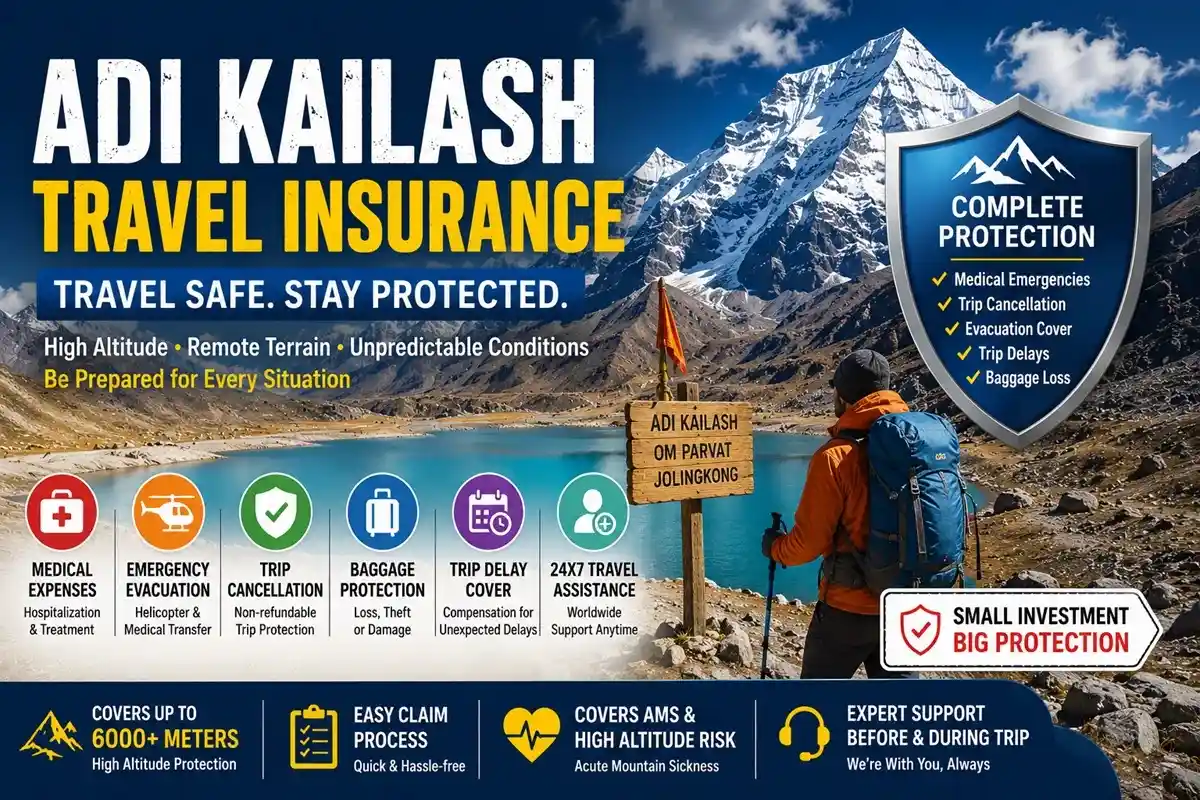
Do You Need Travel Insurance for Adi Kailash Yatra?
Yes. Although travel insurance is not compulsory for the Adi Kailash Yatra, it is strongly recommended for all pilgrims.
The yatra takes place in Uttarakhand’s Pithoragarh district near the Indo-Tibet border, with the route passing through remote, high-altitude areas where access to advanced medical care is limited. In the event of a medical emergency, evacuation can be difficult and costly. A comprehensive travel insurance policy can provide financial protection for medical expenses, emergency evacuation, trip cancellations, and other unforeseen travel disruptions.
Before purchasing a policy, read the policy wording carefully and ensure it explicitly covers high-altitude travel, emergency evacuation, and any trekking or adventure activities included in your itinerary.


Coverage Checklist — What to Look for in Any High-Altitude Yatra Policy
When reading a policy, look at the actual sub-limits and the written definitions of altitude, activity, and evacuation — not just the section headings.
| Coverage Type | Why It Matters for Adi Kailash | What to Verify |
| Emergency Medical Hospitalisation | AMS treatment, trek injuries, illness — hospitalisation in Pithoragarh or Dehradun | Sub-limit adequacy; network hospital list |
| Helicopter / Air Evacuation | Air evacuation may be the only option from Jolingkong or Nabhidhang | Explicit helicopter cover; altitude at which it applies |
| High-Altitude Trekking Cover | Must explicitly cover the altitude of your trek | Written altitude limit in policy document — must cover 4,770 m+ |
| Trip Cancellation / Interruption | Road closures, weather advisories, government suspension, family emergency | Covered reasons list; whether ‘government advisory’ is included |
| Accidental Death and Disability | Falls on rocky terrain, altitude-related complications | Sub-limit; beneficiary designation |
| Personal Accident on Trek | Fractures, injuries from falls at altitude | Coverage applies at altitude; activity included |
| Loss of Documents | ILP, ID loss in a zone with no reprinting facility | ‘Loss of travel documents’ sub-limit present |
| Emergency Cash Advance | No ATMs beyond Dharchula | Whether this benefit exists; advance limit |
Standard Travel Insurance vs High-Altitude Yatra Insurance
| Feature | Standard Domestic Policy | High-Altitude Yatra Policy |
| Altitude limit | Often 2,500–3,500 m or undefined — verify before purchase | Should explicitly cover 5,000 m+ for Adi Kailash |
| Helicopter evacuation | May define evacuation as road transport only | Should include air/helicopter evacuation explicitly |
| Trekking activity | May exclude adventure trekking above a defined altitude | Should include pilgrimage trekking at high altitude |
| AMS / HACE / HAPE | May not be specifically covered | Should cover altitude illness including HACE and HAPE |
| Pre-existing conditions | Often excluded without specific declaration | Available with proper disclosure; check product terms |
| Senior citizen cover | Premium loading; may have age cap | Check insurer’s age limit; specialist plans available |
| Trip cancellation | Often covers only flight-related scenarios | Should cover government Yatra suspension, road closures |
Things to Check Before You Buy
- Read the altitude clause in the policy wording — not the product brochure. The document must state the altitude up to which trekking is covered. If it is below 4,770 m, ask the insurer in writing whether the Jolingkong trek is covered.
- Ask about helicopter evacuation explicitly. Call the insurer’s helpline before purchase. The specific question: ‘Does this policy cover emergency air or helicopter evacuation from a remote high-altitude location in Uttarakhand?’ Get the answer in writing or email.
- Understand the activity classification. Confirm whether pilgrimage trekking at this altitude falls under leisure or adventure in your specific policy — each has different terms.
- Declare all pre-existing conditions at purchase. Non-disclosure is the most common reason for claim rejection. If you have hypertension, diabetes, cardiac conditions, or any ongoing medical history, declare it honestly and buy a policy that accepts those declarations.
- Verify the 24-hour emergency helpline. Some policies reimburse evacuation costs after the fact — others can actively coordinate a rescue. Know which applies before you need it.
When to Buy — Timing Affects What You Can Claim
Buying travel insurance the day before departure is one of the most common planning mistakes. For a high-altitude Yatra, timing has direct consequences:
- Trip cancellation coverage activates from the day of purchase. If the Yatra is suspended by government advisory, or if a family emergency arises before travel — these are only covered if the policy was already active.
- Weather-related claims are typically rejected when a relevant advisory (such as a landslide closure) was already publicly announced before the policy was purchased.
- Some policies have waiting periods for pre-existing conditions starting from the purchase date. Buy early enough for this period to clear before your travel date.
Recommended Timing: Buy your Adi Kailash Yatra travel insurance on the same day you apply for the Inner Line Permit. This approach maximises your cancellation coverage window and pre-existing condition declaration period.
Insurance Myths vs Reality — Common Misconceptions
| Common Belief | Reality |
| My regular health insurance covers this Yatra | Health insurance covers hospitalisation at network hospitals — not the evacuation from altitude to get there. A separate high-altitude travel policy is needed. |
| All travel insurance covers helicopter evacuation | Many standard policies define evacuation as road transport. Helicopter cover requires explicit mention in the policy document. |
| Credit card travel insurance is enough | Card-linked policies typically cover flight delays and lost baggage — not high-altitude medical evacuation or AMS treatment. |
| I am fit — I do not need insurance | AMS can affect anyone regardless of fitness level. Falls, weather cancellations, and family emergencies back home are not fitness-dependent risks. |
| I will buy insurance after the trip is confirmed | Trip cancellation cover does not apply to events that occur before the policy purchase date. Early purchase protects a larger portion of your investment. |
| One policy covers the whole group | Group policies may have standard limits that do not match individual health needs. Verify altitude and helicopter sub-limits before relying on group cover. |
Real Claim Scenarios — What Coverage Applies
Understanding how coverage works in specific situations helps you choose the right policy and know what to do if an incident occurs.
| Scenario | What Happens | Coverage Needed |
| AMS turns serious at Jolingkong (4,770 m) | Helicopter evacuation to Pithoragarh or Dehradun required; hospitalisation for HACE/HAPE | High-altitude medical + helicopter evacuation |
| BRO road closes due to landslide; Yatra cancelled midway | Unable to return or complete Yatra; additional accommodation costs | Trip interruption / cancellation cover |
| Government suspends Yatra season due to security advisory | Non-refundable bookings lost; ILP fee paid | Trip cancellation — verify if ‘government advisory’ is a covered reason |
| Family emergency back home; early return needed | Return flight rebooked; trip cut short | Trip interruption + emergency return cover |
| ILP and ID documents lost in Gunji | No reprinting facility in the restricted zone; Yatra interrupted | Loss of travel documents sub-limit |
| Helicopter cancelled on booking day due to weather | Scheduled helicopter Yatra cannot operate; payment made | Trip cancellation due to weather — must have been active before weather event announced |
If Something Goes Wrong — Claims Step by Step
The Byans Valley has no mobile connectivity. Claims preparation must happen before entering the restricted zone.
- Before Dharchula: Write your insurer’s 24-hour emergency helpline number on paper — in your bag and your guide’s bag. Many insurers require notification within a defined period of an incident (check your policy — timelines vary by insurer).
- At altitude: Your guide can use a satellite phone or the nearest ITBP post to initiate contact. The moment any connectivity is available, call your insurer’s emergency line with your policy number, location, and nature of the incident.
- Document everything: Hospital bills, doctor’s diagnosis, evacuation receipts, transport invoices — the full paper chain from first medical contact to discharge. Insurers require this documentation for all medical claims.
- Trip cancellation: Collect the government advisory, your tour operator’s written statement (Pilgrimage Tour provides these for registered pilgrims on managed tours), your ILP copy, and all booking receipts.
- File within your policy’s claim window — timelines vary by insurer. Check your policy document for the specific filing deadline and do not delay.
Senior Citizens and High-Altitude Yatra Insurance
Pilgrims above 60 face a distinct insurance landscape. Premium loading is common, and some insurers impose age caps or stricter exclusions in this age group.
- Obtain specialist medical clearance before purchase — a cardiologist or internal medicine opinion, not just the standard MBBS fitness certificate required for the ILP. This documentation supports underwriting.
- Look for insurers offering senior-specific pilgrimage or domestic trek plans — some providers have products designed for the 60–70 age range.
- Confirm explicit HACE and HAPE coverage — altitude-related illness is more prevalent in older pilgrims and is the most common medical evacuation trigger.
- Buy while in good health — a recent adverse test result at the time of purchase can trigger exclusions on new policies.
Frequently Asked Questions
Q1. Is travel insurance legally required for Adi Kailash Yatra?
No, insurance is not a condition of the Inner Line Permit. However, given the altitude, remoteness, and limited medical infrastructure in the restricted zone, it is a practical necessity for any responsible pilgrim.
Q2. Does regular health insurance cover this Yatra?
Health insurance covers hospitalisation at network hospitals — not the air or helicopter evacuation needed to reach one from Jolingkong. A separate travel policy with explicit high-altitude and evacuation cover is required.
Q3. What does Adi Kailash Yatra travel insurance typically cost?
Premiums vary by insurer, coverage limits, age, and policy type. As a general indication, a domestic high-altitude travel policy for 8–12 days may range from Rs 500 to Rs 2,000 per person. Senior citizens typically pay more. Compare at least 2–3 policies before purchasing.
Q4. Can I buy travel insurance after the trip has started?
No. Insurance must be purchased before travel begins. Any incident starting before the policy purchase date is excluded. Buy as early as possible — ideally when you apply for the ILP.
Q5. Does travel insurance cover helicopter evacuation from Adi Kailash?
Only if the policy explicitly states helicopter or air evacuation cover at the relevant altitude. Confirm this in writing with the insurer before purchasing — do not rely on the product name alone.
Q6. What altitude does my travel insurance need to cover?
The Jolingkong base is at 4,770 m and Parvati Sarovar at 4,501 m. Your policy’s written altitude limit should explicitly cover trekking at or above these levels. If unclear, ask the insurer in writing.
Q7. Does Pilgrimage Tour include travel insurance in its packages?
Pilgrimage Tour recommends that pilgrims carry independent high-altitude travel insurance with evacuation cover. For current package inclusions and insurance guidance, contact the team at pilgrimagetour.in directly.
Q8. What if my Yatra is cancelled due to bad weather or government advisory?
A policy with trip cancellation cover may pay for non-refundable losses if cancellation is due to a covered reason — such as a government advisory or road closure. The policy must have been active before the event occurred. Verify that ‘government advisory’ is listed as a covered reason in your policy.
Q9. Can pilgrims above 65 get this insurance?
Many insurers offer cover for the 60–70 age range, often with premium loading and specialist medical documentation requirements. Look for senior-specific pilgrimage or domestic trek plans and obtain specialist fitness clearance before applying.
Q10. Is individual insurance better than a group policy?
Individual policies allow full pre-existing condition declarations and customised sub-limits. Group policies may have standard limits that do not suit every traveller’s needs. For pilgrims with any health condition, an individual policy with explicit high-altitude cover is generally more suitable — verify with an insurance advisor.
Q11. What documents are needed to file a claim?
Typically: hospital bills, doctor’s diagnosis and discharge notes, evacuation receipts, transport invoices, policy number, ILP copy, and — for cancellation claims — government advisory notice and operator’s written statement. File within your policy’s specified claim window.
Q12. Is AMS (altitude sickness) covered?
Coverage for AMS and its severe forms (HACE, HAPE) depends on the specific policy. Some high-altitude travel policies explicitly include altitude illness; others do not. Check the covered conditions list before purchasing.
Q13. What if I have diabetes or hypertension?
Declare all conditions honestly at purchase. Many insurers accept controlled diabetes and hypertension with premium loading after disclosure. Non-declaration is the most common reason for claim rejection and should never be attempted.
Q14. What does ‘cashless hospitalisation’ mean for this Yatra?
Cashless hospitalisation means the insurer settles bills directly with the hospital, avoiding upfront payment. This is only available at the insurer’s network hospitals — check whether hospitals in Pithoragarh and Dehradun are in your insurer’s network before purchasing.
Q15. What is the claim timeline — how quickly must I file?
Claim filing deadlines vary by insurer — some require filing within 15 days, others allow 30, 60, or even 90 days from the incident. Check your specific policy document for the exact deadline and do not miss it after returning from the Yatra.
Final Thoughts: Protect the Pilgrimage You Have Planned For
The Adi Kailash Yatra demands months of planning, significant cost, and real physical preparation. The right high-altitude Yatra insurance takes a single afternoon to buy — and it is the planning step that protects everything else.
In the Byans Valley, beyond the last ITBP checkpoint, with limited road access and no mobile connectivity, your policy document is the only financial protection you carry. Make sure it explicitly covers the altitude, the activity, and the evacuation scenario this pilgrimage demands.
Read the altitude clause in the policy wording. Confirm helicopter evacuation in writing. Declare every health condition honestly. Buy on the day you apply for your Inner Line Permit.
For the Chhota Kailash pilgrimage — one of the most extraordinary journeys an Indian pilgrim can undertake — this expedition insurance is not a formality. It is responsible planning.
Pilgrimage Tour offers registered Adi Kailash Yatra packages with comprehensive pre-departure guidance including an insurance verification checklist. Contact our team at pilgrimagetour.in to plan your 2026 Yatra with the preparation it deserves.



 Call
Call WhatsApp
 Enquiry