
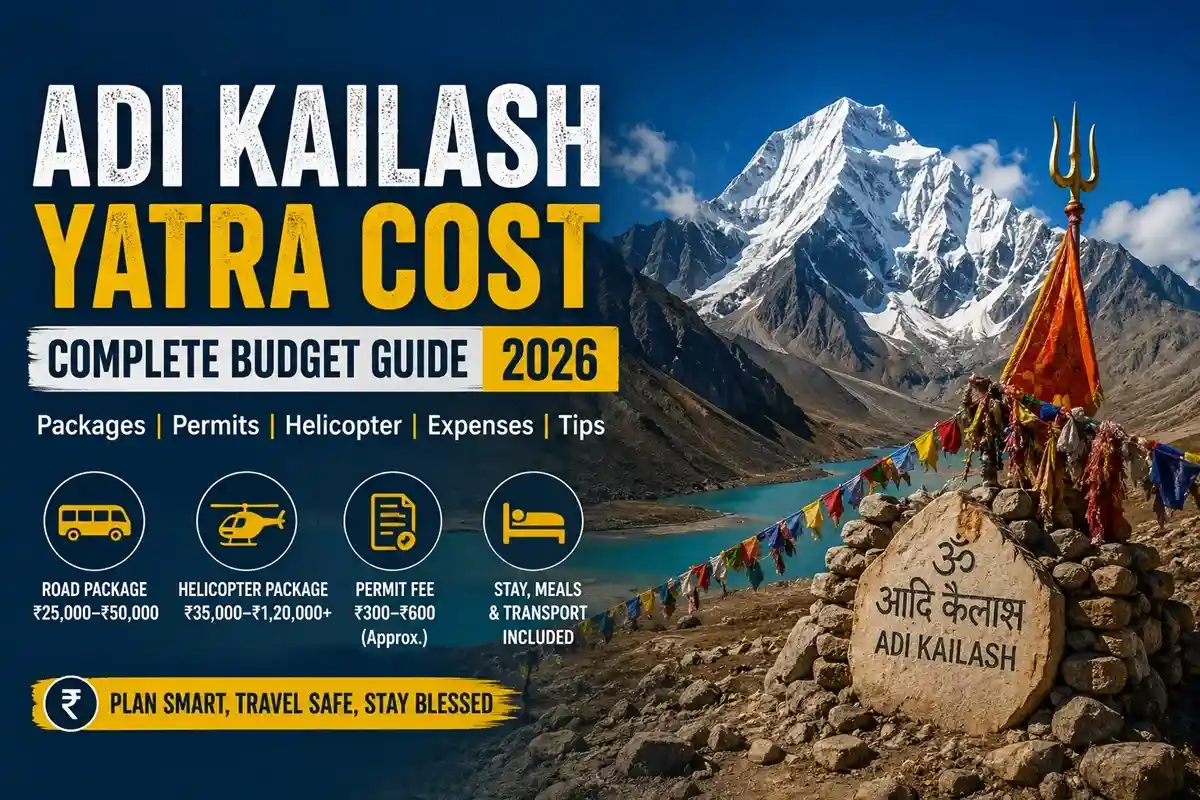
Adi Kailash Yatra cost varies widely — anywhere from roughly ₹25,000 for a basic shared road package to over ₹1,20,000 for a full helicopter circuit. That gap confuses most first-time planners, mainly because nobody explains why the price swings so much. This guide breaks down where the money actually goes, compares road versus helicopter versus self-planned trips, and helps you pick the option that fits your budget and comfort needs. Pricing below reflects publicly listed 2026 operator rates compared across several established travel companies; treat every figure as a planning range and always request a current, itemized quote before paying.
Cost Overview at a Glance
| Package Type | Approx. Cost (per person) | Duration | Best For |
|---|---|---|---|
| Budget/shared road package | ₹25,000–₹30,000 | 6–7 days | Solo travelers, tight budgets |
| Standard road package | ₹30,000–₹40,000 | 7–8 days | Most families and first-timers |
| Deluxe/premium road package | ₹35,000–₹50,000 | 7–8 days | Comfort-focused travelers, couples |
| Bike expedition | ₹25,000–₹32,000 | 6–7 days | Experienced riders |
| Helicopter (aerial darshan only) | ₹35,000–₹45,000 | 3–4 days | Time-constrained travelers |
| Helicopter (comprehensive) | ₹70,000–₹1,20,000+ | 8–9 days | Senior citizens, limited mobility |
Key Takeaways
- Most standard road packages cluster between ₹27,000 and ₹45,000 per person; the range widens mainly due to hotel category, vehicle type, and group size, not hidden fees.
- Helicopter packages cost considerably more upfront, largely because of fuel, weather contingency planning, and limited seat capacity per sortie.
- Group bookings of six or more people typically save 15–25% per person compared to solo bookings.
- Some operators quote prices inclusive of GST and mandatory fees, while others list these separately — always clarify this before comparing two quotes.
- Prices, subsidy claims, and permit fees all change year to year, so treat this guide as a planning reference and re-verify closer to your travel dates.
Why Is the Price Range So Wide?
A ₹25,000 package and a ₹50,000 package for the same route usually differ in four places: hotel category in Pithoragarh and Dharchula, vehicle type (shared Sumo versus private SUV), group size (solo bookings cost more per head), and how much medical/safety support is bundled in. The permit itself, notably, barely moves the needle — it’s the logistics around it that drive cost.
Road Package vs Self-Planned Trip vs Helicopter: Who Should Choose What
- Choose a road package if you want permits, stays, and transport handled for you without paying a premium — this suits most families and first-time pilgrims.
- Choose a self-planned trip if you’re comfortable arranging your own permits and vehicles and want to control costs precisely, accepting more coordination effort in return.
- Choose the helicopter option if you’re a senior citizen, have limited mobility, or simply have less time — it costs more but removes the most physically demanding stretches.
- Choose a bike expedition only if you’re an experienced mountain rider comfortable with high-altitude, unpredictable roads.
What’s Usually Included in a Standard Package
Most Adi Kailash Yatra packages bundle:
- Transport from your starting city (Delhi, Kathgodam, or Haldwani) to Dharchula and onward by 4×4 to Gunji, Kuti, and Jolingkong
- Accommodation in hotels (Pithoragarh, Dharchula) and homestays or KMVN guesthouses further along the route
- Meals, usually vegetarian and designed for high-altitude digestion
- Inner Line Permit assistance and local police verification
- Basic safety support — oximeters, sometimes oxygen cylinders, and an experienced local guide
What’s Usually Excluded
- Personal gear (down jackets, trekking poles, sleeping bags) unless rented locally
- Porters or mules if you want your backpack carried
- Travel insurance — genuinely worth adding even though it’s rarely bundled in
- Personal snacks, bottled water beyond what’s provided, and emergency/extra expenses
- Tips for drivers and guides
Self-Planned (Independent) Trip Cost
If you’d rather not book a package, you can arrange the Inner Line Permit yourself through the Dharchula SDM office, hire local vehicles stage by stage, and book KMVN guesthouses or homestays directly. This route can cost roughly similar to or slightly less than a budget package, but you lose bundled permit coordination, group safety support, and the buffer some operators offer during weather delays. It suits experienced Himalayan travelers more than first-timers.
Solo, Couple, and Family Cost Snapshot
| Traveler Type | Approx. Total Cost | Note |
|---|---|---|
| Solo traveler | ₹32,000–₹45,000 | Often includes a single-occupancy supplement |
| Couple (2 adults) | ₹54,000–₹80,000 combined | Shared room reduces per-person accommodation cost |
| Family of 4 | ₹1,00,000–₹1,50,000 combined | Vehicle and room costs scale with group size, but per-person cost often drops |
These are rough combined estimates for standard packages; exact totals depend on the operator and season.
Permit and Registration Costs
The Inner Line Permit (ILP) itself is inexpensive — generally in the ₹300–₹600 range as a government fee for self-organized travelers, though this is revised periodically by the district administration. For operator-managed packages, this is usually folded into your overall package price as part of their service fee rather than billed separately, so ask your operator to break out the government fee from their own processing charge. Registration for the season generally opens around April, though exact dates depend on district administration announcements, and popular May–June and September–October slots fill quickly.
Transport Cost Breakdown
Transport is usually the single largest cost component after the overall package fee, since it covers a genuinely long distance.
| Leg | Approx. Cost (round trip, per person, shared) |
|---|---|
| Delhi/Kathgodam to Dharchula | ₹4,000–₹8,000 |
| Dharchula to Gunji/Kuti/Jolingkong (4×4) | ₹4,000–₹7,000 |
| Optional helicopter (Dharchula–Gunji leg) | Separate booking, weather-dependent |
Bike Expedition Cost Breakdown
Beyond the headline ₹25,000–₹32,000 package figure, riders should separately budget for fuel (roughly ₹3,000–₹5,000 for the full loop), bike servicing before and after the trip, and spare tyres or tubes given the rough terrain past Gunji. Most bike packages include a support vehicle and an on-call mechanic, but personal riding gear (helmet, riding jacket, gloves) is typically not included.
Accommodation Costs Along the Route
- Pithoragarh/Dharchula hotels: ₹1,500–₹3,500 per night, depending on category.
- KMVN guesthouses (Gunji and beyond): ₹800–₹1,800 per night, basic shared facilities.
- Heritage homestays (Kuti): ₹1,000–₹2,000 per night, including simple meals.
Deluxe packages upgrade the Pithoragarh and Dharchula nights to better-category hotels, which is where most of the price difference between budget and premium packages actually comes from.
Food, Cash, and Payment Methods
If you’re not on a full-board package, budget roughly ₹500–₹800 per day for meals. Carry ₹10,000–₹12,000 in physical cash beyond your package cost, since ATMs disappear entirely past Dharchula. Most operators accept UPI, bank transfer, or card payments for booking, but cash is essential once you’re on the road, since digital payment options vanish along with mobile network.
Helicopter Yatra Cost: Shared Seat vs Comprehensive Package
The helicopter option markets itself as a “zero-trekking” pilgrimage, replacing the most demanding stretches with short sorties between Pithoragarh, Gunji, and Nabhidhang. It generally comes in two forms:
- Shared-seat aerial darshan (3–4 days): ₹35,000–₹45,000 per person, a shorter trip focused mainly on the flight and darshan.
- Comprehensive 8–9 day package from Delhi: ₹70,000–₹1,20,000+ per person, including ground transport, meals, and medical support alongside the helicopter legs.
Private charter options also exist for larger groups wanting flexible timing, generally priced well above the shared-seat rate. Several operator websites mention a government subsidy on the helicopter yatra; see the FAQ below for how to verify this before assuming it applies to you.
Booking, Payment, and Cancellation Terms
Most operators require an advance payment at booking — commonly a percentage of the total package cost — with the balance due before departure or on arrival at Dharchula; get exact terms in writing. Solo travelers often pay a single-occupancy supplement, since most packages are priced assuming shared rooms and shared vehicles.
Cancellation and refund policies differ significantly by operator. Some offer partial refunds or free rescheduling for weather-related cancellations, while others apply strict non-refundable clauses closer to departure. Always request the written cancellation policy before paying your advance, not after.
A word of caution: as demand for this yatra has grown, so have reports of unofficial agents demanding full advance payment through personal accounts with no proper booking confirmation. Book only through registered operators or KMVN’s official channels, and avoid any arrangement that pressures you to pay the full amount upfront without a written itinerary and refund policy.
Hidden and Extra Costs to Budget For
- Porters/mules: ₹800–₹1,500 per day if you want your bag carried.
- Gear rental: Renting a sleeping bag, trekking poles, or a heavy jacket in Dharchula costs more per day than owning the gear.
- Travel insurance: Rarely included by default but genuinely worth adding, especially for senior travelers or anyone with cardiac or respiratory conditions.
- Weather delay buffer: A few operators offer complimentary extra days during weather-induced delays, but not all do — ask before booking, and keep a financial buffer regardless.
- Medical certificate: A modest government-hospital fee, often required for registration and sometimes billed separately from the package.
How to Reduce Your Adi Kailash Yatra Cost
- Travel in a group of six or more — per-person costs typically drop 15–25% compared to solo bookings.
- Book slightly off-peak — departing a week before or after the most popular late-September/early-October window can save ₹3,000–₹6,000 per person for similar weather.
- Carry your own trekking gear rather than renting it locally at tourist-inflated Dharchula prices.
- Stock up on snacks and basic medicines in Pithoragarh, where prices are noticeably lower than further into the mountains.
- Book early — registration typically opens around April, and early-bird pricing can shave another ₹2,000–₹5,000 per person off standard packages.
Senior Citizen and Family Cost Considerations
For senior citizens or anyone with health concerns, the higher upfront cost of a helicopter package is often worth it — it removes the most physically demanding stretches and typically includes stronger medical support at Gunji and Nabhidhang. Families traveling with older members on a standard road package should budget extra for a more comfortable vehicle category and additional acclimatization days rather than the cheapest available slot; families with young children should also confirm each operator’s own age-related pricing or restrictions before booking.
Sample Standard Package Cost Table (7D/6N, per person)
| Component | Approx. Share of Cost |
|---|---|
| Transport (Kathgodam to Jolingkong and back) | ₹10,000–₹14,000 |
| Accommodation and meals (6 nights) | ₹9,000–₹14,000 |
| Permit, registration, and local coordination | ₹1,000–₹2,000 |
| Guide, safety support, and miscellaneous | ₹3,000–₹5,000 |
| Approximate total | ₹27,000–₹35,000 |
Frequently Asked Questions
Q-1: What is the average cost of the Adi Kailash Yatra?
Standard road packages generally range from ₹27,000 to ₹45,000 per person for 7–8 days.
Q-2: Is the Adi Kailash Yatra expensive?
It’s a mid-range domestic pilgrimage cost-wise, but far cheaper than Kailash Mansarovar Yatra in Tibet.
Q-3: Is there really a government subsidy on the helicopter yatra?
Some operators mention one, but we couldn’t confirm an official notification — verify directly with UTDB before assuming it applies.
Q-4: Does the package cost include the Inner Line Permit?
Usually yes, folded into the package; independent travelers pay the government fee separately, around ₹300–₹600.
Q-5: Can I do this yatra without booking a package?
Yes, self-planned trips are possible but require arranging permits and transport yourself.
Q-6: How much extra cash should I carry beyond the package cost?
Around ₹10,000–₹12,000, since ATMs aren’t available beyond Dharchula.
Q-7: Do solo travelers pay more per person?
Often yes, through a single-occupancy supplement, since pricing usually assumes shared rooms.
Q-8: What is the cancellation policy for these packages?
It varies by operator, so always get written cancellation and refund terms before paying your advance.
Q-9: Is travel insurance included in the yatra cost?
Rarely by default; it’s optional but strongly recommended for high-altitude travel.
Q-10: Can I reduce cost by traveling in a group?
Yes, groups of six or more typically save 15–25% per person compared to solo bookings.
Q-11: Are there scams to watch out for while booking?
Yes, avoid agents demanding full advance payment without a written itinerary or refund policy.
Q-12: What’s the cheapest way to do the Adi Kailash Yatra?
A shared budget road package, booked early and in a group, off the absolute peak dates.
Conclusion
Adi Kailash Yatra cost isn’t a single number — it’s a range shaped by your comfort level, group size, timing, and whether you choose the road, helicopter, or self-planned route. For most pilgrims, a standard shared road package in the ₹27,000–₹40,000 range offers the best balance of cost and experience, while the helicopter option makes sense for senior citizens or anyone prioritizing comfort over budget. Whichever you choose, booking early, traveling in a group, and budgeting honestly for the “extras” — insurance, gear, and cash reserves — is what keeps this pilgrimage affordable without cutting corners on safety.
Must Reads on:


 Call
Call WhatsApp
 Enquiry