
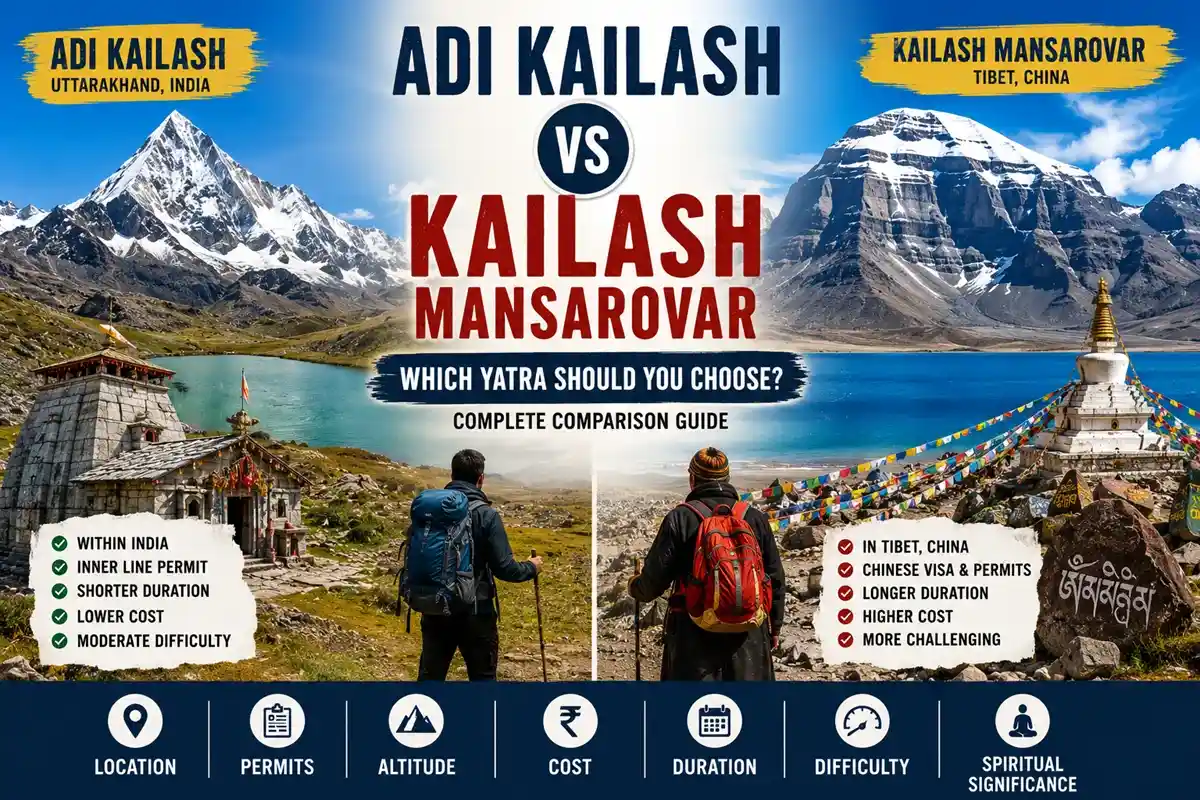
Adi Kailash vs Kailash Mansarovar is a practical question, not a spiritual ranking — both are independent, deeply sacred pilgrimage destinations in Hindu tradition, but they sit in different countries and demand very different budgets, fitness levels, and documentation. This guide compares them factually, including the 2025 resumption of Kailash Mansarovar after a five-year suspension, so you can choose based on your own circumstances.
Quick Comparison
| Factor | Adi Kailash | Kailash Mansarovar |
|---|---|---|
| Location | Pithoragarh, Uttarakhand, India | Ngari Prefecture, Tibet |
| Approx. height | ~5,945 m | ~6,638 m |
| Documents needed | Inner Line Permit, ID, medical check | Passport, Chinese group visa, Tibet permit |
| Typical duration | 7–10 days | ~21–22 days (MEA route); 12–16 days (Nepal route) |
| Approx. cost per person | ₹35,000–1,50,000 | ₹1.8–2.8 lakh (varies by route/operator) |
| Difficulty | Moderate; mostly motorable | Difficult; high-altitude parikrama |
| Highest point | ~4,500 m at Jolingkong (Om Parvat viewed from a distance) | ~5,630 m at Dolma La Pass |
| 2026 status | Open, regulated seasonally | Resumed 2025 after a 5-year pause; June–August 2026 |
Location, Access and a Key 2026 Update
Adi Kailash, also called Chhota Kailash, sits near Dharchula in the Kumaon Himalayas, entirely within India. Kailash Mansarovar lies in Tibet’s Ngari Prefecture, reached via the Lipulekh Pass (Uttarakhand) or Nathu La Pass (Sikkim) under MEA coordination, or through a private Nepal route.
One fact worth knowing upfront: Kailash Mansarovar Yatra was suspended for five years (2020–2024) due to COVID-19 and India-China border tensions, resuming only in June 2025. The 2026 season is just the second since reopening, with roughly 1,000 official seats and reported demand around seven times higher than supply. Adi Kailash faced no such disruption and has remained a steadier, more predictable option throughout.
Permits, Visa and Documentation
Adi Kailash requires an Inner Line Permit from the Dharchula SDM office, generally alongside Aadhaar and a medical fitness check — often completed within a day or two, though exact requirements can vary by season. Kailash Mansarovar requires a valid passport, a Chinese group visa, and a Tibet travel permit, arranged through the MEA or a licensed operator; applicants are typically aged 18–70 and must pass strict medical screening, subject to current MEA guidelines. Processing for Kailash Mansarovar can take months with no guaranteed seat, while Adi Kailash’s process stays comparatively simple.
Cost Comparison
Adi Kailash packages generally run ₹35,000 to ₹1,50,000 per person, covering permits, transport, accommodation, and meals — premium or helicopter-assisted options can push this higher. Kailash Mansarovar costs considerably more: recent MEA-route pricing has run around ₹1.84 lakh via Lipulekh and closer to ₹2.84 lakh via the more motorable Nathu La route, while private Nepal-route packages have been quoted around ₹1.70–2.20 lakh. These figures shift with exchange rates, fuel costs, and operator margins, so treat them as recent reference points rather than fixed prices.
Difficulty, Altitude and Health Considerations
Adi Kailash is moderate, with most of the route motorable and only short walks near Jolingkong (~4,500 m). Kailash Mansarovar is tougher: its parikrama crosses Dolma La Pass at roughly 5,630 metres, where oxygen drops sharply and acute mountain sickness (AMS) risk rises. Both yatras carry genuine altitude risk, and pilgrims with heart conditions, asthma, or high blood pressure should consult a doctor beforehand regardless of which one they choose. Travel insurance covering high-altitude evacuation is strongly advisable for Kailash Mansarovar given its remoteness, and worth considering for Adi Kailash too.
Duration, Season and Safety
Adi Kailash yatras usually run 7–10 days from Kathgodam, within a May–October window. Kailash Mansarovar’s MEA routes run about 21–22 days including India-side travel, while Nepal-route packages take 12–16 days, generally between June and September. Both cross landslide-prone terrain — the 1998 Malpa landslide in the Kali River valley, which killed over 200 people including Kailash Mansarovar pilgrims, remains a sobering reminder that monsoon timing and route conditions deserve serious attention on either yatra.
Choose Adi Kailash If… / Choose Kailash Mansarovar If…
| Choose Adi Kailash if you… | Choose Kailash Mansarovar if you… |
|---|---|
| Want a shorter, moderate pilgrimage | Want the full traditional parikrama experience |
| Have a limited budget | Can commit ₹1.8 lakh or more |
| Are a senior citizen or traveling with family | Are an experienced high-altitude trekker |
| Prefer simple domestic documentation | Are prepared for visa and MEA processes |
| Want a reliable, undisrupted yatra | Accept current post-resumption selection uncertainty |
Helicopter and Premium Options
Some Adi Kailash operators offer helicopter-assisted legs covering part of the route in recent seasons, though this isn’t a standard, guaranteed service and availability should be confirmed directly with an operator. Kailash Mansarovar’s Nepal route has also introduced helicopter options from Kathmandu for pilgrims wanting to skip long overland stretches, at a significant cost premium over standard packages. Neither yatra offers a fully door-to-door helicopter experience — some walking or road travel remains part of both journeys regardless of budget.
Practical Basics: Network, Cash and Accommodation
On the Adi Kailash route, expect KMVN guest houses or homestays in Gunji and Nabi, patchy mobile network beyond Dharchula (BSNL most reliable), and the need to carry cash since ATMs thin out quickly. Kailash Mansarovar accommodation is more basic once inside Tibet — often tents or shared dormitories near Darchen — with essentially no personal mobile network and payments handled through your operator. Neither yatra should be approached expecting consistent connectivity or luxury comfort.
Spiritual Significance
Both sites hold deep meaning in Hindu tradition without one diminishing the other. Kailash Mansarovar’s parikrama and a dip in Mansarovar Lake are regarded as a significant spiritual milestone. Adi Kailash, according to belief, is where Shiva and Parvati rested en route to their wedding — a distinct, independently sacred site rather than a smaller stand-in for the original.
Key Takeaways
- Adi Kailash and Kailash Mansarovar are separate, independently sacred pilgrimages — not substitutes for one another.
- Kailash Mansarovar resumed in 2025 after a five-year suspension, so current demand and selection uncertainty are higher than before.
- Adi Kailash is cheaper, shorter, and less physically demanding, making it practical for families, seniors, and first-time pilgrims.
- Kailash Mansarovar remains longer, costlier, and more physically demanding, suited to prepared, experienced trekkers.
- Altitude-related health risks are real on both routes, so medical checks and insurance matter regardless of which you choose.
Whichever route you take, the Adi Kailash vs Kailash Mansarovar choice ultimately comes down to your fitness, budget, and timeline — not which pilgrimage carries more devotion.
FAQs
Q1. Is Adi Kailash a substitute for Kailash Mansarovar?
No — both are independently sacred pilgrimages in Hindu tradition, not a replacement for each other.
Q2. Is Kailash Mansarovar Yatra open in 2026?
Yes, it resumed in 2025 after a five-year suspension and runs again from June to August 2026.
Q3. Which is cheaper, Adi Kailash or Kailash Mansarovar?
Adi Kailash is significantly cheaper, roughly ₹35,000–1,50,000 versus ₹1.8–2.8 lakh for Kailash Mansarovar.
Q4. Do I need a visa for Adi Kailash?
No, only an Inner Line Permit is needed for Indian citizens.
Q5. How long does each yatra take?
Adi Kailash takes 7–10 days; Kailash Mansarovar’s MEA route takes about 21–22 days, or 12–16 days via Nepal.
Q6. Is Kailash Mansarovar harder than Adi Kailash?
Yes, its parikrama crosses Dolma La Pass at around 5,630 metres, raising AMS risk significantly.
Q7. Can senior citizens do either yatra?
Adi Kailash is generally more suitable; Kailash Mansarovar’s Nathu La route is gentler than Lipulekh for older pilgrims.
Q8. Is travel insurance necessary?
It’s strongly recommended for Kailash Mansarovar given its remoteness, and worth considering for Adi Kailash too.
Q9. What is the age limit for Kailash Mansarovar’s MEA route?
Generally 18–70, subject to medical screening and current MEA guidelines.
Q10. Which route has better mobile network?
Neither is reliable; Adi Kailash has patchy BSNL coverage, while Kailash Mansarovar has essentially none inside Tibet.
Q11. Can I do both yatras together?
No, geography and separate permit zones make it impractical to combine both into one trip.
Q12. Which yatra is recommended for first-time high-altitude pilgrims?
Adi Kailash, due to its lower altitude, shorter duration, and simpler documentation.
Q13. Are health checks required for these yatras?
Yes, especially for Kailash Mansarovar; anyone with heart, BP, or respiratory conditions should consult a doctor first.
Q14. Which yatra is currently easier to get a confirmed seat for?
Adi Kailash, since Kailash Mansarovar’s post-resumption demand far exceeds available official seats.


 Call
Call WhatsApp
 Enquiry