
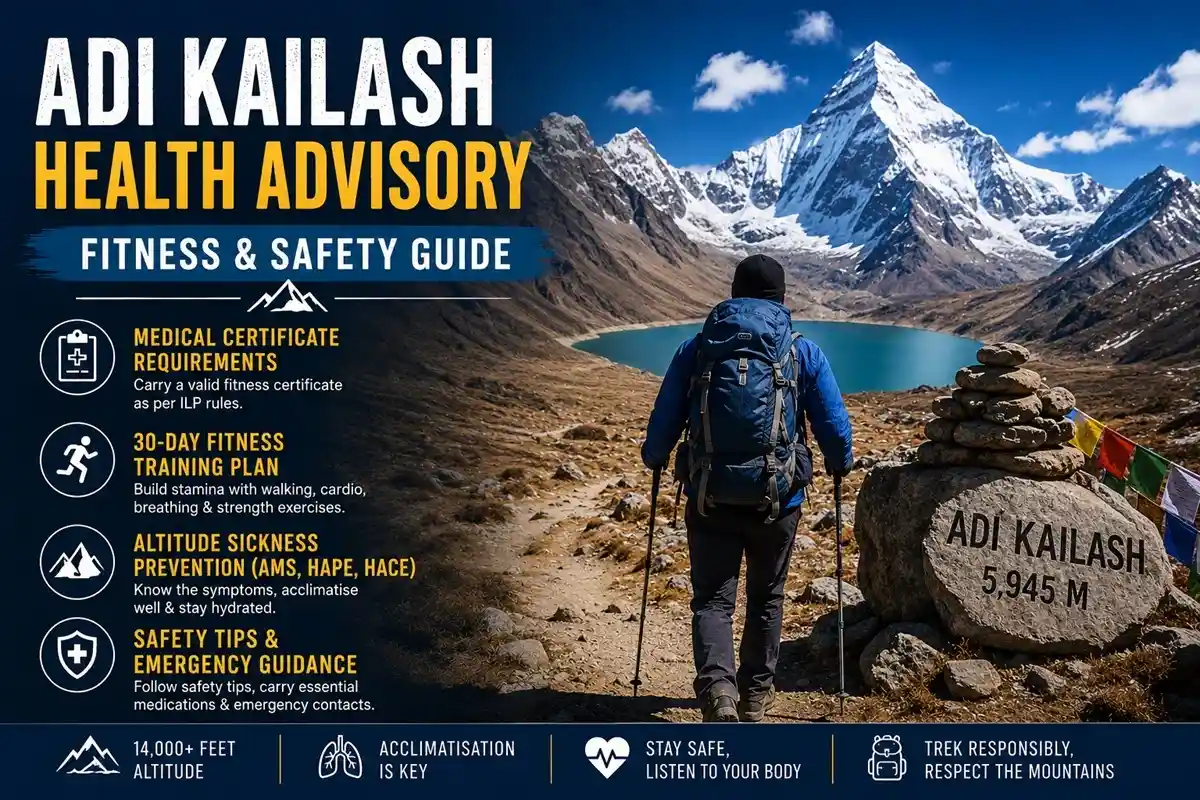
Most pilgrims planning Adi Kailash focus on permits and packing — and underestimate their own body. This Adi Kailash Health Advisory exists because the trek crosses 14,000 feet, where reduced air pressure means significantly less oxygen reaches your body, even though the air itself still contains roughly 21% oxygen. What you do in the 30 days before departure matters more than anything in your bag. Our team has seen many pilgrims struggle on the route simply because they skipped acclimatisation, not because they lacked willpower.
Why This Health Advisory Matters
Once you cross Dharchula into the restricted Indo-Tibetan border zone, medical help thins out fast. Local guides report the same pattern every season: most evacuations trace back to altitude sickness in pilgrims who skipped basic prep, not to accidents.
Adi Kailash, often called Chhota Kailash, isn’t extreme mountaineering — it’s genuinely achievable for a reasonably fit, well-prepared traveller. But “reasonably fit” has to be earned in the weeks before you leave, not assumed on day one of the trek.
Adi Kailash Altitude and Route at a Glance
| Checkpoint | Approx. Altitude |
| Dharchula (ILP collection point) | 930 metres |
| Gunji | 3,180 metres |
| Jolingkong (base near Adi Kailash) | 3,800 metres |
| Adi Kailash peak | Approx. 5,945 metres |
| Om Parvat viewpoint | Approx. 3,600 metres |
The climb from Dharchula to Jolingkong happens over just a few days, which is exactly why acclimatisation matters more here than total distance.



Medical Fitness Documentation for Adi Kailash Yatra
As per the current Inner Line Permit (ILP) process administered by SDM Dharchula, a medical fitness document — typically from a registered doctor and dated close to your travel — is generally required. Rules can be updated season to season, so confirm the exact format and validity window with your operator or the SDM office before you travel.
- Pilgrims aged 60–70 are usually asked for additional medical documentation.
- Uncontrolled cardiovascular disease, severe respiratory disorders, or acute kidney/liver disease are conditions doctors generally advise caution around for high-altitude travel.
- If you take regular medication for blood pressure or diabetes, declare it — that’s exactly what this screening is meant to flag.
Age Limit and Who Should Get Specialist Clearance
Most registered operators and KMVN apply a practical age range of 18 to 70 years; this is an operational guideline rather than a fixed government statute, and exceptions are handled case-by-case with stronger medical clearance.
- Pregnant travellers should consult their physician before booking, as high-altitude travel carries additional risks.
- A history of recent heart surgery, uncontrolled asthma, or severe past altitude sickness needs specialist clearance, not just a routine screening.
Your 30-Day Fitness Training Plan
Start this routine 30 days before departure — skipping it is the most common mistake first-time yatris make.
- Daily cardio: walk or jog 5–10 km daily to build the leg endurance needed for the Om Parvat approach.
- Breathing practice: 15 minutes of Anulom-Vilom or Kapalbhati daily; pranayama practices may improve breathing efficiency and relaxation, which can help you stay calmer during the ascent.
- Stair climbing: 3–4 floors without stopping, mimicking the steep Jolingkong approach.
- Strength basics: bodyweight squats and lunges, three times a week, to protect your knees on descent days.
Vaccinations, Medications and Diet at Altitude
- No specific vaccination is mandated for this route, but routine immunisations should be up to date before any remote travel.
- Carry your regular prescriptions plus a basic first-aid kit; only take altitude-specific medication if your own doctor has prescribed it.
- Eat light, carbohydrate-rich meals at altitude and avoid alcohol the night before gaining height — both directly affect acclimatisation.
AMS, HAPE and HACE: Know the Difference
Acute Mountain Sickness (AMS) is the mild, common form — headache, fatigue, nausea — that usually eases with rest. High-Altitude Pulmonary Edema (HAPE) and High-Altitude Cerebral Edema (HACE) are rare but serious complications involving fluid in the lungs or brain; both require immediate descent and medical attention, not just rest.
Above 3,500 metres, mild headache or breathlessness on exertion in the first 24 hours is common AMS and usually eases with rest and water. Confusion, a severe unrelenting headache, or breathlessness at rest can signal HAPE or HACE and call for immediate descent.
- Drink more water than feels necessary; dehydration worsens altitude symptoms. A simple hydration schedule of a small glass every hour while active works better than a few large bottles at mealtimes.
- Ascend gradually and use built-in rest days rather than skipping them to save time.
Who Should Take Extra Precautions
- Women travellers: generally safe with standard precautions; carry any personal medication and inform your group leader of menstrual-related discomfort, which can be amplified by altitude fatigue.
- Children: most operators set a minimum age (commonly around 10–18 depending on the operator); younger children are best left for a future, lower-altitude trip.
- Smokers and those with a higher BMI: both factors are linked to slower acclimatisation; starting the 30-day fitness plan early and cutting back on smoking beforehand genuinely helps.
- Asthma: well-controlled asthma is usually manageable with your regular inhaler on hand, but uncontrolled or exercise-induced asthma needs a doctor’s specific clearance.
Connectivity, KMVN Stays and Emergency Contacts
Mobile network coverage becomes patchy past Dharchula and largely disappears near Gunji and Jolingkong; KMVN guesthouses along the route are typically the only reliable lodging with staff who can help in an emergency. The area falls under ITBP and BRO oversight, and road conditions near Lipulekh and the border stretch can change quickly after rain or snow, so build a buffer day into your itinerary.
- Save the SDM Dharchula office number, your operator’s 24×7 contact, and the nearest KMVN guesthouse number before you lose signal.
- Carry printed copies of your ILP, ID, and medical document — phone screenshots aren’t a reliable backup without network access.
Pilgrims over 60 who complete the yatra comfortably usually start training 45 days out instead of 30, and build extra rest at Gunji rather than rushing ahead.
- Book itineraries with built-in acclimatisation days, not the fastest available package.
- Carry a written list of current medications for any en-route consultation.
Travel Insurance and Emergency Evacuation
Choose travel insurance that explicitly covers high-altitude trekking and emergency evacuation; standard domestic policies often exclude altitudes above 3,000 metres. Save the SDM Dharchula helpline and your operator’s emergency contact before you lose network coverage.
Common Mistakes Pilgrims Make
- Booking the trip first and starting fitness prep only a week before departure.
- Ignoring mild day-one symptoms, assuming they’ll “walk it off.”
- Carrying an outdated medical certificate beyond the 30-day window.
Pro Tips From the Ground
- Get your medical certificate close to departure so it doesn’t expire mid-process at the SDM office.
- Pack a basic pulse oximeter; a falling SpO2 reading alongside symptoms like headache or breathlessness is more meaningful than the number alone, since SpO2 naturally drops for everyone at altitude.
- Layer clothing rather than relying on one heavy jacket — temperatures swing fast between Gunji and Jolingkong.
What to Pack for High-Altitude Comfort
- Thermal base layers plus a windproof outer jacket — daytime sun can feel warm while wind chill stays sharp.
- Sturdy, broken-in trekking shoes; new, unworn boots are a common cause of blisters on multi-day routes.
- Sunscreen and UV-protection sunglasses — glare intensifies noticeably above 3,000 metres.
Best Time to Visit Adi Kailash
The yatra runs in two windows: May–June and September–October, when roads are clearest and weather most stable. Outside these months, the route is generally closed due to snow.
Conclusion: Train First, Then Trek
Adi Kailash rewards preparation more than raw fitness. A 30-day routine of walking, breathing practice, and stair climbing, paired with an honest medical certificate and the right insurance, covers most of what keeps pilgrims safe on this sacred journey. Pack smart, train consistently, and treat every warning sign at altitude seriously rather than pushing through it. If you’re planning this seriously, start training the same week you book your Inner Line Permit appointment — not after.
FAQs
Is a medical certificate compulsory for Adi Kailash Yatra?
Yes, an MBBS doctor’s fitness certificate issued within 30 days of travel is mandatory for the Inner Line Permit.
What is the age limit for Adi Kailash Yatra?
The practical range is 18 to 70 years; above 70 requires case-by-case specialist clearance.
How high is Adi Kailash above sea level?
Approximately 5,945 metres, with overnight halts above 3,500 metres en route.
How should I train before the Adi Kailash trek?
Start 30 days early with daily walking, breathing exercises, and stair climbing to build altitude endurance.
What are the warning signs of altitude sickness?
Severe headache, confusion, or breathlessness at rest require immediate descent, unlike mild first-day symptoms.
Can people with heart conditions do the Adi Kailash Yatra?
Uncontrolled cardiovascular conditions are generally advised against; specialist clearance is required if attempting it.
What is the best time to visit Adi Kailash?
May–June and September–October, due to stable weather and clearer roads.
Do senior citizens need extra precautions for this yatra?
Yes, those above 60 need extra medical documentation and benefit from starting fitness prep earlier.
Is breathing exercise really necessary before the trek?
Yes, daily pranayama practice improves oxygen absorption at high altitude.
What happens if I don’t meet the fitness requirement?
Operators and authorities can deny ascent if fitness or medical documentation doesn’t meet requirements.
Is travel insurance required for Adi Kailash Yatra?
It’s not legally mandatory, but insurance covering high-altitude evacuation is strongly recommended.
Are vaccinations required before the Adi Kailash trek?
No specific vaccine is mandated, but routine immunisations should be up to date before travel.
What should pregnant women know about this yatra?
Pregnant travellers are advised not to attempt this high-altitude pilgrimage due to health risks.
Can I take my own medication during the trek?
Yes, carry your regular prescriptions and a basic first-aid kit; declare existing conditions on your certificate.
How do I get emergency help during the Adi Kailash Yatra?
Save the SDM Dharchula helpline and your operator’s contact in advance, as network coverage is limited en route.
How fit should you be for Adi Kailash?
You should comfortably manage 5–10 km of daily walking and stair climbing without major breathlessness before departure.
How many days are needed to prepare for Adi Kailash?
A 30-day fitness and breathing routine is the commonly recommended minimum preparation window.
Can diabetics go on the Adi Kailash Yatra?
Yes, with stable, well-managed diabetes and a doctor’s clearance; carry medication and inform your operator in advance.
What is the difference between AMS, HAPE and HACE?
AMS is mild altitude sickness; HAPE and HACE are rare, serious lung and brain complications needing immediate descent.
Is the Adi Kailash trek difficult for beginners?
It’s moderately demanding due to altitude rather than technical climbing, so steady fitness prep matters more than trekking experience.
This advisory draws on publicly available guidance from Wilderness Medical Society altitude-illness resources and standard KMVN/SDM Dharchula travel-document practices; it is not a substitute for a consultation with your own physician or the current official permit guidelines.
Disclaimer: This Adi Kailash Health Advisory is for informational purposes only and does not replace professional medical advice. Always consult your personal physician and verify current ILP and medical-document rules with the SDM Dharchula/Pithoragarh office before booking.




 Call
Call WhatsApp
 Enquiry